Map of Poland showing where the Keiter arms are recorded
The Keiter arms were recorded in Livonia, c. 1772.
Livonia was Baltic country held by a small number of landed families who kept their estates for centuries. Land there passed down whole rather than being divided, and long unbroken tenure is what fills a register.
This is where the arms were entered in the register. Families often moved to other parts of the country, so the same name can turn up in more than one region.
Region
Livonia
First recorded
1772
Granting Authority for the Keiter Arms
Ennoblement by the Sejm
Author: Olek Remesz · CC BY-SA 3.0
The body that granted and recorded arms in Poland in this period.
Stanisław August Poniatowski
Sovereign of the period
Stanisław August Poniatowski
1764–1795
Reigning in Poland when the Keiter arms are first recorded.
How Arms Worked in Poland
Polish noble families shared a single coat of arms across many different surnames, creating large clans rather than individual designs. These symbols were held collectively by all members of the clan regardless of their specific family name. When a new family joined the nobility, they were adopted into an existing clan and began using that group's established shield.
Granting authority
The Sejm, which was the Polish parliament, held the power to grant noble status and the right to bear arms.
How they got arms
Families typically received their coat of arms through a formal act of ennoblement granted by the Sejm for distinguished service.
Where arms were recorded
These grants were officially recorded in the Crown Metrica, which served as the central archive for state documents starting in the sixteenth century.
The family's standing
Recorded among the armigerous families of Livonia.
Origin & History of the Keiter Family in Poland
The family name Keiter has deep roots tied to the historical region of Livonia, which covers parts of modern-day Estonia and Latvia. By the year 1772, records confirm that members of the family were well-established within this Baltic territory. During this era, Livonia was a melting pot of cultures, influenced heavily by German, Baltic, and Russian traditions. The name likely emerged as a descriptive identifier or a locational surname during a time when families were increasingly identified by their trade or place of origin. Because the region was undergoing significant administrative changes under the Russian Empire during the late 18th century, families like the Keiters often appear in local church registers and land surveys that tracked the movement and status of residents. These early ancestors lived through a period of transition, helping to shape the social fabric of the Baltic provinces before the modern era.
Keiter Meaning & Related Branches
Root word
Keit
A Middle High German term referring to a kite or bird of prey.
This name
KeiterAn occupational or descriptive surname for a person resembling a bird of prey or a falconer.
also spelled
Kiter
Kyeter
Keeter
Documented Sources
J. B. Rietstap, Armorial Général, Gouda: G. B. van Goor Zonen, 1884–87
Hupel, August Wilhelm. Topographische Nachrichten von Lief- und Ehstland. 1774
Plakans, Andrejs. The Kinship Pressures: A Study of the Baltic Peasantry. 1977
Estonian Historical Archives (Eesti Ajalooarhiiv), Livonian Land Revision Records (Liivimaa adramaarevisjonid)
Digital archive packCoat of arms PNG, gold border print PDF, vector SVG and the certificate of authenticity. Sent to your email in minutes.


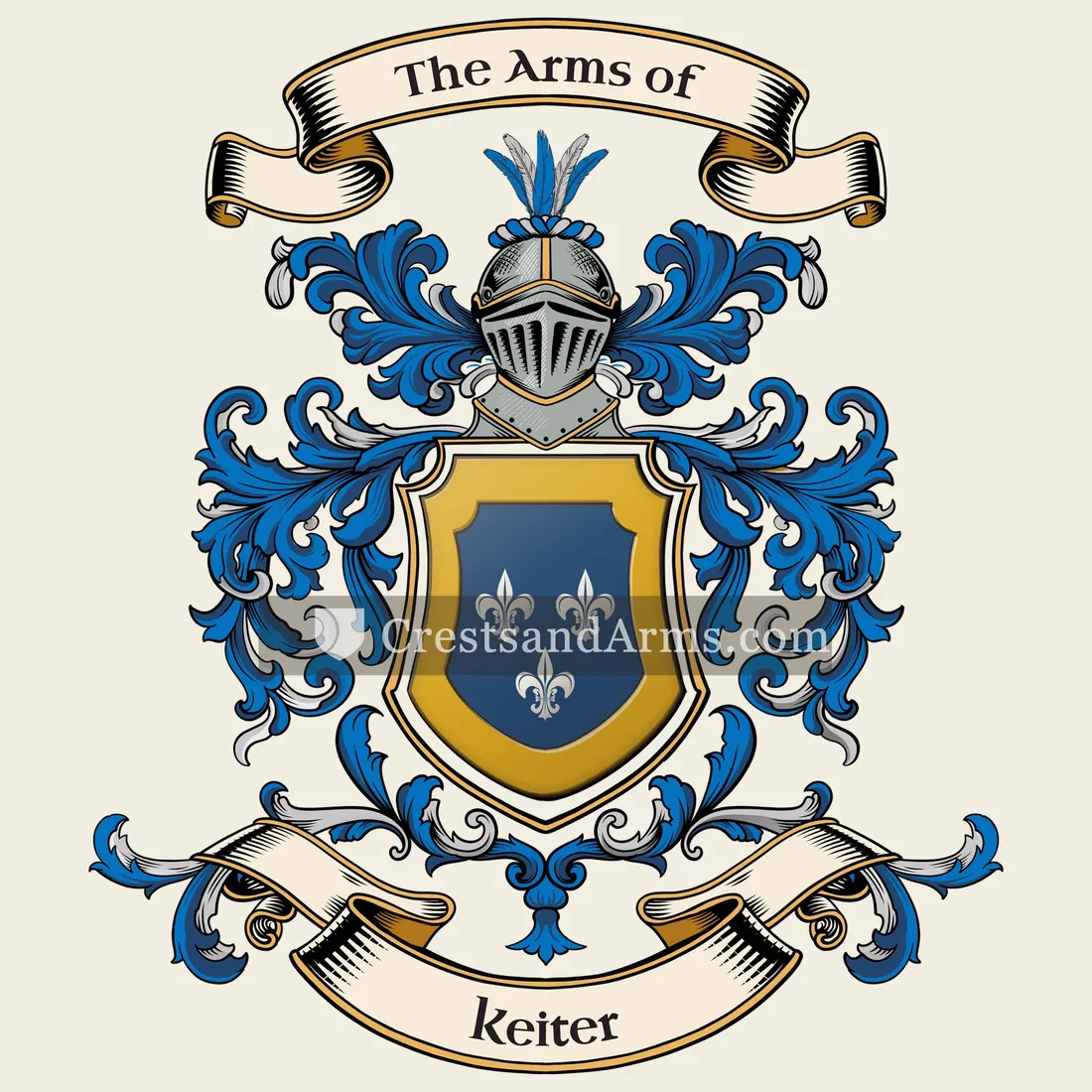
 fleur de lisPurity, light, and the sixth son
 fleur de lisPurity, light, and the sixth son