A record of documented arms, meaning and origin, researched for the Kellner family lines. Documented in 2 countries.
Reg. 9920 · German, J–L
Coat of Arms & Family Crest Details
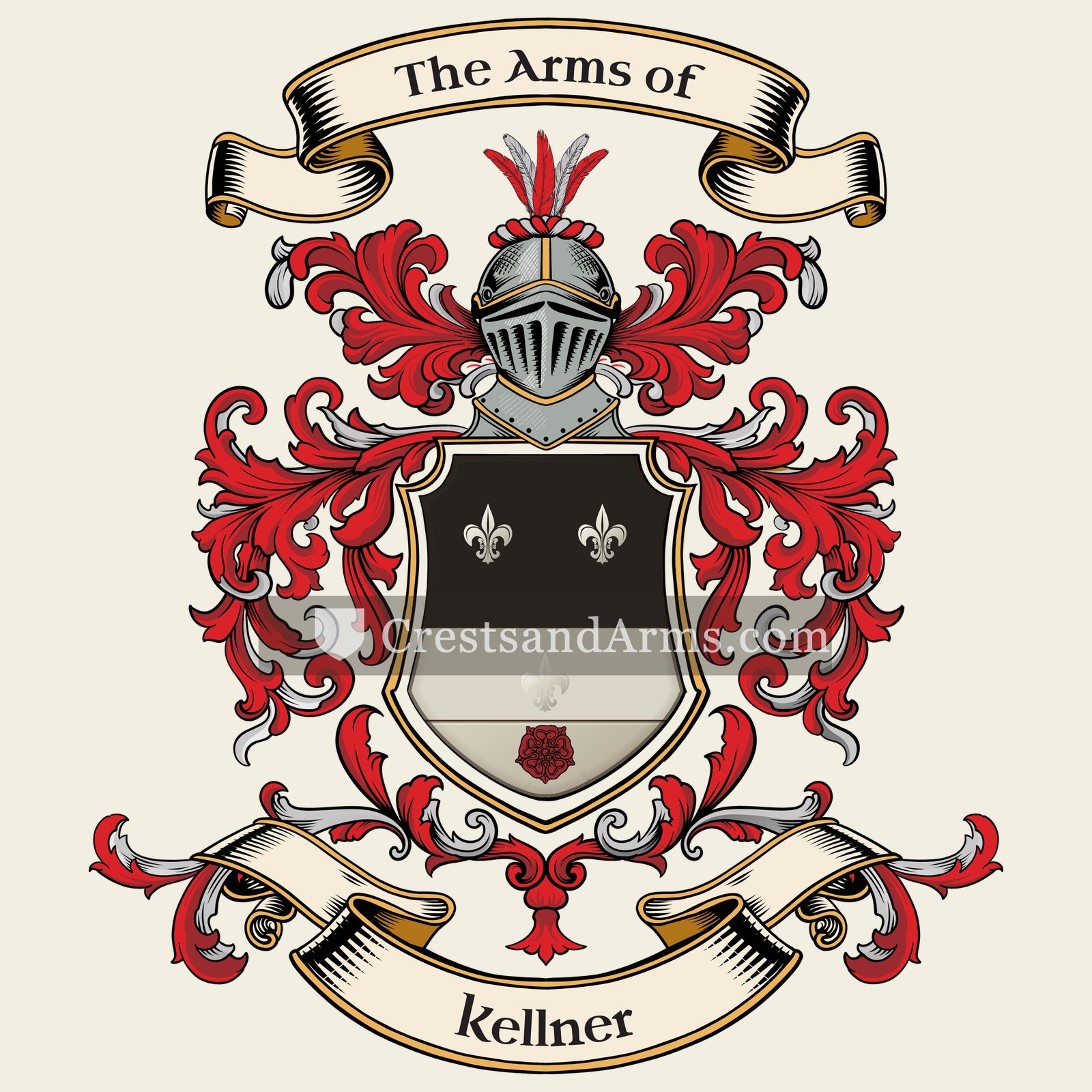
Symbols on this shield
fleur de lisPurity, light, and the sixth son
roseThe seventh son, and beauty with grace
Colours
Black (Sable)Means: Constancy
Silver (Argent)Means: Peace and sincerity
Red (Gules)Means: Military strength
Historical info
Source
J. B. Rietstap, Armorial Général, Gouda: G. B. van Goor Zonen, 1884–87
Blazon (the actual original written record)
“Coupé de sa., sur un mur crén. d'arg. maçonné de sa.; le sa. ch. de trois fleurs-de-lis rangées d'arg.; le mur ch. d'une rose de gu. C.: un chapeau de sa., retr. d'arg., sommé de deux chicots de sa. [V. Günderrode dit von Kellner.]”
GermanyFrancfort s, c. 1765
Digital archive packCoat of arms PNG, gold border print PDF, vector SVG and the certificate of authenticity. Sent to your email in minutes.
Map of Germany showing where the Kellner arms are recorded
The Kellner arms were recorded in Francfort s, c. 1765.
This is where the arms were entered in the register. Families often moved to other parts of the country, so the same name can turn up in more than one region.
The body that granted and recorded arms in Germany in this period.
Francis I, Holy Roman Emperor
Sovereign of the period
Francis I, Holy Roman Emperor
1745–1765
Reigning in Germany when the Kellner arms are first recorded.
How Arms Worked in Germany
In the Holy Roman Empire, coats of arms were often granted to individuals by the Emperor or his representatives. These arms were then passed down through the generations to all legitimate descendants of the original holder. Younger branches of a family usually kept the same shield design without needing to change it, as the arms belonged to the entire lineage.
Granting authority
The Holy Roman Emperor held the sole power to grant new coats of arms throughout his vast imperial territories.
How they got arms
Families typically obtained their coats of arms through a formal imperial grant or by proving their noble status to the authorities.
Where arms were recorded
These grants were officially recorded in the Imperial Chancery registers, which began keeping formal records of such honors during the Middle Ages.
The family's standing
Recorded among the armigerous families of Germany.
Origin & History of the Kellner Family in Germany
The name Kellner is a classic occupational surname that emerged in medieval Germany. It originates from the Middle High German word *kellenaere*, which referred to a cellarer or a steward responsible for managing the food and wine supplies in a monastery, a castle, or a noble household. Because these individuals held positions of trust and authority over valuable resources, the name became a common way to identify someone by their professional role. By the time the family was documented in Frankfurt in 1765, the name had been established for centuries across German-speaking lands as families moved from rural estates into growing urban centers. As the role of the cellarer evolved, the name remained a permanent link to the family's historical roots in estate management and domestic administration.
Coat of Arms & Family Crest Details
Symbols on this shield
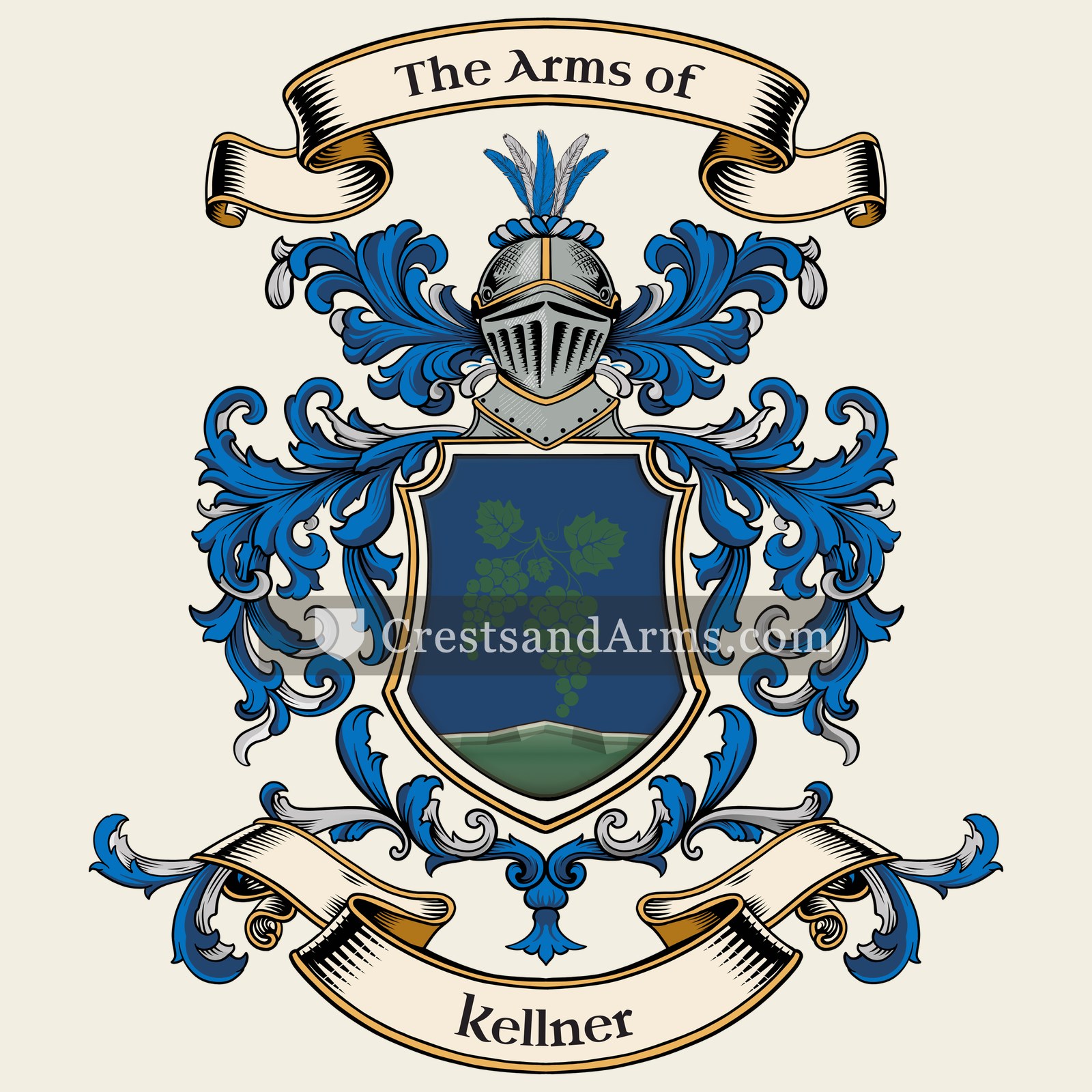
mountThe ground held, and steadfastness upon it
grapesPlenty, and the labour of the vine
Colours
Blue (Azure)Means: Loyalty and truth
Green (Vert)Means: Hope
Historical info
Source
J. B. Rietstap, Armorial Général, Gouda: G. B. van Goor Zonen, 1884–87
Blazon (the actual original written record)
“d'azur à un cep de vigne de sin., fruité de quatre grappes de raisins d'or, posé sur une colline du sec. Cq. cour. C.: quatre pl. d'aut.: de gu., d'arg. et d'azur. L.: à dextre d'or et de gu., à sen. d'arg. et d'azur. S.: deux lions d'or, arm. et lamp. de gu. D.: CONSTANTER.”
Austriac. 1772
Digital archive packCoat of arms PNG, gold border print PDF, vector SVG and the certificate of authenticity. Sent to your email in minutes.
Map of Austria showing where the Kellner arms are recorded
The Kellner arms were recorded in Austria, c. 1772.
Arms such as these were typically recorded in Tyrol.
Tyrol was mountain country in western Austria, where the valleys were held by families who had been there a very long time. Old tenure counted for more than money, and old families carried arms.
This is where the arms were entered in the register. Families often moved to other parts of the country, so the same name can turn up in more than one region.
Region
Tyrol
First recorded
1772
Granting Authority for the Kellner Arms
Imperial and Royal chancery
Sodacan · CC BY-SA 3.0
The body that granted and recorded arms in Austria in this period.
Joseph II, Holy Roman Emperor
Sovereign of the period
Joseph II, Holy Roman Emperor
1765–1790
Reigning in Germany when the Kellner arms are first recorded.
How Arms Worked in Austria
Austrian coats of arms were often linked directly to noble titles granted by the Emperor. These symbols belonged to the entire family line rather than just one individual. When a family grew, new branches kept the original design without needing to change it. This system allowed all members of a noble house to share the same identity across many generations.
Granting authority
The Imperial and Royal chancery managed all heraldic matters and controlled the official granting of arms throughout the Austrian lands.
How they got arms
Families typically received their arms through a formal imperial decree that often accompanied the elevation of a person to noble status.
Where arms were recorded
Official records of these grants were kept in the Imperial Register of Nobility which began its formal documentation process in 1453.
The family's standing
Recorded among the armigerous families of Austria.
Origin & History of the Kellner Family in Austria
The surname Kellner is an occupational name that originated from the Middle High German word *kellenaere*, which referred to a cellarer or a person in charge of a wine cellar or storehouse. In the mountainous region of Tyrol, this name was often given to individuals who managed the supplies for large estates, monasteries, or noble households. By 1772, records show that families bearing this name were well-established within the Tyrolean landscape, where they likely served as essential administrators of food and beverage stores in a society heavily reliant on agriculture and trade. Because the name describes a vital role in local logistics, it was common for families to adopt it as they moved through the alpine valleys. This history reflects the transition of the name from a specific job title to a hereditary family name as these individuals settled into the social structure of the Austrian Empire.
Kellner Meaning & Related Branches
Root word
Kellner
Derived from the Middle High German word for cellarer or steward.
This name
KellnerAn occupational surname for a person in charge of a wine cellar or storeroom.
also spelled
Kelner
Kellnar
Documented Sources
J. B. Rietstap, Armorial Général, Gouda: G. B. van Goor Zonen, 1884–87
Bahlow, Hans. Deutsches Namenlexikon: Familien- und Vornamen nach Ursprung und Sinn erklärt. 1967
Heintze, Albert. Die deutschen Familiennamen: geschichtlich, geographisch, sprachlich. 1903
Institut für Stadtgeschichte Frankfurt am Main. Bürgerbücher der Stadt Frankfurt am Main. 1765
Digital archive packCoat of arms PNG, gold border print PDF, vector SVG and the certificate of authenticity. Sent to your email in minutes.


 fleur de lisPurity, light, and the sixth son
 roseThe seventh son, and beauty with grace
 fleur de lisPurity, light, and the sixth son
 roseThe seventh son, and beauty with grace


 mountThe ground held, and steadfastness upon it
 grapesPlenty, and the labour of the vine