Map of England showing where the Ken arms are recorded
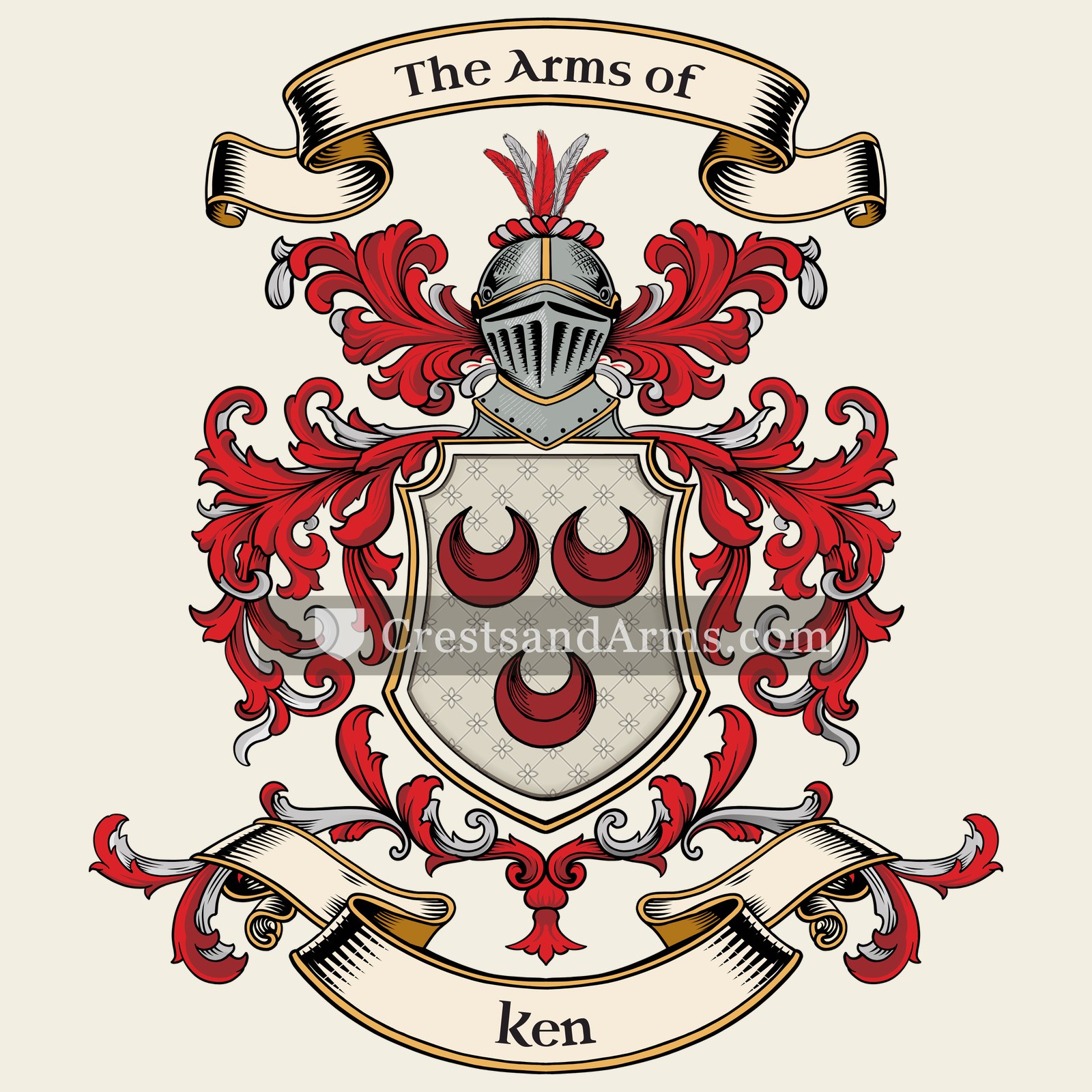
The Ken arms were recorded in Somerset, c. 1561.
Somerset was rich farming country with a thick scattering of manor houses. Its gentry were numerous and long-settled, and a settled landed family almost always ended up with arms.
This is where the arms were entered in the register. Families often moved to other parts of the country, so the same name can turn up in more than one region.
The body that granted and recorded arms in England in this period.
Elizabeth I of England
Sovereign of the period
Elizabeth I of England
1558–1603
Reigning in England when the Ken arms are first recorded.
How Arms Worked in England
English heraldry allowed arms to be shared by all legitimate descendants of the original owner. These symbols were treated as personal property that moved through the generations to all children. While the eldest son kept the original design, other family members could use the same shield without needing to change it or register their own unique versions.
Granting authority
The College of Arms in London has regulated the use of coats of arms throughout England and Wales since 1484.
How they got arms
Families typically obtained their coats of arms through a formal grant from the Crown or by proving their ancient right to them.
Where arms were recorded
All official coats of arms are recorded in the registers kept at the College of Arms, which date back to the fifteenth century.
The family's standing
Recorded among the armigerous families of Somerset.
Origin & History of the Ken Family in England
The family name Ken finds its historical roots in the county of Somerset, England, where members of the family were firmly established by the year 1561. The name is believed to be locational in origin, likely derived from the village of Kenn located near Clevedon in North Somerset. During the sixteenth century, the family began to rise in local prominence, eventually becoming deeply integrated into the social and religious life of the region. One of the most notable figures from this lineage was Thomas Ken, who was born in the city of Wells in 1637 and later became the Bishop of Bath and Wells. The family name remained closely tied to the landscape of the West Country for generations, reflecting the common practice of families adopting the names of the small parishes or hamlets where they first settled and worked the land.
Related Branches & Arms
Root word
Cyn
Old English element meaning royal or kin.
This name
KenDerived from a shortened form of names like Kenneth or Kenelm, signifying royal birth.
also spelled
Ken
Documented Sources
Sir Bernard Burke, The General Armory of England, Scotland, Ireland and Wales, London: Harrison & Sons, 1884
Collinson, John, The History and Antiquities of the County of Somerset, 1791
Plumptre, Edward Hayes, The Life of Thomas Ken, D.D., Bishop of Bath and Wells, 1888
Somerset Archives, Parish Register Transcripts for the Diocese of Bath and Wells, D\P\ken
Digital archive packCoat of arms PNG, gold border print PDF, vector SVG and the certificate of authenticity. Sent to your email in minutes.


 crescentHonour by the sovereign, and the second son
 crescentHonour by the sovereign, and the second son