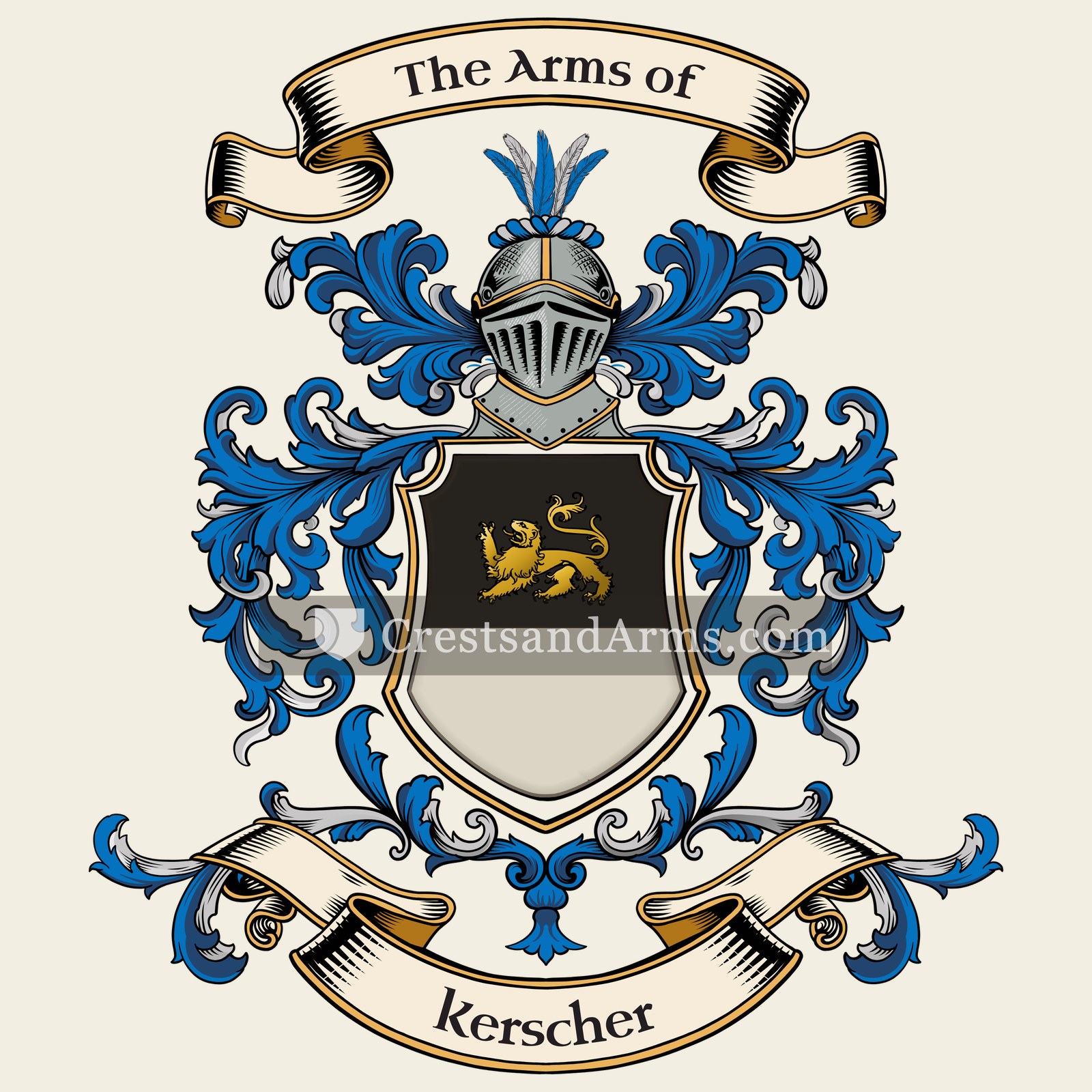
A record of documented arms, meaning and origin, researched for the Kerscher family of Germany.
Reg. 5257 · German, J–L
Coat of Arms & Family Crest Details
Symbols on this shield
paleMilitary strength, and a fortified defence
lionCourage, strength and royalty
Colours
Black (Sable)Means: Constancy
Silver (Argent)Means: Peace and sincerity
Gold (Or)Means: Generosity
Blue (Azure)Means: Loyalty and truth
Historical info
Source
J. B. Rietstap, Armorial Général, Gouda: G. B. van Goor Zonen, 1884–87
Blazon (the actual original written record)
“Coupé: au 1 de sa. au lion léopardé d'or, tenant de sa patte dextre trois cerises de gu.; au 2 palé d'arg. et d'azur, de quatre pièces. C.: le lion, iss.; entre deux prob. coupées, à dextre d'or sur sa., à sen. d'arg. sur azur. L. conformes aux émaux des prob.”
GermanyRatisbonne, c. 1765
Digital archive packCoat of arms PNG, gold border print PDF, vector SVG and the certificate of authenticity. Sent to your email in minutes.
Map of Germany showing where the Kerscher arms are recorded
The Kerscher arms were recorded in Ratisbonne, c. 1765.
This is where the arms were entered in the register. Families often moved to other parts of the country, so the same name can turn up in more than one region.
The body that granted and recorded arms in Germany in this period.
Francis I, Holy Roman Emperor
Sovereign of the period
Francis I, Holy Roman Emperor
1745–1765
Reigning in Germany when the Kerscher arms are first recorded.
How Arms Worked in Germany
In the Holy Roman Empire, coats of arms were often granted to individuals by the Emperor or his representatives. These arms were then passed down through the generations to all legitimate descendants of the original holder. Younger branches of a family usually kept the same shield design without needing to change it, as the arms belonged to the entire lineage.
Granting authority
The Holy Roman Emperor held the sole power to grant new coats of arms throughout his vast imperial territories.
How they got arms
Families typically obtained their coats of arms through a formal imperial grant or by proving their noble status to the authorities.
Where arms were recorded
These grants were officially recorded in the Imperial Chancery registers, which began keeping formal records of such honors during the Middle Ages.
The family's standing
Recorded among the armigerous families of Germany.
Origin & History of the Kerscher Family in Germany
The family name Kerscher is a topographic surname that originated in the German-speaking regions of Central Europe. It is derived from the Middle High German word "kersche," which translates to cherry, suggesting that early ancestors likely lived near a cherry orchard or a prominent cherry tree. By the mid-eighteenth century, the family established a notable presence in Ratisbonne, which is the French name for the historic city of Regensburg in Bavaria. Records from 1765 confirm that members of the family were active residents in this area, living in a city that served as a vital political and commercial hub along the Danube River. During this period, families often took their names from the specific landscapes or agricultural features of their home plots, helping to distinguish them within the growing urban population of the eighteenth century.
Related Branches & Arms
Root word
Kirche
A building used for public Christian worship.
This name
KerscherAn occupational name for someone who lived near a church or worked as a church official.
also spelled
Kersche
Kersher
Related arms
Binder Edle von Lanzgardsimilar arms
Schwunghammersimilar arms
Documented Sources
J. B. Rietstap, Armorial Général, Gouda: G. B. van Goor Zonen, 1884–87
Bahlow, Hans, Deutsches Namenlexikon: Familien- und Vornamen nach Ursprung und Sinn erklärt, 1972
Stadtarchiv Regensburg, Bürgeraufnahme- und Zunftprotokolle der Stadt Regensburg, 1765
Gottschald, Max, Deutsche Namenkunde: Unsere Familiennamen, 1971
Digital archive packCoat of arms PNG, gold border print PDF, vector SVG and the certificate of authenticity. Sent to your email in minutes.


 paleMilitary strength, and a fortified defence
 lionCourage, strength and royalty
 paleMilitary strength, and a fortified defence
 lionCourage, strength and royalty