Map of Germany showing where the Kessler arms are recorded
The Kessler arms were recorded in Francfort s, c. 1765.
This is where the arms were entered in the register. Families often moved to other parts of the country, so the same name can turn up in more than one region.
The body that granted and recorded arms in Germany in this period.
Francis I, Holy Roman Emperor
Sovereign of the period
Francis I, Holy Roman Emperor
1745–1765
Reigning in Germany when the Kessler arms are first recorded.
How Arms Worked in Germany
In the Holy Roman Empire, coats of arms were often granted to individuals by the Emperor or his representatives. These arms were then passed down through the generations to all legitimate descendants of the original holder. Younger branches of a family usually kept the same shield design without needing to change it, as the arms belonged to the entire lineage.
Granting authority
The Holy Roman Emperor held the sole power to grant new coats of arms throughout his vast imperial territories.
How they got arms
Families typically obtained their coats of arms through a formal imperial grant or by proving their noble status to the authorities.
Where arms were recorded
These grants were officially recorded in the Imperial Chancery registers, which began keeping formal records of such honors during the Middle Ages.
The family's standing
Recorded among the armigerous families of Germany.
Origin & History of the Kessler Family in Germany
The surname Kessler is an occupational name that emerged in medieval Germany, derived from the Middle High German word *kessel*, which means kettle or cauldron. This indicates that the earliest ancestors bearing this name were likely coppersmiths or tinsmiths who specialized in crafting metal vessels for cooking and brewing. By the mid-18th century, families carrying this name were well-established in urban centers like Frankfurt am Main. In 1765, Frankfurt served as a bustling hub of trade and craftsmanship, providing a fertile environment for skilled metalworkers to thrive within the city's guild system. As these artisans moved through the German states, they carried their trade and their name with them, cementing the Kessler identity as one deeply rooted in the practical, essential work of early industrial craftsmanship.
Meaning of the Kessler family crest colors & symbols
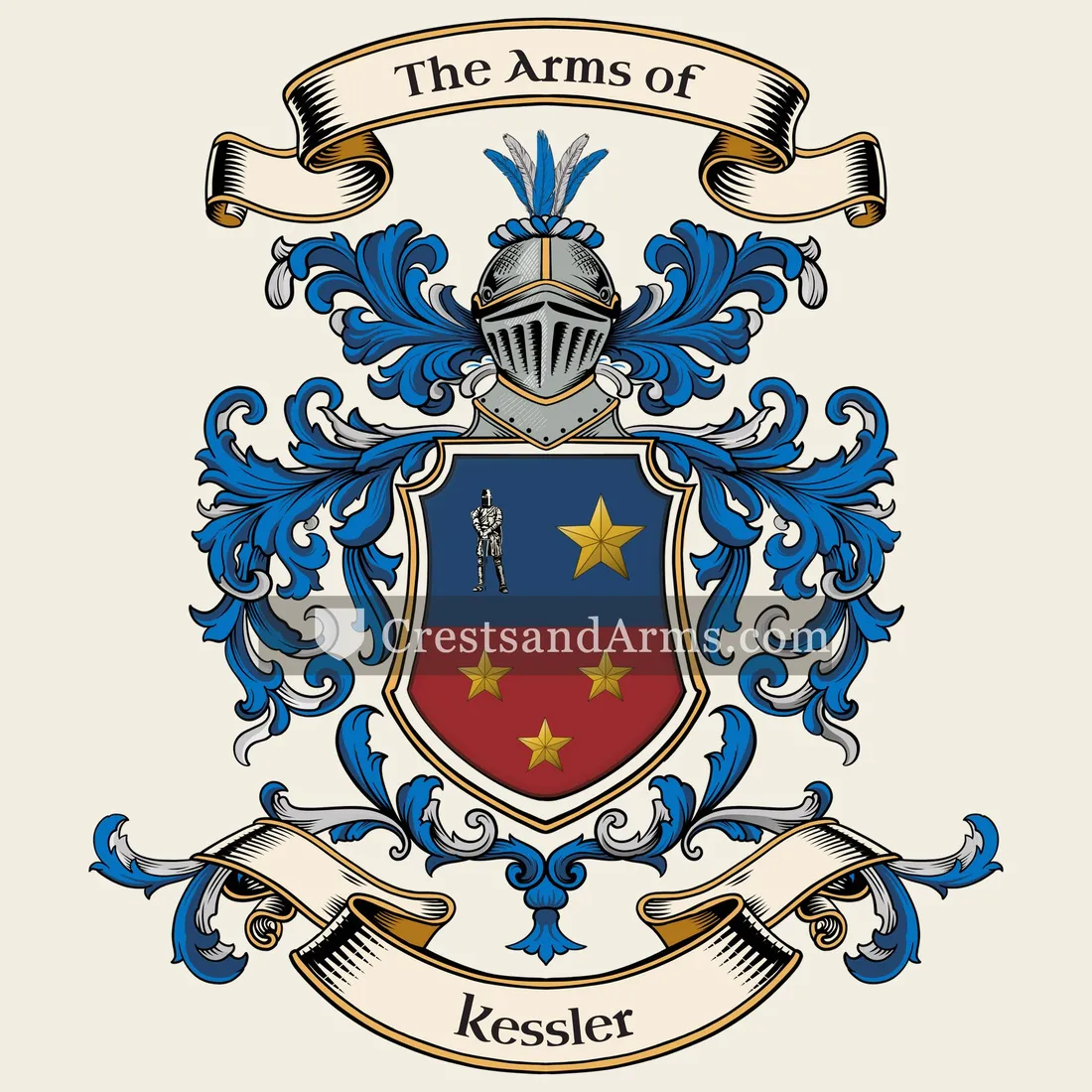
Symbols on this shield
cupFaith, office, and a trust discharged
Colours
Blue (Azure)Means: Loyalty and truth
Gold (Or)Means: Generosity
Historical info
Source
J. B. Rietstap, Armorial Général, Gouda: G. B. van Goor Zonen, 1884–87
Blazon (the actual original written record)
“D'azur à une chaudière d'or, à cornière du même. Cq. cour. C.: trois lis d'arg., tigés et feuillés de sin.; entre un vol, coupé alt. d'azur et d'or.”
LivoniaLivonia, c. 1772
Digital archive packCoat of arms PNG, gold border print PDF, vector SVG and the certificate of authenticity. Sent to your email in minutes.
Map of Poland showing where the Kessler arms are recorded
The Kessler arms were recorded in Livonia, c. 1772.
Livonia was Baltic country held by a small number of landed families who kept their estates for centuries. Land there passed down whole rather than being divided, and long unbroken tenure is what fills a register.
This is where the arms were entered in the register. Families often moved to other parts of the country, so the same name can turn up in more than one region.
Region
Livonia
First recorded
1772
Granting Authority for the Kessler Arms
Ennoblement by the Sejm
Author: Olek Remesz · CC BY-SA 3.0
The body that granted and recorded arms in Poland in this period.
Stanisław August Poniatowski
Sovereign of the period
Stanisław August Poniatowski
1764–1795
Reigning in Germany when the Kessler arms are first recorded.
How Arms Worked in Poland
Polish noble families shared a single coat of arms across many different surnames, creating large clans rather than individual designs. These symbols were held collectively by all members of the clan regardless of their specific family name. When a new family joined the nobility, they were adopted into an existing clan and began using that group's established shield.
Granting authority
The Sejm, which was the Polish parliament, held the power to grant noble status and the right to bear arms.
How they got arms
Families typically received their coat of arms through a formal act of ennoblement granted by the Sejm for distinguished service.
Where arms were recorded
These grants were officially recorded in the Crown Metrica, which served as the central archive for state documents starting in the sixteenth century.
The family's standing
Recorded among the armigerous families of Livonia.
Origin & History of the Kessler Family in Poland
The Kessler name is rooted in the German word for a kettle maker, which identifies the family as skilled metalworkers who likely traveled across Central and Eastern Europe to practice their trade. By the late eighteenth century, members of the family were firmly established in the region of Livonia. This area, which spanned parts of modern-day Latvia and Estonia, was a melting pot of cultures under the influence of the Polish-Lithuanian Commonwealth and the Russian Empire. The presence of the Kessler family in this territory by 1772 suggests they were part of the professional class of artisans who moved into the Baltic lands to support the growing urban centers. Because the family worked in a specialized craft, they were often able to maintain a stable social standing while navigating the complex political shifts that defined the Polish and Baltic borderlands during this era.
Meaning of the Kessler family crest colors & symbols
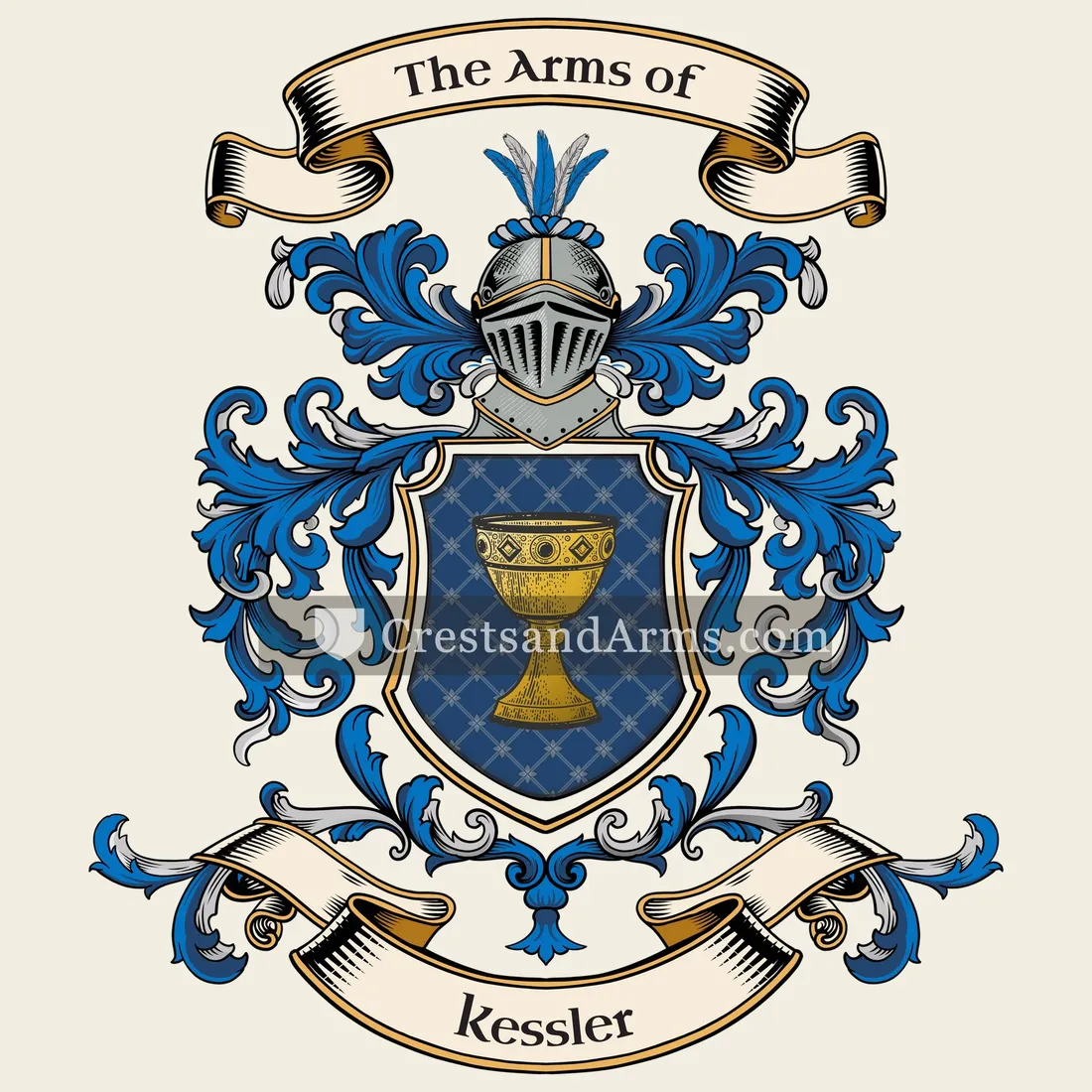
Symbols on this shield
knightChivalry and service in arms
mulletThe third son, and a divine quality from above
Colours
Blue (Azure)Means: Loyalty and truth
Red (Gules)Means: Military strength
Gold (Or)Means: Generosity
Historical info
Source
J. B. Rietstap, Armorial Général, Gouda: G. B. van Goor Zonen, 1884–87
Blazon (the actual original written record)
“Coupé: au 1 d'azur à un sauvage iss. de carn., ceint et cour. de lierre, posé de front, mouv. du coupé, supp. de sa main dextre une étoile (5) d'or et de sa sen. un croiss. du même; au 2 de gu. à deux cotices d'arg., alternant avec trois étoiles (5) d'or, rangées en fasce.”
SwitzerlandFribourg, c. 1745
Digital archive packCoat of arms PNG, gold border print PDF, vector SVG and the certificate of authenticity. Sent to your email in minutes.
Map of Switzerland showing where the Kessler arms are recorded
The Kessler arms were recorded in Fribourg, c. 1745.
This is where the arms were entered in the register. Families often moved to other parts of the country, so the same name can turn up in more than one region.
The body that granted and recorded arms in Switzerland in this period.
How Arms Worked in Switzerland
In Switzerland, coats of arms were not restricted to the nobility and were often adopted by common citizens and families. These symbols were passed down through generations to show family identity. When branches of a family grew, they often changed small details of the design to distinguish their own line from the original group.
Granting authority
Cantonal and civic authorities managed the use of coats of arms within their specific regions and local jurisdictions.
How they got arms
Families typically assumed their own coats of arms based on local custom rather than receiving them from a central monarch.
Where arms were recorded
Arms were recorded in various cantonal and civic registers starting from the fourteenth century throughout the Swiss region.
The family's standing
Recorded among the armigerous families of Switzerland.
Origin & History of the Kessler Family in Switzerland
The family name Kessler is rooted in the German word *Kessel*, which translates to kettle or cauldron. Historically, this name functioned as an occupational surname for a coppersmith or a maker of metal vessels. By the time the family was documented in the Swiss canton of Fribourg in 1745, the name was already well-established across various German-speaking regions. In Switzerland, individuals with this name often belonged to the artisan class, playing a vital role in the local economy by crafting essential household and industrial tools. As these families settled in Fribourg, they became part of the intricate social fabric of the region, contributing to the growth of trade and craftsmanship during the eighteenth century. Their presence in the historical records of this area reflects the broader movement of skilled workers who helped shape the development of Swiss towns and cities through their specialized labor.
Kessler Meaning & Related Branches
Root word
Kessel
A vessel, basin, or cauldron used for cooking or metalworking.
This name
KesslerAn occupational surname for a maker or repairer of copper kettles and pots.
also spelled
Kesseler
Kesler
Related arms
Koroda de Felsö-Kubinsimilar arms
Kesselervariant spelling
Behambrecorded with Kessler, same area
Gehringrecorded with Kessler, same area
Documented Sources
J. B. Rietstap, Armorial Général, Gouda: G. B. van Goor Zonen, 1884–87
Bahlow, Hans, Deutsches Namenlexikon: Familien- und Vornamen nach Ursprung und Sinn erklärt, 1967
Heintze, Albert, Die deutschen Familiennamen: geschichtlich, geographisch, sprachlich, 1903
Institut für Stadtgeschichte Frankfurt am Main, Bürgerbücher der Stadt Frankfurt am Main, 1765
Digital archive packCoat of arms PNG, gold border print PDF, vector SVG and the certificate of authenticity. Sent to your email in minutes.


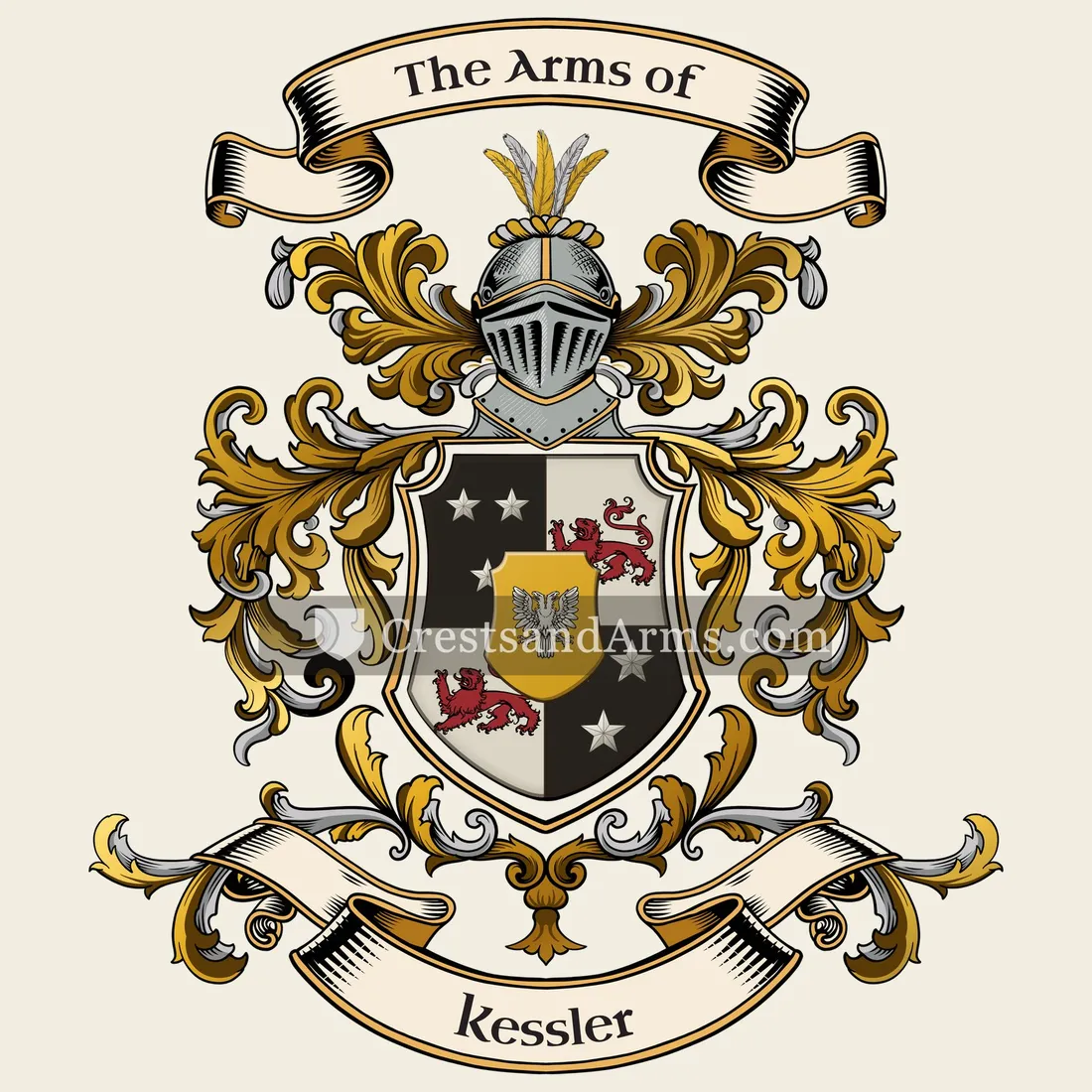
 eagleNobility, strength and a keen mind
 mulletThe third son, and a divine quality from above
 lionCourage, strength and royalty
 eagleNobility, strength and a keen mind
 mulletThe third son, and a divine quality from above
 lionCourage, strength and royalty


 cupFaith, office, and a trust discharged


 knightChivalry and service in arms