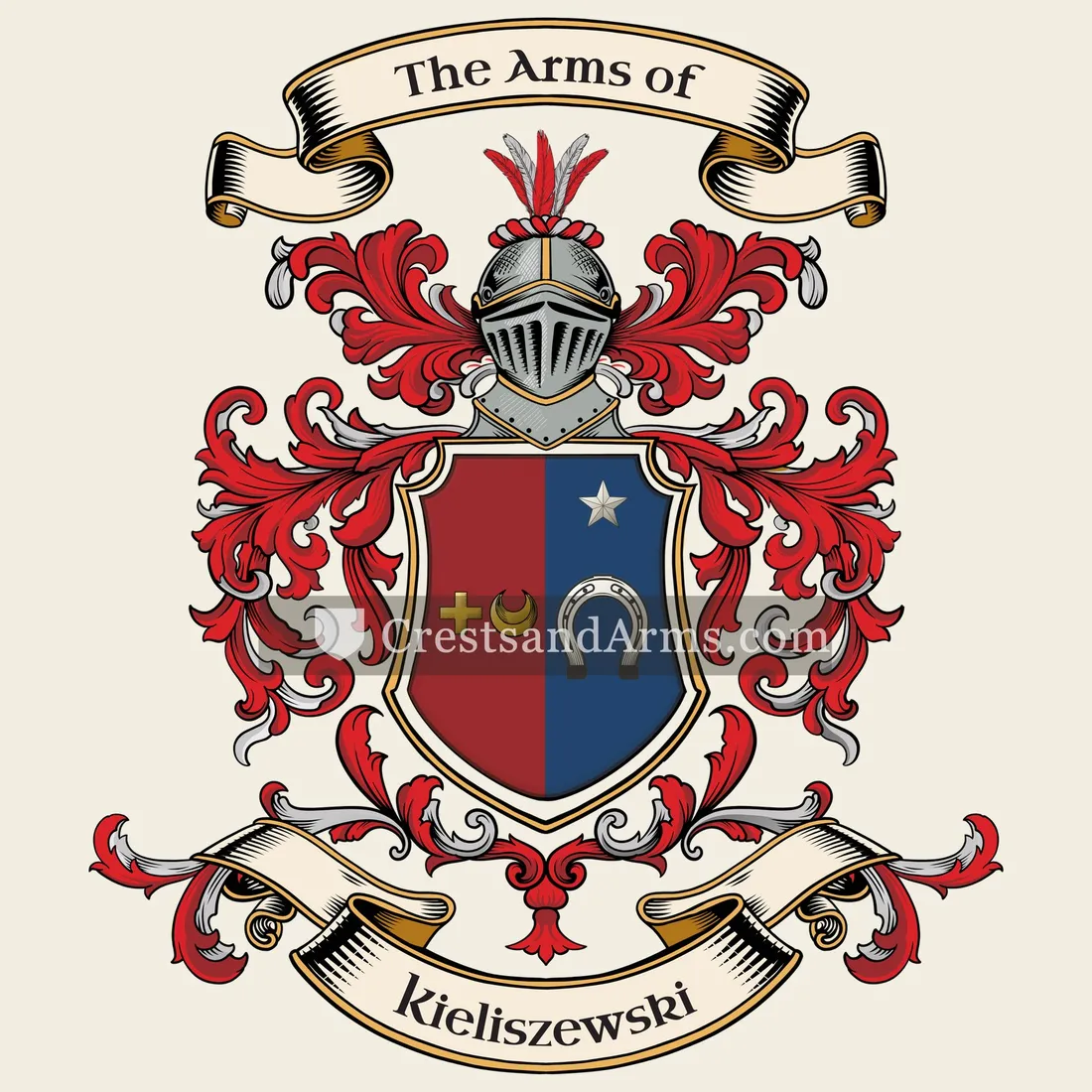
A record of documented arms, meaning and origin, researched for the Kieliszewski family of Austria.
Reg. 8496 · Austrian, J–L
Meaning of the Kieliszewski family crest colors & symbols
Symbols on this shield
cross symbolChristian faith and service
crescentHonour by the sovereign, and the second son
horseshoeGood fortune and protection from harm
mulletThe third son, and a divine quality from above
Colours
Red (Gules)Means: Military strength
Blue (Azure)Means: Loyalty and truth
Gold (Or)Means: Generosity
Silver (Argent)Means: Peace and sincerity
Historical info
Source
J. B. Rietstap, Armorial Général, Gouda: G. B. van Goor Zonen, 1884–87
Blazon (the actual original written record)
“Parti: au 1 de gu. à une croix pattée d'or en chef et un croiss. du même en p.; au 2 d'azur à un fer-à-cheval d'arg., les bouts en bas, sommé d'une croisette pattée d'or, qui supporte un corbeau de sa., tenant en son bec une bague d'or; le fer-à-cheval acc. d'une étoile d'arg. entre ses branches. Deux cq. cour. C.: 1° trois pl. d'aut. d'arg., l. d'arg. et de gu.; 2° le corbeau avec la bague, le vol étendu; l. d'arg. et d'azur.”
GaliciaGalicia, c. 1772
Digital archive packCoat of arms PNG, gold border print PDF, vector SVG and the certificate of authenticity. Sent to your email in minutes.
Map of Austria showing where the Kieliszewski arms are recorded
The Kieliszewski arms were recorded in Galicia, c. 1772.
Galicia was eastern country of large estates and small farming villages, held by families who had been there for a very long time. Land was what entitled a family to arms, and land there rarely changed hands.
This is where the arms were entered in the register. Families often moved to other parts of the country, so the same name can turn up in more than one region.
Region
Galicia
First recorded
1772
Granting Authority for the Kieliszewski Arms
Imperial and Royal chancery
Sodacan · CC BY-SA 3.0
The body that granted and recorded arms in Austria in this period.
Joseph II, Holy Roman Emperor
Sovereign of the period
Joseph II, Holy Roman Emperor
1765–1790
Reigning in Austria when the Kieliszewski arms are first recorded.
How Arms Worked in Austria
Austrian coats of arms were often linked directly to noble titles granted by the Emperor. These symbols belonged to the entire family line rather than just one individual. When a family grew, new branches kept the original design without needing to change it. This system allowed all members of a noble house to share the same identity across many generations.
Granting authority
The Imperial and Royal chancery managed all heraldic matters and controlled the official granting of arms throughout the Austrian lands.
How they got arms
Families typically received their arms through a formal imperial decree that often accompanied the elevation of a person to noble status.
Where arms were recorded
Official records of these grants were kept in the Imperial Register of Nobility which began its formal documentation process in 1453.
The family's standing
Recorded among the armigerous families of Galicia.
Origin & History of the Kieliszewski Family in Austria
The surname Kieliszewski originates from the historical region of Galicia, which was located in what is now southeastern Poland and western Ukraine. By the year 1772, when the region was incorporated into the Austrian Empire following the First Partition of Poland, the family was already well-established in the area. The name itself follows a common Polish naming pattern, as it is derived from the word "kieliszek," which translates to a small glass or goblet. This suggests that the family’s earliest ancestors may have been associated with the craft of glassmaking or perhaps worked as tavern keepers in the rural villages of the Galician countryside. As the family grew over the following centuries, they became deeply integrated into the agricultural and social life of the region, maintaining their presence through the complex political shifts that defined the history of the Austro-Hungarian Empire.
Kieliszewski Meaning & Related Branches
Root word
Kielich
A chalice or cup used in religious or ceremonial contexts.
This name
KieliszewskiA habitational name for someone originating from a place associated with chalice makers or cupbearers.
also spelled
Kluszewsky
Klushevsky
Documented Sources
J. B. Rietstap, Armorial Général, Gouda: G. B. van Goor Zonen, 1884–87
Krzysztof Górski, Nazwiska Polaków: Słownik historyczno-etymologiczny, 2001
Kazimierz Rymut, Nazwiska Polaków: Słownik historyczno-etymologiczny, 1999
Central State Historical Archives of Ukraine in Lviv, Fond 146: Galicia Viceroyalty Records (Galizische Statthalterei)
State Archives in Przemyśl, Metryki parafialne (Parish registers of the Galician region)
Digital archive packCoat of arms PNG, gold border print PDF, vector SVG and the certificate of authenticity. Sent to your email in minutes.


 cross symbolChristian faith and service
 crescentHonour by the sovereign, and the second son
 horseshoeGood fortune and protection from harm
 mulletThe third son, and a divine quality from above
 cross symbolChristian faith and service
 crescentHonour by the sovereign, and the second son
 horseshoeGood fortune and protection from harm
 mulletThe third son, and a divine quality from above