Map of France showing where the Kiesel arms are recorded
The Kiesel arms were recorded in Flandre, c. 1663.
Flandre grew rich on cloth, and its towns were among the busiest in Europe. Merchant families bought land with their profits and took arms to go with it, so trade put as many names in the registers here as land did.
This is where the arms were entered in the register. Families often moved to other parts of the country, so the same name can turn up in more than one region.
The body that granted and recorded arms in France in this period.
Louis XIV of France
Sovereign of the period
Louis XIV of France
1643–1715
Reigning in France when the Kiesel arms are first recorded.
How Arms Worked in France
In France, a coat of arms was a mark of honor that passed down through the male line to all legitimate descendants. Families often used the same shield without changes to show their shared heritage. If a branch wanted to stand out, they could add a small mark to their shield to show their specific place in the family tree.
Granting authority
The Juge d'armes de France acted as the official authority that regulated and verified coats of arms across the country.
How they got arms
Families typically inherited their arms from ancestors, though they could also receive them through royal grants or by proving their noble status.
Where arms were recorded
Coats of arms were officially recorded in the Armorial Général de France, which began its main collection in the year 1696.
The family's standing
Recorded among the armigerous families of Flandre.
Origin & History of the Kiesel Family in France
The family name Kiesel traces its roots to the Germanic linguistic traditions that influenced the border regions of northern France. By 1663, records confirm that members of the family were established in the historical region of Flandre. During this period, the area was a complex crossroads of culture where French and Flemish identities often overlapped due to shifting political borders and trade routes. The name itself is derived from the Middle High German word for pebble or gravel, which suggests that the family’s original ancestors may have been associated with a specific geographic feature or a trade involving stone. As the family settled in Flandre, they integrated into the local social fabric, likely working as skilled laborers or merchants who moved across the porous boundaries of the seventeenth-century landscape. This early presence in the region highlights how families often migrated along river valleys and trade corridors, carrying their linguistic heritage into new territories while adapting to the customs of their adopted homes.
Coat of Arms & Family Crest Details
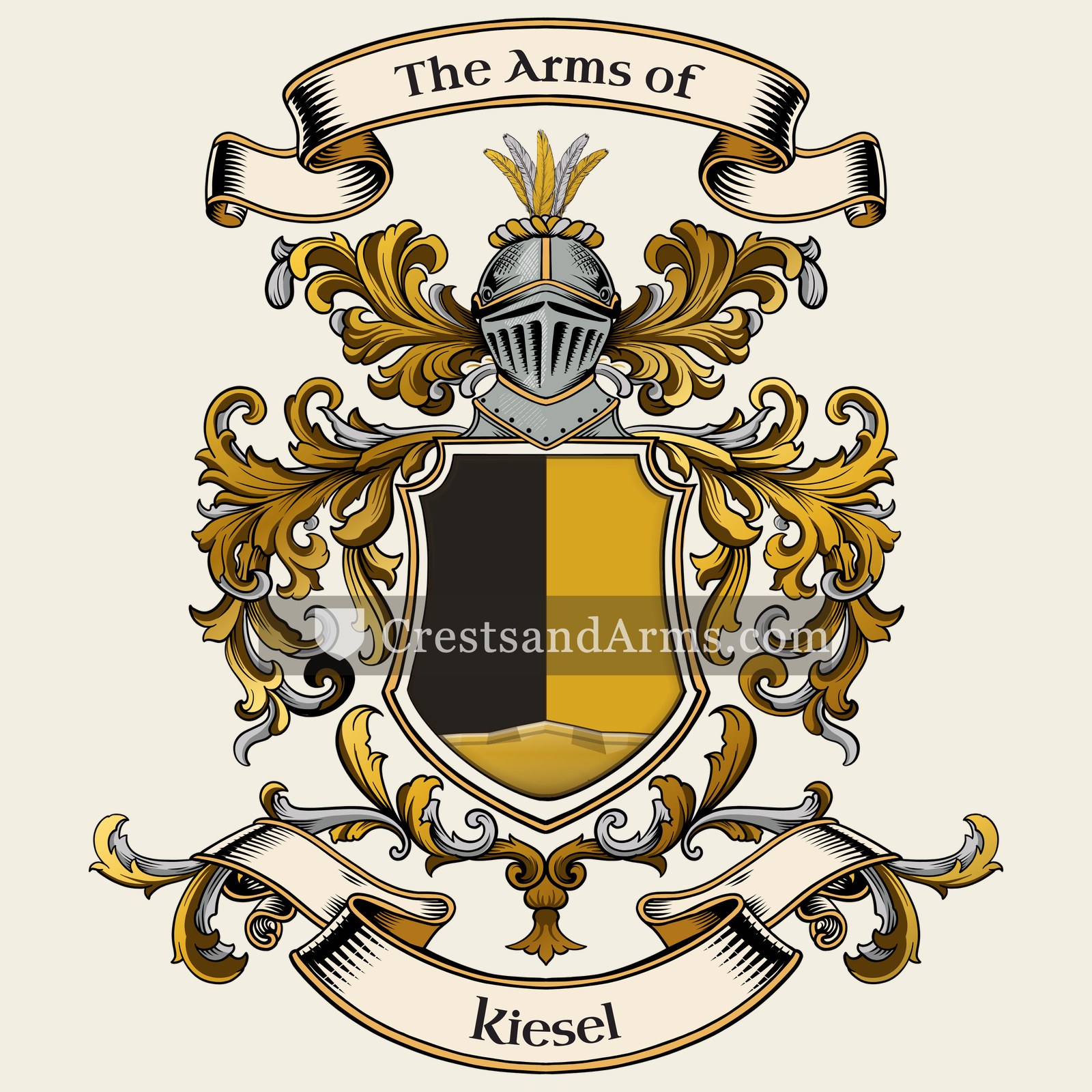
Symbols on this shield
mountThe ground held, and steadfastness upon it
Colours
Black (Sable)Means: Constancy
Gold (Or)Means: Generosity
Historical info
Source
J. B. Rietstap, Armorial Général, Gouda: G. B. van Goor Zonen, 1884–87
Blazon (the actual original written record)
“Parti de sa. et d'or; à un soc de charrue, en pal, soutenu d'un tertre de trois coupeaux, le tout de l'un en l'autre. C.: deux prob., coupées alt. de sa. et d'or.”
AustriaSalzbourg, c. 1772
Digital archive packCoat of arms PNG, gold border print PDF, vector SVG and the certificate of authenticity. Sent to your email in minutes.
Map of Austria showing where the Kiesel arms are recorded
The Kiesel arms were recorded in Salzbourg, c. 1772.
This is where the arms were entered in the register. Families often moved to other parts of the country, so the same name can turn up in more than one region.
Region
Salzbourg
Town
Salzbourg
First recorded
1772
Granting Authority for the Kiesel Arms
Imperial and Royal chancery
Sodacan · CC BY-SA 3.0
The body that granted and recorded arms in Austria in this period.
Joseph II, Holy Roman Emperor
Sovereign of the period
Joseph II, Holy Roman Emperor
1765–1790
Reigning in France when the Kiesel arms are first recorded.
How Arms Worked in Austria
Austrian coats of arms were often linked directly to noble titles granted by the Emperor. These symbols belonged to the entire family line rather than just one individual. When a family grew, new branches kept the original design without needing to change it. This system allowed all members of a noble house to share the same identity across many generations.
Granting authority
The Imperial and Royal chancery managed all heraldic matters and controlled the official granting of arms throughout the Austrian lands.
How they got arms
Families typically received their arms through a formal imperial decree that often accompanied the elevation of a person to noble status.
Where arms were recorded
Official records of these grants were kept in the Imperial Register of Nobility which began its formal documentation process in 1453.
The family's standing
Recorded among the armigerous families of Austria.
Origin & History of the Kiesel Family in Austria
The surname Kiesel is rooted in the German language and serves as a descriptive occupational or topographic name, derived from the word for a pebble or gravel. By the late 18th century, families bearing this name were firmly established in the alpine landscapes of Salzburg, Austria. Records from 1772 indicate that individuals named Kiesel were integrated into the local social and economic fabric of this region, which was then an independent ecclesiastical principality ruled by powerful prince-archbishops. During this era, families with this name were often associated with the rugged terrain of the Austrian Alps, where their livelihoods were frequently tied to agriculture, forestry, or the skilled trades necessary to sustain life in mountainous communities. As the family navigated the complexities of life under the rule of the church, they became part of the enduring history of the Salzburg province, contributing to the local culture and the development of the region long before the modern borders of Austria were fully defined.
Related Branches & Arms
Root word
Kiesel
Germanic term referring to a pebble, gravel, or small stone.
This name
KieselA topographic name for someone who lived near a gravelly area or a pebbly stream.
also spelled
Kisel
Kiesl
Keesel
Related arms
Kiselvariant spelling
Documented Sources
J. B. Rietstap, Armorial Général, Gouda: G. B. van Goor Zonen, 1884–87
Dauzat, Albert, Dictionnaire étymologique des noms de famille et prénoms de France, 1951
Morlet, Marie-Thérèse, Dictionnaire étymologique des noms de famille, 1991
Archives départementales du Nord, Registres paroissiaux et d'état civil de la Flandre française
Digital archive packCoat of arms PNG, gold border print PDF, vector SVG and the certificate of authenticity. Sent to your email in minutes.


 chevronProtection, and faithful service completed
 mulletThe third son, and a divine quality from above
 chevronProtection, and faithful service completed
 mulletThe third son, and a divine quality from above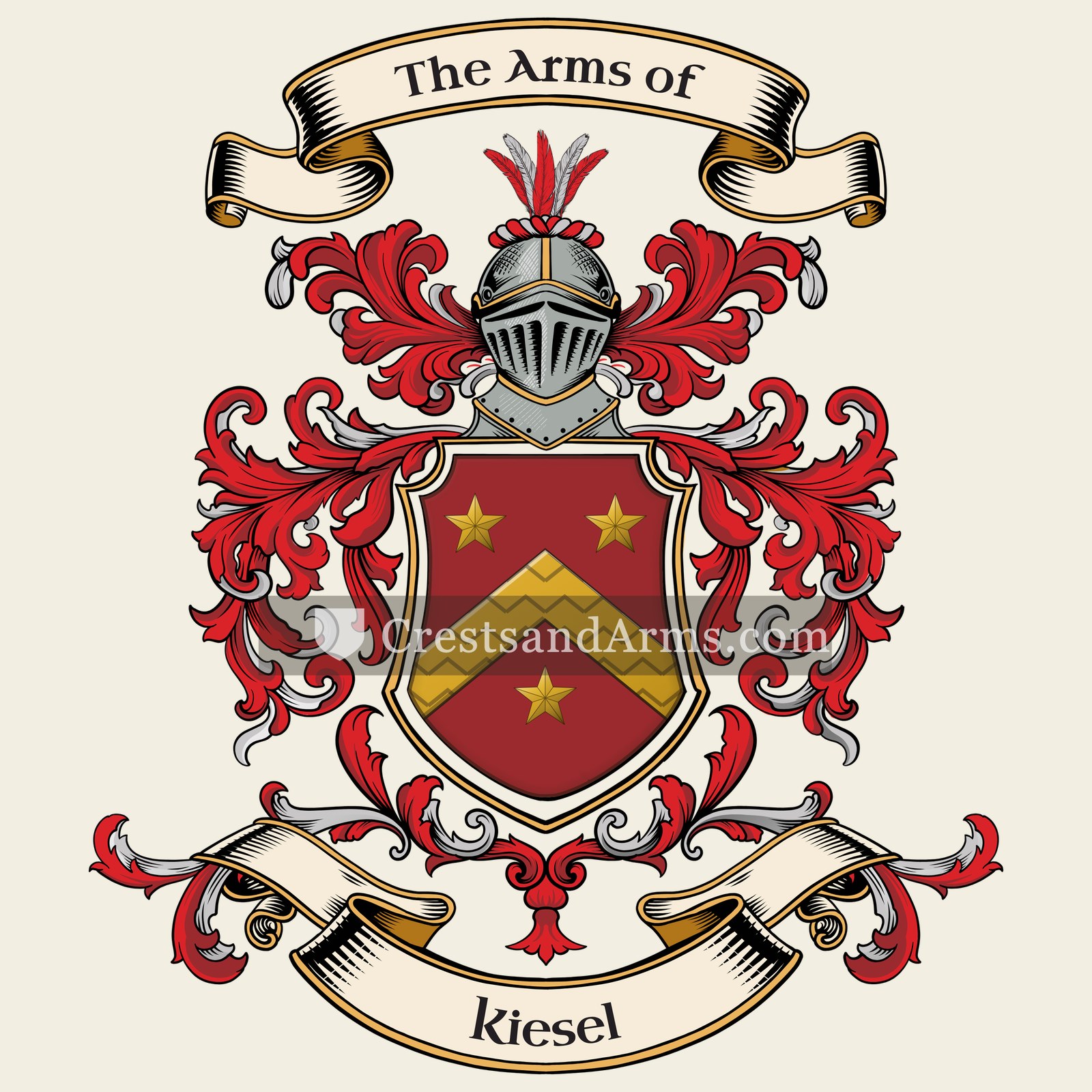


 mountThe ground held, and steadfastness upon it