Map of Netherlands showing where the Killman arms are recorded
The Killman arms were recorded in Netherlands, c. 1815.
Arms such as these were typically recorded in Friesland.
Friesland was low, wet country on the northern coast of the Netherlands, farmed by families who had held the same land for centuries. Free landholders were unusually common there, and a free landholder could carry arms.
This is where the arms were entered in the register. Families often moved to other parts of the country, so the same name can turn up in more than one region.
Region
Friesland
First recorded
1815
Granting Authority for the Killman Arms
Hoge Raad van Adel
Photograph made by me · CC BY-SA 3.0
The body that granted and recorded arms in Netherlands in this period.
William I of the Netherlands
Sovereign of the period
William I of the Netherlands
1815–1840
Reigning in Netherlands when the Killman arms are first recorded.
How Arms Worked in Netherlands
In the Netherlands, coats of arms were often used by noble families and those who held specific public offices. These arms were passed down through the generations to legitimate descendants. Younger branches of a family usually kept the original design without needing to add special marks. This system ensured that the family identity remained clear and consistent over many years.
Granting authority
The Hoge Raad van Adel is the official body that regulates and manages noble titles and coats of arms in the Netherlands.
How they got arms
Families typically obtained their coats of arms through official royal grants or by proving their long-standing historical use of the symbols.
Where arms were recorded
Coats of arms are officially recorded in the registers held by the Hoge Raad van Adel, which began its work in 1814.
The family's standing
Recorded among the armigerous families of Netherlands.
Origin & History of the Killman Family in Netherlands
The history of the Killman name in the Netherlands is rooted in the northern province of Friesland, where records confirm the family’s presence by 1815. During this period, the Netherlands underwent significant changes in how citizens registered their surnames due to the introduction of the Napoleonic civil registry. Families in Friesland often held deep ties to the land and local maritime trades, which influenced how they identified themselves within their communities. The name likely evolved from regional dialects or descriptive terms used to distinguish specific households in rural Frisian villages. As the region transitioned into the modern Kingdom of the Netherlands, the Killman family became part of a documented population that maintained strong cultural traditions while adapting to new national administrative requirements. This early presence in Friesland suggests that the family was well-established within the local social structure long before the formal census records of the nineteenth century began to track their movements across the Dutch provinces.
Meaning of the Killman family crest colors & symbols
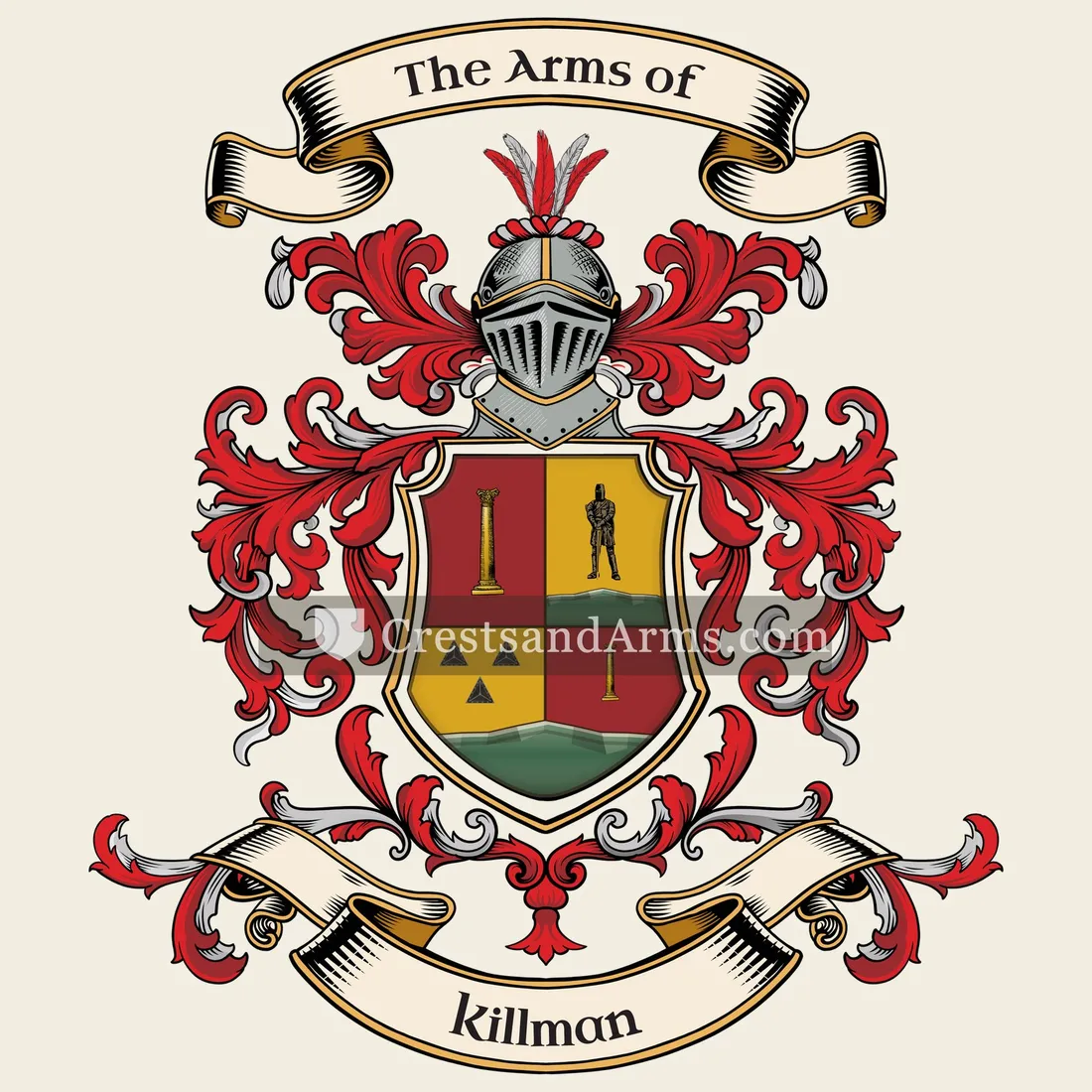
Symbols on this shield
mountThe ground held, and steadfastness upon it
columnFortitude and constancy
knightChivalry and service in arms
triangleThe Trinity, and stability
Colours
Red (Gules)Means: Military strength
Gold (Or)Means: Generosity
Green (Vert)Means: Hope
Historical info
Source
J. B. Rietstap, Armorial Général, Gouda: G. B. van Goor Zonen, 1884–87
Blazon (the actual original written record)
“Ec.: aux 1 et 4 de gu. à une colonne d'or, cour. du même, sur son piédestal aussi d'or; le fût entouré en haut d'une couronne de laurier de sin.; au 2 d'or à un sauvage de carn., ceint et cour. de lierre, posé sur une terrasse de sin., tenant une massue posée sur son épaule; au 3 d'azur à trois triangles vidés d'or, 2 et 1, posés sur l'un de leurs angles. C.: le sauvage, entre un vol de sa.”
HolsteinHolstein, c. 1632
Digital archive packCoat of arms PNG, gold border print PDF, vector SVG and the certificate of authenticity. Sent to your email in minutes.
Map of Germany showing where the Killman arms are recorded
The Killman arms were recorded in Holstein, c. 1632.
Holstein was farming country between the North Sea and the Baltic, held in large estates. The same families kept the same land for generations, and generations of holding is what fills a register.
This is where the arms were entered in the register. Families often moved to other parts of the country, so the same name can turn up in more than one region.
The body that granted and recorded arms in Germany in this period.
Ferdinand II, Holy Roman Emperor
Sovereign of the period
Ferdinand II, Holy Roman Emperor
1619–1637
Reigning in Netherlands when the Killman arms are first recorded.
How Arms Worked in Germany
In the Holy Roman Empire, coats of arms were often granted to individuals by the Emperor or his representatives. These arms were then passed down through the generations to all legitimate descendants of the original holder. Younger branches of a family usually kept the same shield design without needing to change it, as the arms belonged to the entire lineage.
Granting authority
The Holy Roman Emperor held the sole power to grant new coats of arms throughout his vast imperial territories.
How they got arms
Families typically obtained their coats of arms through a formal imperial grant or by proving their noble status to the authorities.
Where arms were recorded
These grants were officially recorded in the Imperial Chancery registers, which began keeping formal records of such honors during the Middle Ages.
The family's standing
Recorded among the armigerous families of Holstein.
Origin & History of the Killman Family in Germany
The surname Killman, often recorded in historical documents as Kuhlmann or similar variations, finds its roots in the northern regions of Germany. By the early 17th century, the family was firmly established in the duchy of Holstein. During this period, the region was heavily influenced by the Thirty Years' War, which caused significant upheaval for local families. Records from 1632 indicate that members of the family were living in this area during a time of intense political and military conflict between regional powers. Because the name likely originated as a descriptive term for a person who worked near a cool spring or a specific geographic feature, it suggests that the early Killmans were deeply connected to the rural landscape of northern Germany. As the family moved through the 1600s, they navigated the complex social structures of the Holy Roman Empire, transitioning from local agrarian life into the broader historical narrative of the Schleswig-Holstein region.
Killman Meaning & Related Branches
Root word
Kille
A Germanic personal name derived from the word for source or spring.
This name
KillmanA patronymic surname indicating descent from a person named Kille or a dweller near a stream.
also spelled
Kielmann
Kielmane
Kilman
Documented Sources
J. B. Rietstap, Armorial Général, Gouda: G. B. van Goor Zonen, 1884–87
AlleFriezen, Burgerlijke Stand Geboorteakten (1811–1910)
Nationaal Archief, Burgerlijke Stand en Bevolkingsregisters (1811–1900)
Tresoar, Friese familienamen: Een overzicht van de herkomst en verspreiding (2005)
Van Berkel, G. and Samplonius, K., Nederlandse plaatsnamen verklaard (2018)
Digital archive packCoat of arms PNG, gold border print PDF, vector SVG and the certificate of authenticity. Sent to your email in minutes.


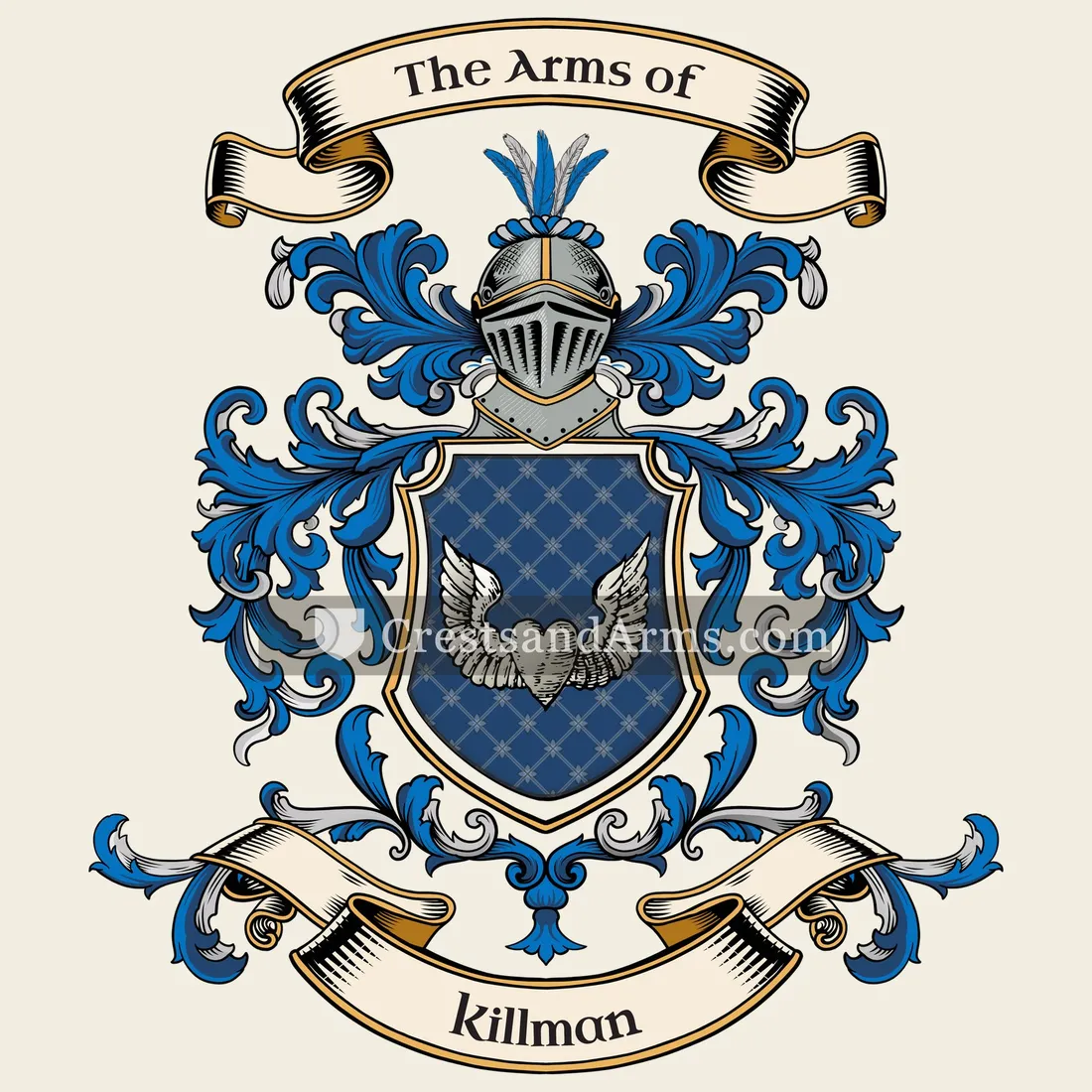
 heartSincerity, charity and true affection
 heartSincerity, charity and true affection


 mountThe ground held, and steadfastness upon it
 columnFortitude and constancy
 knightChivalry and service in arms
 triangleThe Trinity, and stability