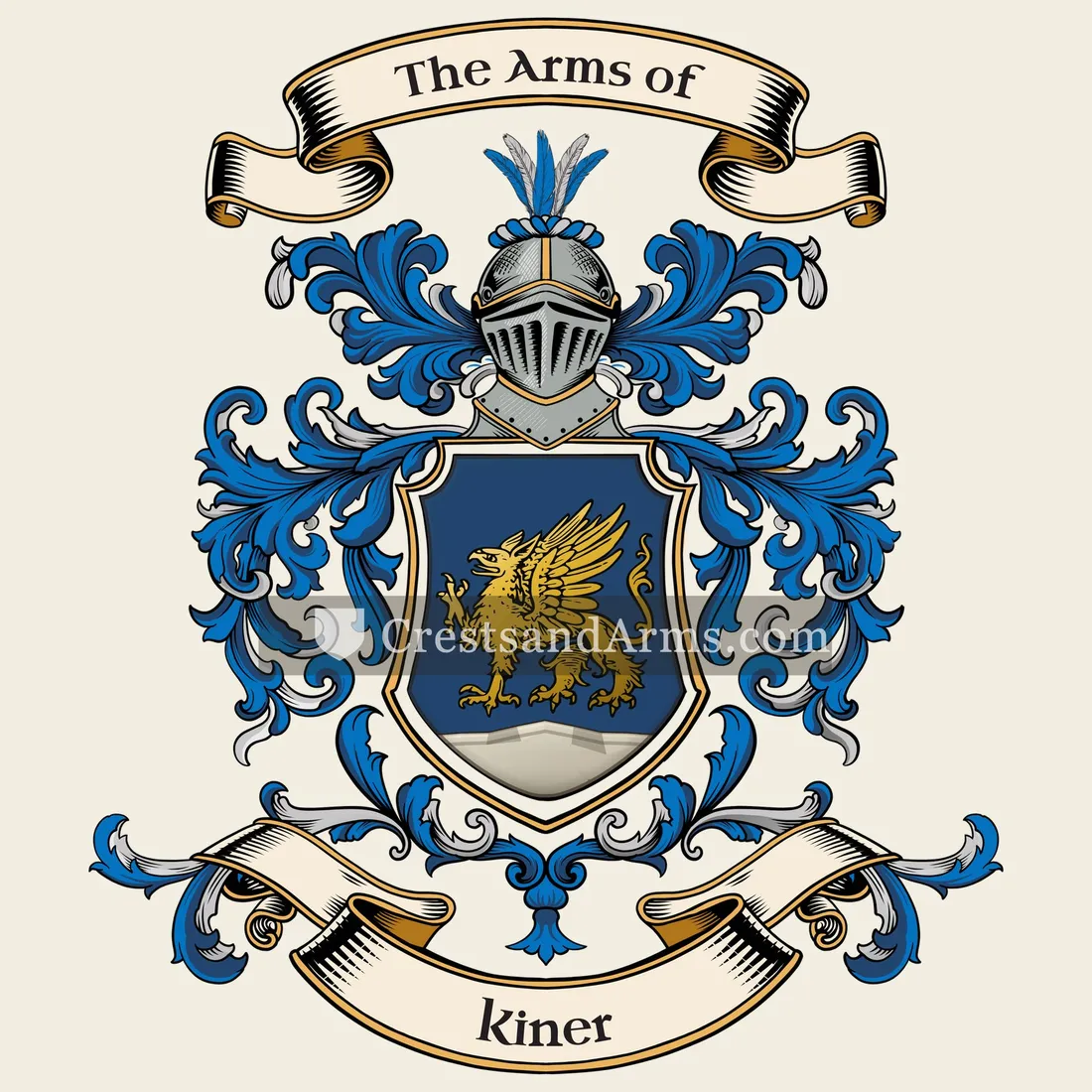
A record of documented arms, meaning and origin, researched for the Kiner family of Germany.
Reg. 0696 · German, J–L
Meaning of the Kiner family crest colors & symbols
Symbols on this shield
mountThe ground held, and steadfastness upon it
griffinValour and vigilance, guarding great treasure
Colours
Blue (Azure)Means: Loyalty and truth
Silver (Argent)Means: Peace and sincerity
Gold (Or)Means: Generosity
Historical info
Source
J. B. Rietstap, Armorial Général, Gouda: G. B. van Goor Zonen, 1884–87
Blazon (the actual original written record)
“D'azur à un griffon d'or, soutenu d'un rocher de trois coupeaux d'arg. Cq. cour. C.: le griffon, tenant entre ses pattes une tête de poisson, en fasce, entre deux prob. coupées, à dextre de gu. sur or, à sen. d'or sur azur. L. conformes aux émaux des prob.”
SilesiaSilesia, c. 1765
Digital archive packCoat of arms PNG, gold border print PDF, vector SVG and the certificate of authenticity. Sent to your email in minutes.
Map of Germany showing where the Kiner arms are recorded
The Kiner arms were recorded in Silesia, c. 1765.
Silesia was farming country in the east of the German lands, held in large estates by families who stayed put for generations. Owning land was what entitled a family to arms, so the region fills a good deal of the register.
This is where the arms were entered in the register. Families often moved to other parts of the country, so the same name can turn up in more than one region.
The body that granted and recorded arms in Germany in this period.
Francis I, Holy Roman Emperor
Sovereign of the period
Francis I, Holy Roman Emperor
1745–1765
Reigning in Germany when the Kiner arms are first recorded.
How Arms Worked in Germany
In the Holy Roman Empire, coats of arms were often granted to individuals by the Emperor or his representatives. These arms were then passed down through the generations to all legitimate descendants of the original holder. Younger branches of a family usually kept the same shield design without needing to change it, as the arms belonged to the entire lineage.
Granting authority
The Holy Roman Emperor held the sole power to grant new coats of arms throughout his vast imperial territories.
How they got arms
Families typically obtained their coats of arms through a formal imperial grant or by proving their noble status to the authorities.
Where arms were recorded
These grants were officially recorded in the Imperial Chancery registers, which began keeping formal records of such honors during the Middle Ages.
The family's standing
Recorded among the armigerous families of Silesia.
Origin & History of the Kiner Family in Germany
The family name Kiner has deep roots in the historical region of Silesia, where records confirm members of the family were living as early as 1765. During this period, Silesia was a vibrant territory caught between the cultural influences of Central Europe, and families like the Kiners were often involved in the agricultural or trade-based economies that defined village life. The name itself is likely derived from occupational or descriptive origins common to the German-speaking populations of the time. As the family moved through the eighteenth century, they navigated the complex social changes brought on by shifting borders and the expansion of local administrative record-keeping. By settling in this region, the early Kiner ancestors became part of a long tradition of families who helped shape the local community and economy of the Silesian landscape.
Kiner Meaning & Related Branches
Root word
Kühner
Derived from the Middle High German word for bold or brave.
This name
KinerAn occupational or descriptive surname referring to a courageous or daring individual.
also spelled
Kiner
Scharfenstein
Keener de Sharfenstein
Documented Sources
J. B. Rietstap, Armorial Général, Gouda: G. B. van Goor Zonen, 1884–87
State Archive in Wrocław (Archiwum Państwowe we Wrocławiu), Akta stanu cywilnego parafii rzymskokatolickiej w Świdnicy
State Archive in Opole (Archiwum Państwowe w Opolu), Księgi metrykalne i akta parafialne
Bahlow, Hans, Deutsches Namenlexikon: Familien- und Vornamen nach Ursprung und Sinn erklärt, 1967
Knie, Johann Georg, Alphabetisch-statistisch-topographische Uebersicht der Dörfer, Flecken, Städte und andern Orte der Königl. Preuss. Provinz Schlesien, 1845
Digital archive packCoat of arms PNG, gold border print PDF, vector SVG and the certificate of authenticity. Sent to your email in minutes.


 mountThe ground held, and steadfastness upon it
 griffinValour and vigilance, guarding great treasure
 mountThe ground held, and steadfastness upon it
 griffinValour and vigilance, guarding great treasure