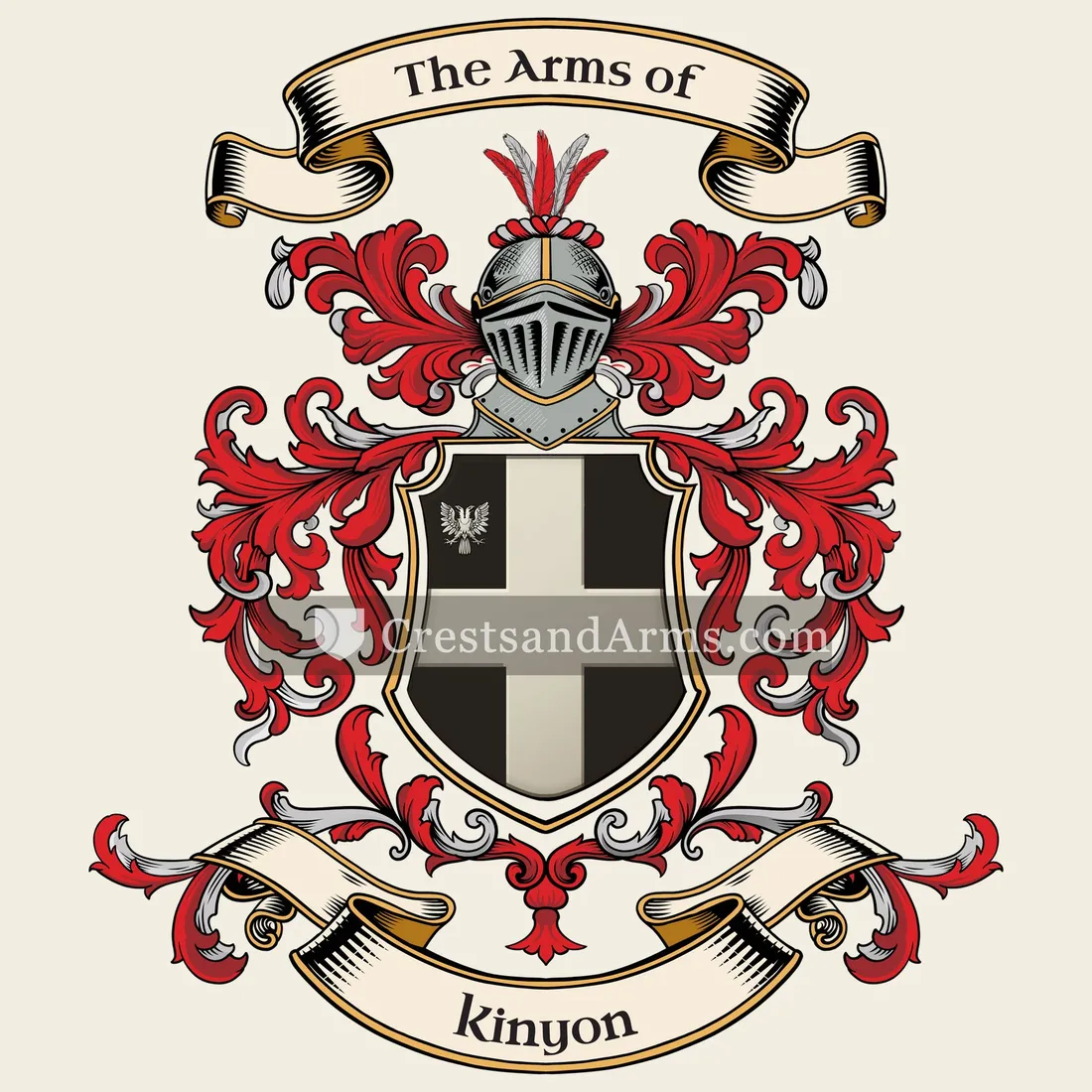
A record of documented arms, meaning and origin, researched for the Kinyon family lines. Documented in 3 countries.
Reg. 1294 · Britain, J–L
Meaning of the Kinyon family crest colors & symbols
Symbols on this shield
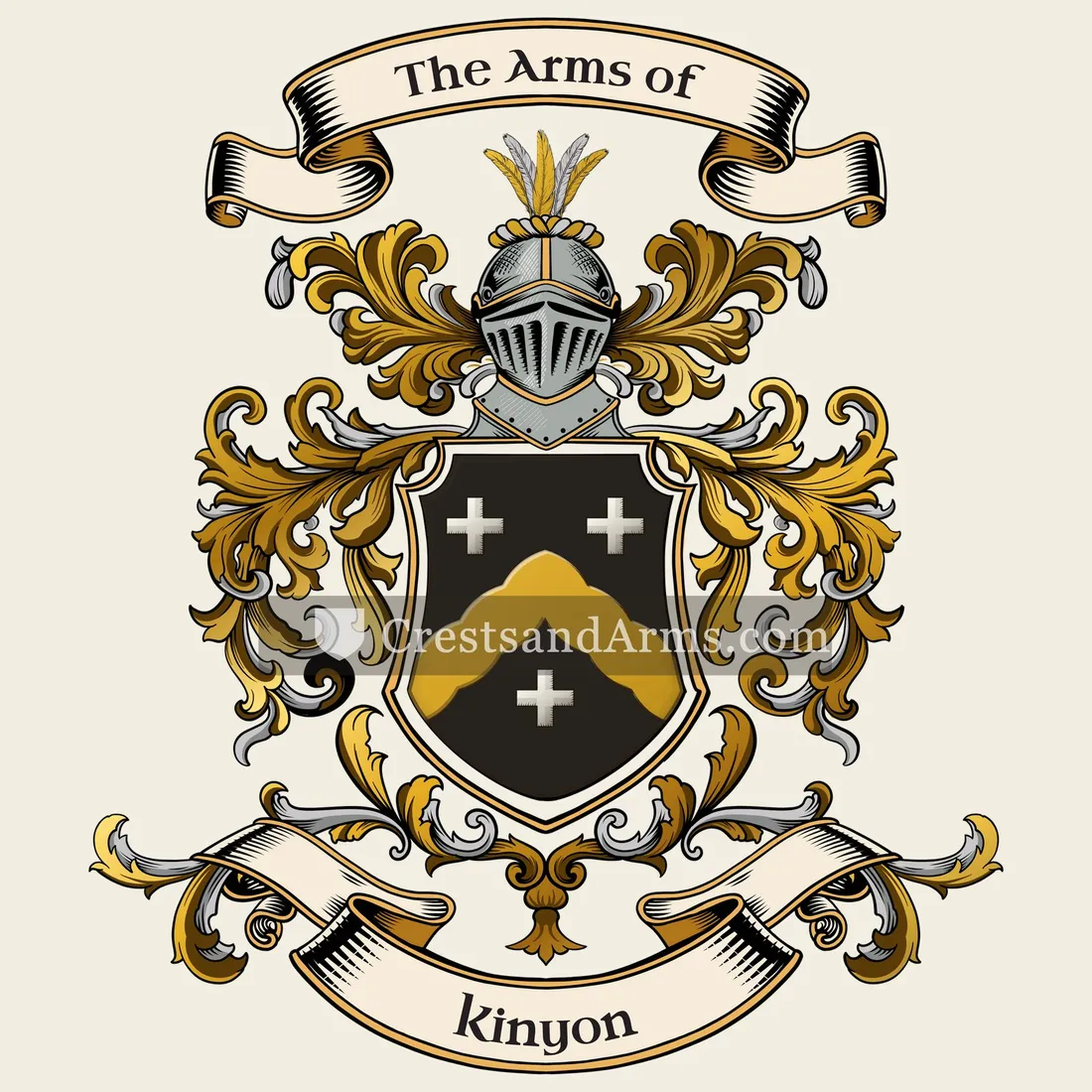
chevronProtection, and faithful service completed
cross symbolChristian faith and service
Colours
Black (Sable)Means: Constancy
Gold (Or)Means: Generosity
Silver (Argent)Means: Peace and sincerity
Historical info
Source
J. B. Rietstap, Armorial Général, Gouda: G. B. van Goor Zonen, 1884–87
Blazon (the actual original written record)
“De sa. au chev. engr. d'or, acc. de trois croix florencées d'arg. C.: un lion couché au nat., tenant entre ses pattes une croix de l'écu. T.: la Prudence et la Fortitude. D.: MAGNANIMITER CRUCEM SUSTINE.”
Britainc. 1700
Digital archive packCoat of arms PNG, gold border print PDF, vector SVG and the certificate of authenticity. Sent to your email in minutes.
Map of Britain showing where the Kinyon arms are recorded
The Kinyon arms were recorded in Britain, c. 1700.
Arms such as these were typically recorded in Kent.
Kent sits between London and the short crossing to Europe, and the trade passing through made it wealthy. Merchant families bought land with that money, and it was landowners who took coats of arms.
This is where the arms were entered in the register. Families often moved to other parts of the country, so the same name can turn up in more than one region.
The body that granted and recorded arms in Britain in this period.
William III of England
Sovereign of the period
William III of England
1694–1702
Reigning in Britain when the Kinyon arms are first recorded.
How Arms Worked in Britain
English heraldry allowed arms to be shared by all legitimate descendants of the original owner. These symbols were treated as personal property that moved through the generations to all children. While the eldest son kept the original design, other family members could use the same shield without needing to change it or register their own unique versions.
Granting authority
The College of Arms in London has regulated the use of coats of arms throughout England and Wales since 1484.
How they got arms
Families typically obtained their coats of arms through a formal grant from the Crown or by proving their ancient right to them.
Where arms were recorded
All official coats of arms are recorded in the registers kept at the College of Arms, which date back to the fifteenth century.
The family's standing
Recorded among the armigerous families of Britain.
Origin & History of the Kinyon Family in Britain
The family name Kinyon has deep roots in the English county of Kent, where records confirm members of the family were living by the year 1700. During this period, Kent was a vital region known for its agricultural output and its proximity to the trade routes of the English Channel. Families like the Kinyons often lived in rural parishes where they worked as skilled laborers or farmers. Life in 18th-century Kent was defined by the local church, which kept meticulous records of births, marriages, and deaths. These documents show that the Kinyon family was well-integrated into the local community, contributing to the social and economic life of the region for generations. By settling in this part of England, the early Kinyons were part of a stable population that helped shape the local culture and history of the Kentish countryside.
Meaning of the Kinyon family crest colors & symbols
Symbols on this shield
chevronProtection, and faithful service completed
cross symbolChristian faith and service
Colours
Black (Sable)Means: Constancy
Gold (Or)Means: Generosity
Silver (Argent)Means: Peace and sincerity
Historical info
Source
Sir Bernard Burke, The General Armory of England, Scotland, Ireland and Wales, London: Harrison & Sons, 1884
Blazon (the actual original written record)
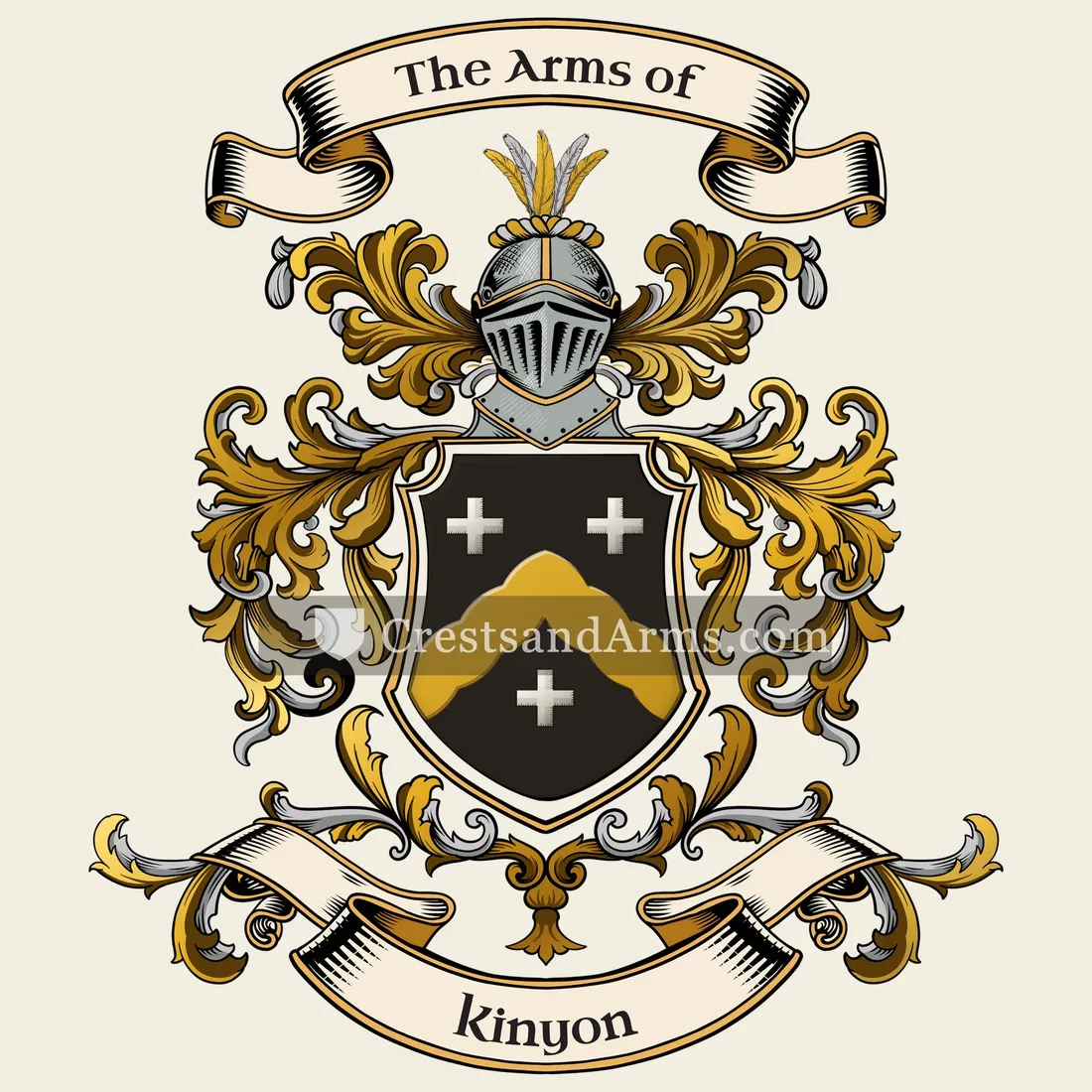
“Sa. a chev. engr. or, betw. three crosses flory ar”
Irelandc. 1645
Digital archive packCoat of arms PNG, gold border print PDF, vector SVG and the certificate of authenticity. Sent to your email in minutes.
Map of Ireland showing where the Kinyon arms are recorded
The Kinyon arms were recorded in Ireland, c. 1645.
Arms such as these were typically recorded in Dublin.
Dublin was the seat of government in Ireland and the place where grants were sought and recorded. Families with business at the castle or the courts settled nearby, and settling there put their arms on record.
This is where the arms were entered in the register. Families often moved to other parts of the country, so the same name can turn up in more than one region.
The body that granted and recorded arms in Ireland in this period.
Charles I of England
Sovereign of the period
Charles I of England
1625–1649
Reigning in Britain when the Kinyon arms are first recorded.
How Arms Worked in Ireland
The Ulster King of Arms granted coats of arms to individuals who proved their social standing and good character. These symbols were typically inherited by all legitimate descendants of the original holder. If a family branch wanted a unique look, they could apply for a specific change to their design through the office to ensure their identity remained distinct.
Granting authority
The Ulster King of Arms acted as the official body that regulated and issued all coats of arms throughout Ireland.
How they got arms
Families obtained their arms through formal grants issued by the office after proving their eligibility and paying the required fees.
Where arms were recorded
All official grants were recorded in the registers held by the Ulster King of Arms starting from the year 1552.
The family's standing
Recorded among the armigerous families of Ireland.
Origin & History of the Kinyon Family in Ireland
The Kinyon family name has roots that reach back into the complex social landscape of seventeenth-century Ireland. By 1645, records confirm that members of the family were established in Dublin, a city that served as a major center for trade and political administration during a time of great upheaval. At this stage in history, the name likely emerged as a variant of older Gaelic or Anglo-Norman surnames that were being adapted to fit the English linguistic patterns common in the capital. Living in Dublin during the mid-1600s meant that the family was situated at the heart of Irish commerce, likely participating in the urban life of a city that was rapidly changing due to shifting colonial policies and economic growth. While the exact origins of the name remain a subject of study, its presence in Dublin archives during this period highlights the family's integration into the administrative and social fabric of the city during a pivotal era of Irish history.
Meaning of the Kinyon family crest colors & symbols
Symbols on this shield
cross symbolChristian faith and service
eagleNobility, strength and a keen mind
Colours
Black (Sable)Means: Constancy
Silver (Argent)Means: Peace and sincerity
Historical info
Source
Sir Bernard Burke, The General Armory of England, Scotland, Ireland and Wales, London: Harrison & Sons, 1884
Blazon (the actual original written record)
“Sa. a cross lozengy ar. in sinister chief an eagle displ. of the last”
OxfordEasthall · Oxford, c. 1634
Digital archive packCoat of arms PNG, gold border print PDF, vector SVG and the certificate of authenticity. Sent to your email in minutes.
Map of England showing where the Kinyon arms are recorded
The Kinyon arms were recorded in Oxford, c. 1634.
Oxfordshire was farming country with the university at its centre, and both produced families of standing. Scholars and lawyers who did well bought manors nearby, and holding a manor was the ordinary route to a coat of arms.
This is where the arms were entered in the register. Families often moved to other parts of the country, so the same name can turn up in more than one region.
The body that granted and recorded arms in England in this period.
Charles I of England
Sovereign of the period
Charles I of England
1625–1649
Reigning in Britain when the Kinyon arms are first recorded.
How Arms Worked in England
English heraldry allowed arms to be shared by all legitimate descendants of the original owner. These symbols were treated as personal property that moved through the generations to all children. While the eldest son kept the original design, other family members could use the same shield without needing to change it or register their own unique versions.
Granting authority
The College of Arms in London has regulated the use of coats of arms throughout England and Wales since 1484.
How they got arms
Families typically obtained their coats of arms through a formal grant from the Crown or by proving their ancient right to them.
Where arms were recorded
All official coats of arms are recorded in the registers kept at the College of Arms, which date back to the fifteenth century.
The family's standing
Recorded among the armigerous families of Oxford.
Origin & History of the Kinyon Family in England
The Kinyon family name traces its roots to the historical landscape of England, where it emerged as a distinct surname during the medieval period. By the early seventeenth century, members of the family were firmly established in the academic and social circles of Oxford. Records from 1634 confirm their presence in this city, which was then a major center for scholars and tradespeople. During this era, surnames often shifted in spelling based on local dialects or the way a clerk recorded a name in a parish register. As the family moved through different regions, they likely contributed to the local economy and community life that defined English society before the great migrations to the American colonies. This period in Oxford highlights the family's deep connection to the intellectual and historical heart of England.
Kinyon Meaning & Related Branches
Root word
Cynan
A Brythonic personal name derived from the word for chief or leader.
This name
KinyonA locative surname referring to someone originating from the village of Kynion in Cornwall.
also spelled
Kenyoun
Kenion
Kenyen
Kennion
Documented Sources
J. B. Rietstap, Armorial Général, Gouda: G. B. van Goor Zonen, 1884–87
Everitt, Alan, Continuity and Colonization: The Evolution of Kentish Settlement, 1986
Hasted, Edward, The History and Topographical Survey of the County of Kent, 1797
Kent History and Library Centre, Parish Registers of Kent, 1538–1900
Digital archive packCoat of arms PNG, gold border print PDF, vector SVG and the certificate of authenticity. Sent to your email in minutes.


 chevronProtection, and faithful service completed
 cross symbolChristian faith and service
 chevronProtection, and faithful service completed
 cross symbolChristian faith and service




 eagleNobility, strength and a keen mind