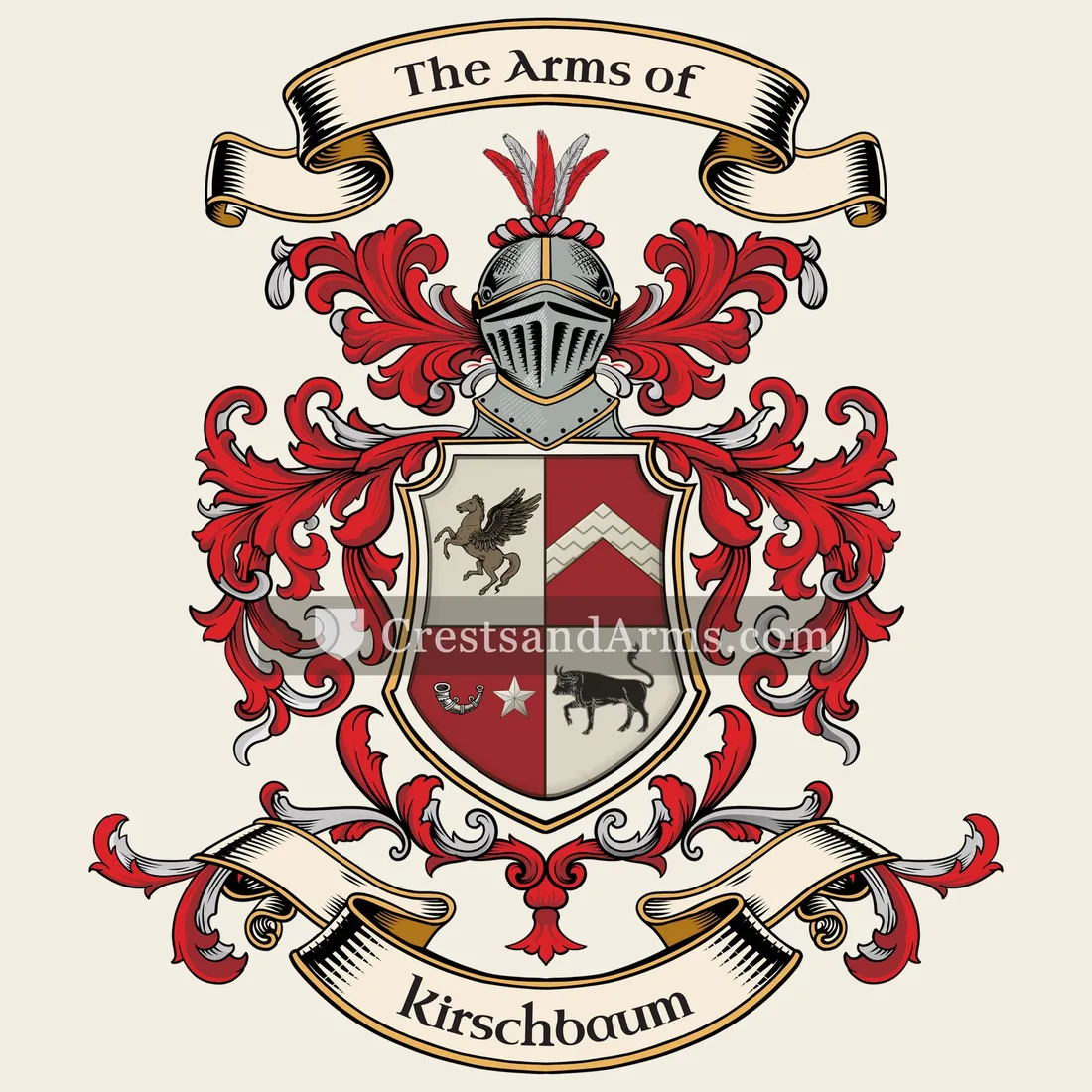
A record of documented arms, meaning and origin, researched for the Kirschbaum family of Germany.
Reg. 6792 · German, J–L
Meaning of the Kirschbaum family crest colors & symbols
Symbols on this shield
chevronProtection, and faithful service completed
pegasusFame, eloquence and swift renown
hunting horn stringedOne who delights in the chase
mulletThe third son, and a divine quality from above
bullValour and generosity
Colours
Silver (Argent)Means: Peace and sincerity
Red (Gules)Means: Military strength
Black (Sable)Means: Constancy
Historical info
Source
J. B. Rietstap, Armorial Général, Gouda: G. B. van Goor Zonen, 1884–87
Blazon (the actual original written record)
“Ec.: au 1 d'arg. à un Pégase naiss. et cont., au nat., mouv. d'une couronne d'or; au 2 de gu. à trois chev. d'arg.; au 3 d'azur à un cor-de-chasse d'arg. en chef et une étoile du même en p.; au 4 d'or à un rencontre de boeuf de sa. Cq. cour. C.: un cerisier au nat.; entre un vol, coupé alt. de gu. et d'or. L.: à dextre d'or et de gu., à sen. d'arg. et d'azur.”
BavariaBavaria, c. 1814
Digital archive packCoat of arms PNG, gold border print PDF, vector SVG and the certificate of authenticity. Sent to your email in minutes.
Map of Germany showing where the Kirschbaum arms are recorded
The Kirschbaum arms were recorded in Bavaria, c. 1814.
Bavaria was a country of old landed families and walled market towns. Estates passed down the same line for centuries, and both the landowners and the leading townsmen kept arms, which is why so many Bavarian names sit in the registers.
This is where the arms were entered in the register. Families often moved to other parts of the country, so the same name can turn up in more than one region.
The body that granted and recorded arms in Germany in this period.
Frederick William III of Prussia
Sovereign of the period
Frederick William III of Prussia
1797–1840
Reigning in Germany when the Kirschbaum arms are first recorded.
How Arms Worked in Germany
Prussian heraldry was strictly tied to social rank and noble status rather than being a free choice for every citizen. These symbols were treated as permanent family property that moved through the generations to all legitimate heirs. If a family branch wanted to change their design to stand out, they had to apply for official permission to alter their specific version of the shield.
Granting authority
The Prussian Heroldsamt acted as the central state office that managed and strictly controlled all noble titles and coats of arms.
How they got arms
Families usually obtained their arms through formal royal grants or by proving their long-standing noble status to the state authorities.
Where arms were recorded
All official coats of arms were kept in the rolls of the Prussian Heroldsamt, which functioned from 1706 until 1918.
The family's standing
Recorded among the armigerous families of Bavaria.
Origin & History of the Kirschbaum Family in Germany
The surname Kirschbaum is a German occupational or topographic name that translates literally to "cherry tree." During the Middle Ages, families often adopted names based on the landscape surrounding their homes or the specific trees that marked their property boundaries. By the early 19th century, records confirm that members of the Kirschbaum family were well-established in the Bavarian region of Germany. At that time, Bavaria was undergoing significant social and administrative changes following the Napoleonic Wars. Families living in this area were often involved in agriculture or skilled trades, and their presence in local parish registers from 1814 suggests they were part of the stable, land-holding population that formed the backbone of rural Bavarian society. As the family grew, these early ancestors helped shape the local community through their work and their deep connection to the regional landscape.
Kirschbaum Meaning & Related Branches
Root word
Kirsch and Baum
German words for cherry and tree respectively.
This name
KirschbaumAn occupational or topographic name for someone living near a cherry tree.
also spelled
Kyrschbaum
Documented Sources
J. B. Rietstap, Armorial Général, Gouda: G. B. van Goor Zonen, 1884–87
Bavarian State Archives (Bayerisches Hauptstaatsarchiv), Kirchenbücher der Pfarreien in Bayern (Parish Registers of Bavaria)
Bahlow, Hans, Deutsches Namenlexikon: Familien- und Vornamen nach Ursprung und Sinn erklärt (1967)
Heintze, Albert, Die deutschen Familien-Namen: geschichtlich, geographisch, sprachlich (1903)
Digital archive packCoat of arms PNG, gold border print PDF, vector SVG and the certificate of authenticity. Sent to your email in minutes.


 chevronProtection, and faithful service completed
 pegasusFame, eloquence and swift renown
 hunting horn stringedOne who delights in the chase
 mulletThe third son, and a divine quality from above
 bullValour and generosity
 chevronProtection, and faithful service completed
 pegasusFame, eloquence and swift renown
 hunting horn stringedOne who delights in the chase
 mulletThe third son, and a divine quality from above
 bullValour and generosity