Map of Britain showing where the Kirwan arms are recorded
The Kirwan arms were recorded in France, c. 1700.
Arms such as these were typically recorded in Kent.
Kent sits between London and the short crossing to Europe, and the trade passing through made it wealthy. Merchant families bought land with that money, and it was landowners who took coats of arms.
This is where the arms were entered in the register. Families often moved to other parts of the country, so the same name can turn up in more than one region.
The body that granted and recorded arms in Britain in this period.
William III of England
Sovereign of the period
William III of England
1694–1702
Reigning in Britain when the Kirwan arms are first recorded.
How Arms Worked in Britain
English heraldry allowed arms to be shared by all legitimate descendants of the original owner. These symbols were treated as personal property that moved through the generations to all children. While the eldest son kept the original design, other family members could use the same shield without needing to change it or register their own unique versions.
Granting authority
The College of Arms in London has regulated the use of coats of arms throughout England and Wales since 1484.
How they got arms
Families typically obtained their coats of arms through a formal grant from the Crown or by proving their ancient right to them.
Where arms were recorded
All official coats of arms are recorded in the registers kept at the College of Arms, which date back to the fifteenth century.
The family's standing
Recorded among the armigerous families of Britain.
Origin & History of the Kirwan Family in Britain
The Kirwan family name has roots that stretch back across the British Isles, though its presence in Kent by the year 1700 marks a significant chapter in the family story. During the late seventeenth and early eighteenth centuries, families often moved across the country to seek new opportunities in trade, agriculture, or local administration. In Kent, which served as a bustling gateway for commerce and travel near London, the Kirwans likely integrated into the local community as skilled workers or landowners. While the name is often associated with Irish origins, the movement of people between Ireland and England during this period was common due to shifting political landscapes and economic ties. By establishing themselves in the English countryside, these early family members helped weave the name into the regional history of Kent, contributing to the local parish records and social life that defined the era.
Coat of Arms & Family Crest Details
Symbols on this shield
chevronProtection, and faithful service completed
martletA younger son, who must win his own land
Colours
Silver (Argent)Means: Peace and sincerity
Black (Sable)Means: Constancy
Historical info
Source
Sir Bernard Burke, The General Armory of England, Scotland, Ireland and Wales, London: Harrison & Sons, 1884
Blazon (the actual original written record)
“Ar. a chev. sa. betw. three Cornish choughs ppr”
GalwayCregg · Galway, c. 1499
Digital archive packCoat of arms PNG, gold border print PDF, vector SVG and the certificate of authenticity. Sent to your email in minutes.
Map of Ireland showing where the Kirwan arms are recorded
The Kirwan arms were recorded in Galway, c. 1499.
Galway was western Irish country of poor land and a rich port. A small group of merchant families ran the town for centuries and held estates around it, and both kinds of property carried arms.
This is where the arms were entered in the register. Families often moved to other parts of the country, so the same name can turn up in more than one region.
The body that granted and recorded arms in Ireland in this period.
Henry VII of England
Sovereign of the period
Henry VII of England
1485–1509
Reigning in Britain when the Kirwan arms are first recorded.
How Arms Worked in Ireland
The Ulster King of Arms granted coats of arms to individuals who proved their social standing and good character. These symbols were typically inherited by all legitimate descendants of the original holder. If a family branch wanted a unique look, they could apply for a specific change to their design through the office to ensure their identity remained distinct.
Granting authority
The Ulster King of Arms acted as the official body that regulated and issued all coats of arms throughout Ireland.
How they got arms
Families obtained their arms through formal grants issued by the office after proving their eligibility and paying the required fees.
Where arms were recorded
All official grants were recorded in the registers held by the Ulster King of Arms starting from the year 1552.
The family's standing
Recorded among the armigerous families of Galway.
Origin & History of the Kirwan Family in Ireland
The Kirwan family name has deep roots in the history of County Galway, where they emerged as one of the prominent Tribes of Galway. By the year 1499, the family was already well established within the city, playing a significant role in the local merchant class. The name itself is derived from the Irish language term *Ó Ciardhubháin*, which translates to the descendant of the dark-haired one. As the family grew in influence, they became deeply involved in the civic and political life of the region. They were known for their extensive trade connections and their ability to maintain status throughout the changing political landscape of medieval Ireland. Their presence in Galway for over five centuries highlights their long-standing commitment to the development of the city and its surrounding territories.
Coat of Arms & Family Crest Details
Symbols on this shield
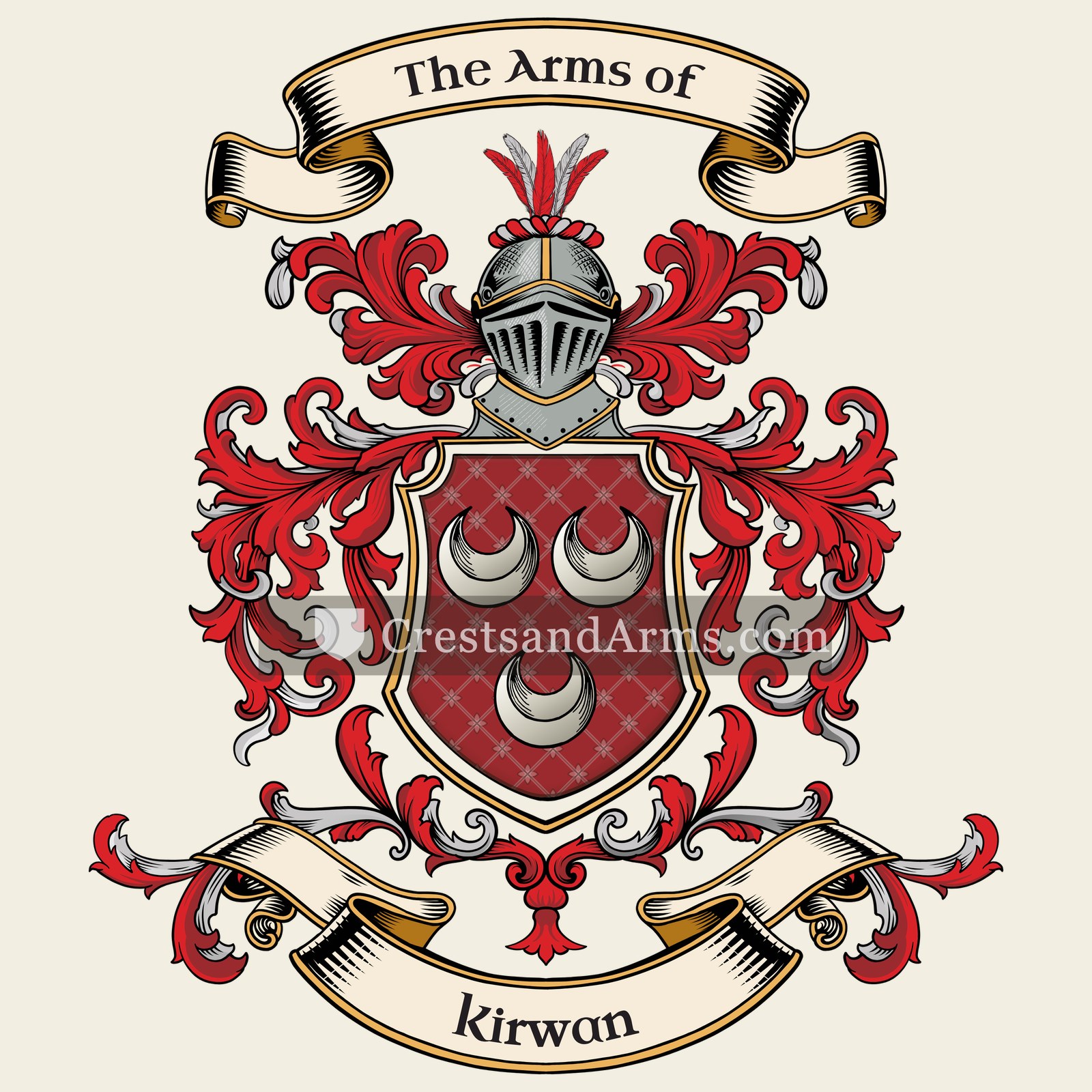
crescentHonour by the sovereign, and the second son
Colours
Red (Gules)Means: Military strength
Silver (Argent)Means: Peace and sincerity
Historical info
Source
Sir Bernard Burke, The General Armory of England, Scotland, Ireland and Wales, London: Harrison & Sons, 1884
Blazon (the actual original written record)
“Gu. three crescents ar”
Englandc. 1620
Digital archive packCoat of arms PNG, gold border print PDF, vector SVG and the certificate of authenticity. Sent to your email in minutes.
Map of England showing where the Kirwan arms are recorded
The Kirwan arms were recorded in England, c. 1620.
Arms such as these were typically recorded in York.
Yorkshire is the largest of the English counties, and it held more gentry families than any other. Land there was split among a great many households rather than a few, so a great many of them carried arms.
This is where the arms were entered in the register. Families often moved to other parts of the country, so the same name can turn up in more than one region.
The body that granted and recorded arms in England in this period.
James VI and I
Sovereign of the period
James VI and I
1603–1625
Reigning in Britain when the Kirwan arms are first recorded.
How Arms Worked in England
English heraldry allowed arms to be shared by all legitimate descendants of the original owner. These symbols were treated as personal property that moved through the generations to all children. While the eldest son kept the original design, other family members could use the same shield without needing to change it or register their own unique versions.
Granting authority
The College of Arms in London has regulated the use of coats of arms throughout England and Wales since 1484.
How they got arms
Families typically obtained their coats of arms through a formal grant from the Crown or by proving their ancient right to them.
Where arms were recorded
All official coats of arms are recorded in the registers kept at the College of Arms, which date back to the fifteenth century.
The family's standing
Recorded among the armigerous families of England.
Origin & History of the Kirwan Family in England
The Kirwan family name has roots that stretch back into the early seventeenth century in the historic city of York. By 1620, records indicate that members of the family were already established residents within this northern English hub. During this period, York served as a vital center for trade and regional administration, suggesting that the early Kirwans were likely integrated into the local merchant or professional classes. As the family navigated life in a city defined by its medieval walls and religious significance, they contributed to the social fabric of the region. While the name is often associated with later migrations and broader historical movements, its presence in York during the reign of King James I highlights the family’s long-standing connection to the urban development of Northern England.
Related Branches & Arms
Root word
Ciar
An ancient Gaelic term meaning dark or black.
This name
KirwanA descendant of the dark-haired or swarthy one.
also spelled
Kyrwan
Kerwan
Kirwen
Related arms
Lally-Tolendalrecorded with Kirwan, same area
Neilsonrecorded with Kirwan, same area
O'Donellrecorded with Kirwan, same area
Aldwellrecorded with Kirwan, same area
Documented Sources
J. B. Rietstap, Armorial Général, Gouda: G. B. van Goor Zonen, 1884–87
Bardsley, Charles Wareing, A Dictionary of English and Welsh Surnames, 1901
Cottle, Basil, The Penguin Dictionary of Surnames, 1967
The National Archives, Parish registers for the county of Kent, 1538-1900
Kent History and Library Centre, Quarter Sessions records and local administrative papers, 1600-1800
Digital archive packCoat of arms PNG, gold border print PDF, vector SVG and the certificate of authenticity. Sent to your email in minutes.


 chevronProtection, and faithful service completed
 ravenConstancy and divine providence
 chevronProtection, and faithful service completed
 ravenConstancy and divine providence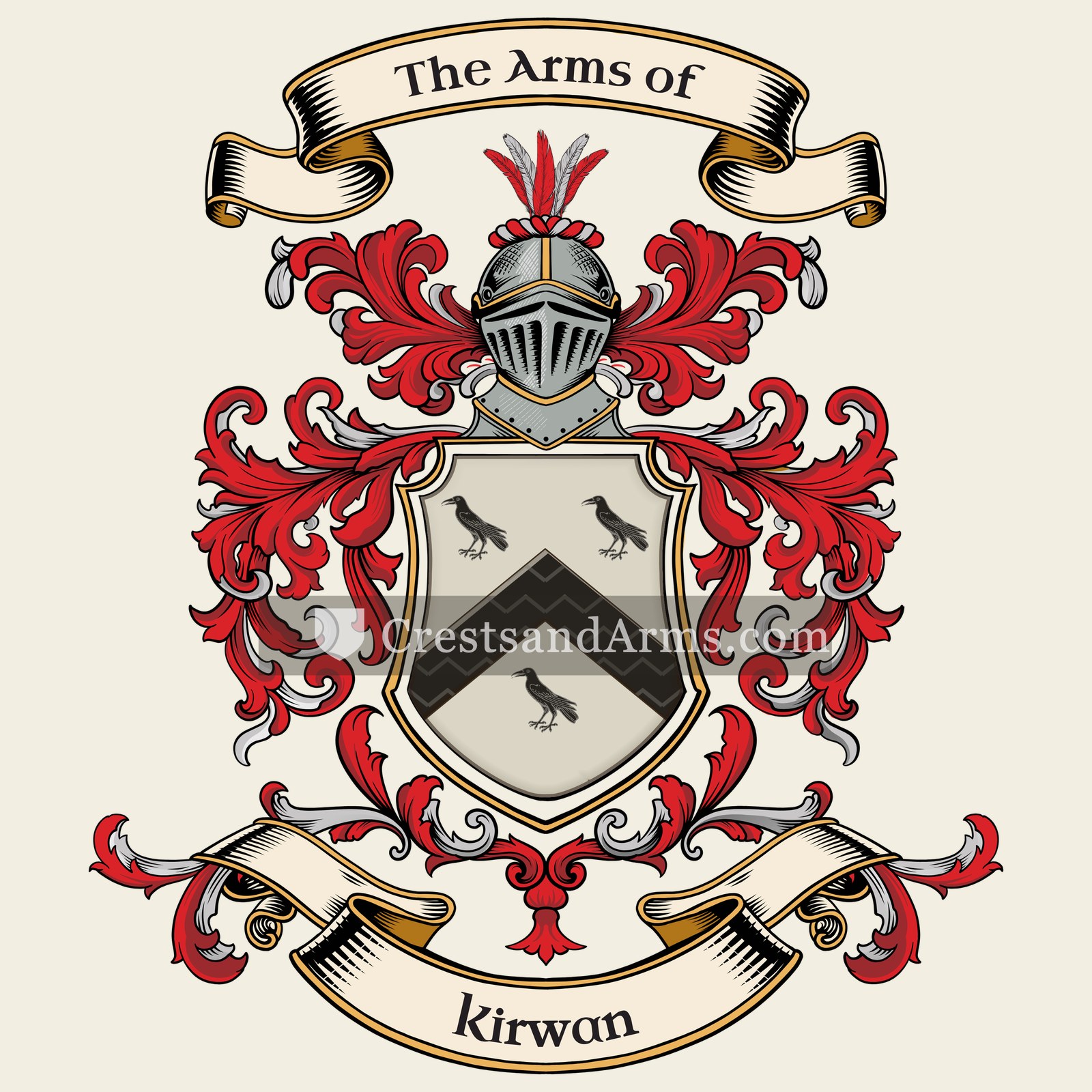


 martletA younger son, who must win his own land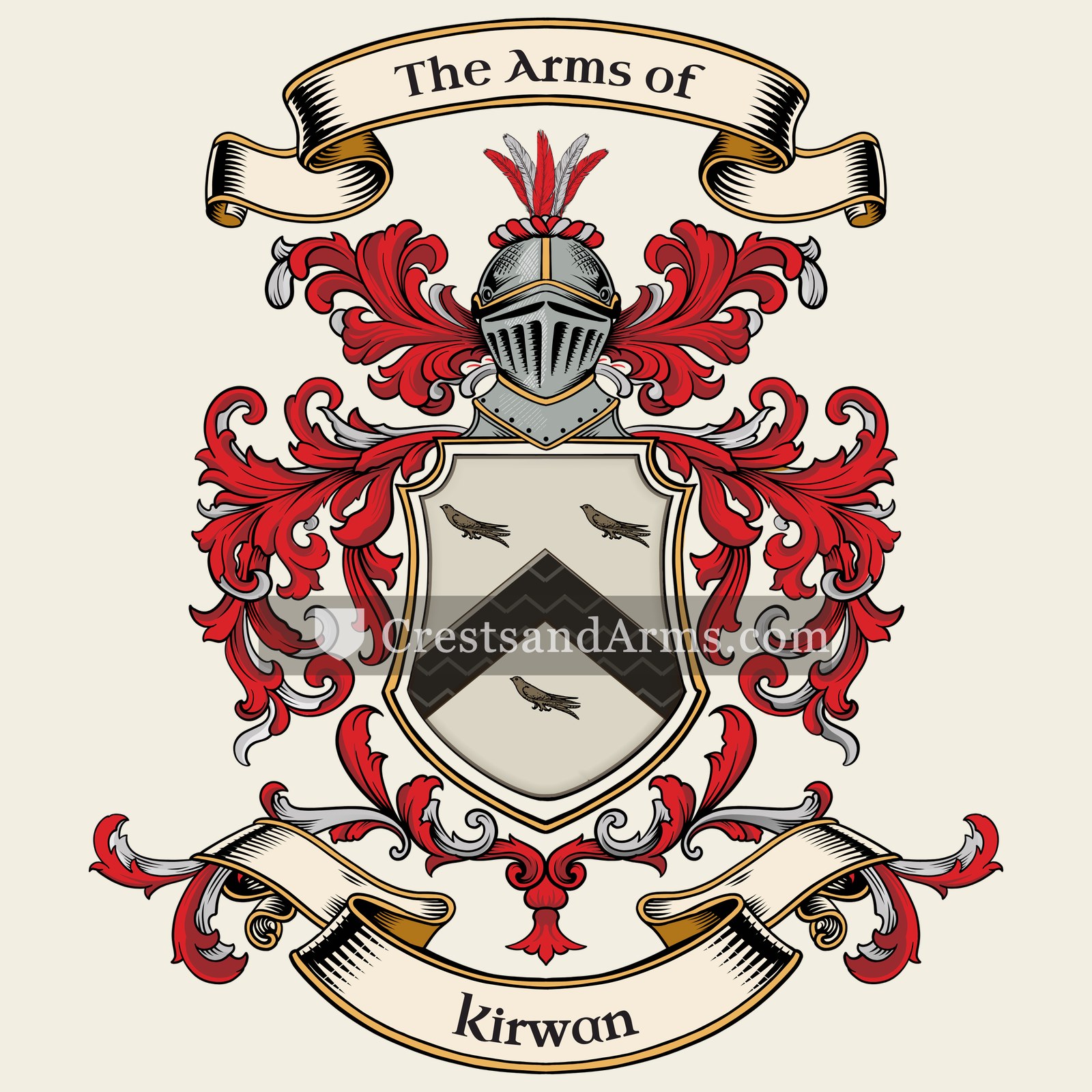


 crescentHonour by the sovereign, and the second son