Map of Germany showing where the Klem arms are recorded
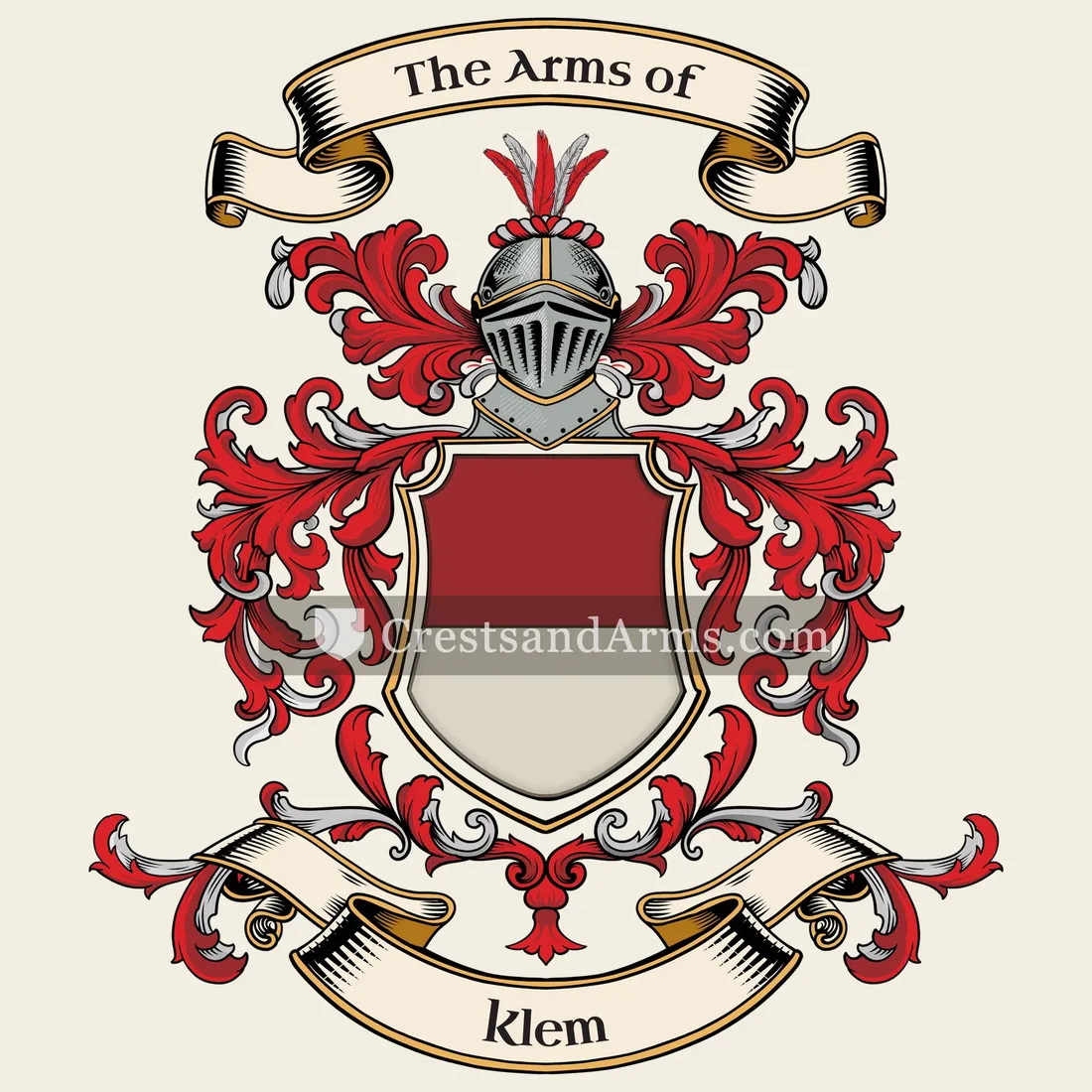
The Klem arms were recorded in Swabia, c. 1765.
Swabia was broken into a great many small territories in southern Germany, and each had its own landowners and its own leading townsmen. That fragmentation produced an unusual number of families with arms.
This is where the arms were entered in the register. Families often moved to other parts of the country, so the same name can turn up in more than one region.
The body that granted and recorded arms in Germany in this period.
Francis I, Holy Roman Emperor
Sovereign of the period
Francis I, Holy Roman Emperor
1745–1765
Reigning in Germany when the Klem arms are first recorded.
How Arms Worked in Germany
In the Holy Roman Empire, coats of arms were often granted to individuals by the Emperor or his representatives. These arms were then passed down through the generations to all legitimate descendants of the original holder. Younger branches of a family usually kept the same shield design without needing to change it, as the arms belonged to the entire lineage.
Granting authority
The Holy Roman Emperor held the sole power to grant new coats of arms throughout his vast imperial territories.
How they got arms
Families typically obtained their coats of arms through a formal imperial grant or by proving their noble status to the authorities.
Where arms were recorded
These grants were officially recorded in the Imperial Chancery registers, which began keeping formal records of such honors during the Middle Ages.
The family's standing
Recorded among the armigerous families of Swabia.
Origin & History of the Klem Family in Germany
The surname Klem traces its roots to the historic region of Swabia, a territory in southwestern Germany known for its distinct dialect and long-standing agricultural traditions. By the mid-eighteenth century, families bearing this name were well-established in local communities, likely working as skilled craftsmen or farmers who played a vital role in the regional economy. The name itself is often considered a shortened form of the name Clement, which carries the Latin meaning of being mild or merciful. During the 1760s, families in Swabia lived through a period of significant social change as the region transitioned toward more modern administrative structures. Members of the Klem family were part of this stable society, contributing to the growth of their local parishes and maintaining the traditions that defined life in the German highlands. Their presence in the historical record during this era highlights a legacy of resilience and community involvement that has persisted for generations.
Klem Meaning & Related Branches
Root word
Clemens
Latin term meaning merciful, gentle, or mild in temperament.
This name
KlemA shortened form of the given name Clement, denoting a person of mild or compassionate character.
also spelled
Klumm
Clum
Klume
Documented Sources
J. B. Rietstap, Armorial Général, Gouda: G. B. van Goor Zonen, 1884–87
Brechenmacher, Josef Karlmann. Etymologisches Wörterbuch der deutschen Familiennamen. 1957
Kohlhammer, W. Schwäbische Lebensbilder. 1940
Landesarchiv Baden-Württemberg, Kirchenbücher der evangelischen Landeskirche in Württemberg
Digital archive packCoat of arms PNG, gold border print PDF, vector SVG and the certificate of authenticity. Sent to your email in minutes.