Map of France showing where the Klement arms are recorded
The Klement arms were recorded in Lorraine, c. 1487.
Lorraine sat on the border between France and the German lands, and border country bred soldiers. Families here held small estates and served in arms, and a fighting man was exactly the sort who carried a shield of his own.
This is where the arms were entered in the register. Families often moved to other parts of the country, so the same name can turn up in more than one region.
The body that granted and recorded arms in France in this period.
Charles VIII of France
Sovereign of the period
Charles VIII of France
1483–1498
Reigning in France when the Klement arms are first recorded.
How Arms Worked in France
In France, a coat of arms was a mark of honor that passed down through the male line to all legitimate descendants. Families often used the same shield without changes to show their shared heritage. If a branch wanted to stand out, they could add a small mark to their shield to show their specific place in the family tree.
Granting authority
The Juge d'armes de France acted as the official authority that regulated and verified coats of arms across the country.
How they got arms
Families typically inherited their arms from ancestors, though they could also receive them through royal grants or by proving their noble status.
Where arms were recorded
Coats of arms were officially recorded in the Armorial Général de France, which began its main collection in the year 1696.
The family's standing
Recorded among the armigerous families of Lorraine.
Origin & History of the Klement Family in France
The Klement family name traces its roots back to the late fifteenth century in the Lorraine region of France. By 1487, records confirm that members of this family were already established residents in this historically significant border territory. During this era, Lorraine served as a cultural crossroads between French and Germanic influences, which shaped the lives and naming traditions of its inhabitants. Families like the Klements often lived as farmers, artisans, or local tradespeople who contributed to the development of small village communities. As the name spread through the region, it became closely tied to the social and economic shifts of the late Middle Ages. The persistence of the name in local tax rolls and parish registers suggests that the family maintained a stable presence in the area for generations. This early history reflects the broader experience of families who helped build the foundations of rural society in eastern France.
Meaning of the Klement family crest colors & symbols
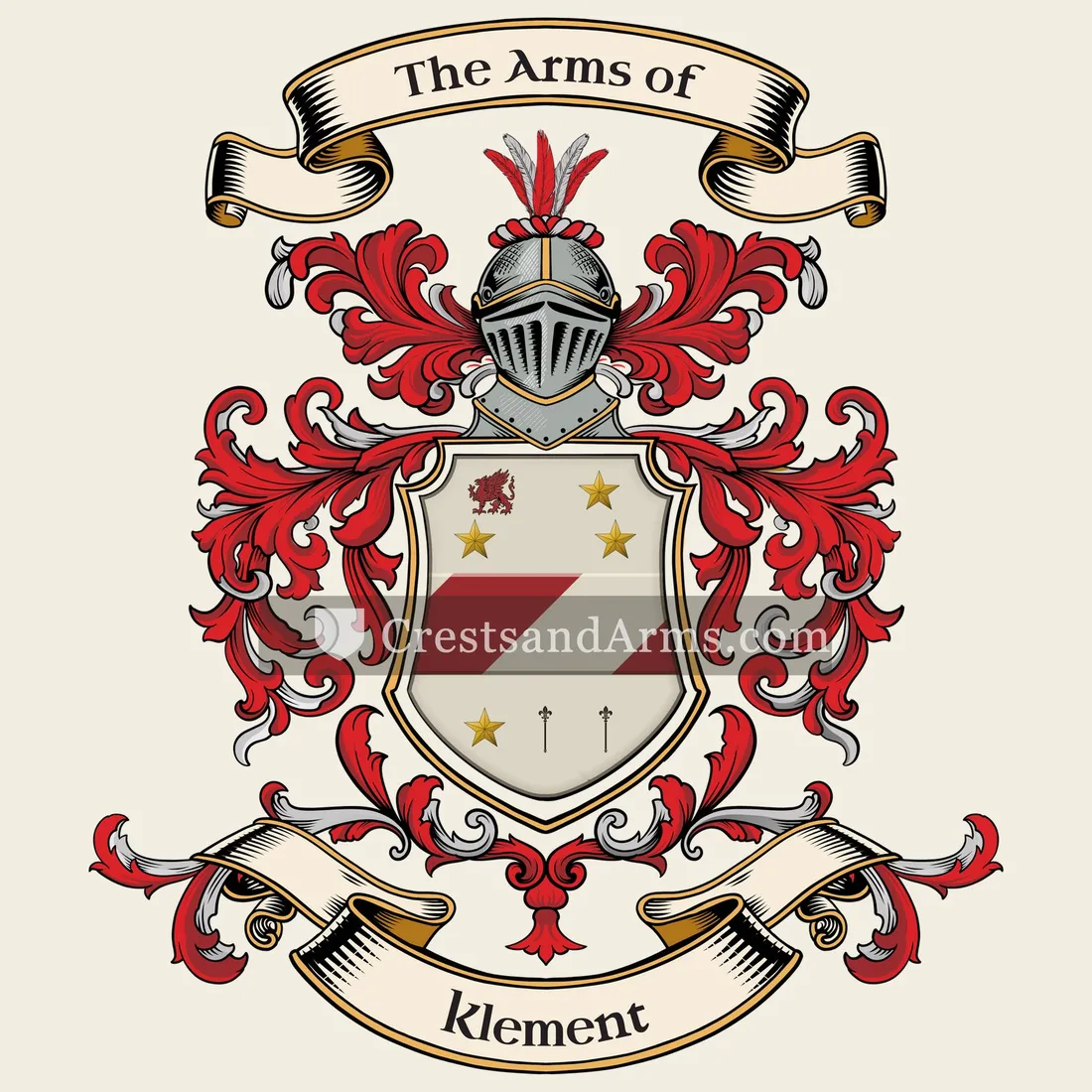
Symbols on this shield
fessThe military belt, and readiness to serve
griffinValour and vigilance, guarding great treasure
mulletThe third son, and a divine quality from above
batonAuthority and office held under the crown
Colours
Silver (Argent)Means: Peace and sincerity
Red (Gules)Means: Military strength
Gold (Or)Means: Generosity
Black (Sable)Means: Constancy
Historical info
Source
J. B. Rietstap, Armorial Général, Gouda: G. B. van Goor Zonen, 1884–87
Blazon (the actual original written record)
“Coupé: au 1 recoupé: a. d'arg. au griffon pass. de gu., tenant une flèche d'or en pal, sommée d'une étoile du même; b. d'azur à trois étoiles d'or; au 2 d'or à deux chicots de sa., passés en saut., et une fasce bandée d'azur et d'arg., br. sur les chicots. Cq. cour. C.: le griffon, iss. L.: à dextre d'arg. et de gu., à sen. d'or et d'azur.”
Germanyc. 1765
Digital archive packCoat of arms PNG, gold border print PDF, vector SVG and the certificate of authenticity. Sent to your email in minutes.
Map of Germany showing where the Klement arms are recorded
The Klement arms were recorded in Germany, c. 1765.
Arms such as these were typically recorded in Bavaria.
Bavaria was a country of old landed families and walled market towns. Estates passed down the same line for centuries, and both the landowners and the leading townsmen kept arms, which is why so many Bavarian names sit in the registers.
This is where the arms were entered in the register. Families often moved to other parts of the country, so the same name can turn up in more than one region.
The body that granted and recorded arms in Germany in this period.
Francis I, Holy Roman Emperor
Sovereign of the period
Francis I, Holy Roman Emperor
1745–1765
Reigning in France when the Klement arms are first recorded.
How Arms Worked in Germany
In the Holy Roman Empire, coats of arms were often granted to individuals by the Emperor or his representatives. These arms were then passed down through the generations to all legitimate descendants of the original holder. Younger branches of a family usually kept the same shield design without needing to change it, as the arms belonged to the entire lineage.
Granting authority
The Holy Roman Emperor held the sole power to grant new coats of arms throughout his vast imperial territories.
How they got arms
Families typically obtained their coats of arms through a formal imperial grant or by proving their noble status to the authorities.
Where arms were recorded
These grants were officially recorded in the Imperial Chancery registers, which began keeping formal records of such honors during the Middle Ages.
The family's standing
Recorded among the armigerous families of Germany.
Origin & History of the Klement Family in Germany
The surname Klement traces its roots to the Latin name Clemens, which means mild or merciful. In Germany, this name became popular due to the influence of early Christian saints and several popes who bore the title. By the middle of the eighteenth century, the Klement family was well established in the southern region of Bavaria. During this period, Bavaria was a collection of rural communities where families often lived on the same land for generations. Life for the Klements in 1765 would have centered on the agricultural rhythms of the Alpine foothills. As the name spread through the German states, it evolved from a personal name into a hereditary surname used to identify specific family lines within their local villages. This transition reflected a broader trend in German history where families began using fixed names to manage tax records and church registrations more effectively.
Klement Meaning & Related Branches
Root word
Clemens
Latin word meaning merciful, gentle, or mild in temperament.
This name
KlementA surname derived from a personal name signifying a kind and compassionate nature.
also spelled
Klement
Clemment
Kleman
Clemence
Documented Sources
J. B. Rietstap, Armorial Général, Gouda: G. B. van Goor Zonen, 1884–87
Archives départementales de Meurthe-et-Moselle, Série B: Cours et juridictions
Bastien, Michel, Histoire de la Lorraine, 1998
Lepage, Henri, Les communes de la Meurthe: journal historique des villes, bourgs, villages, hameaux et censes de ce département, 1853
Digital archive packCoat of arms PNG, gold border print PDF, vector SVG and the certificate of authenticity. Sent to your email in minutes.


 starThe celestial goddess, and nobility
 starThe celestial goddess, and nobility
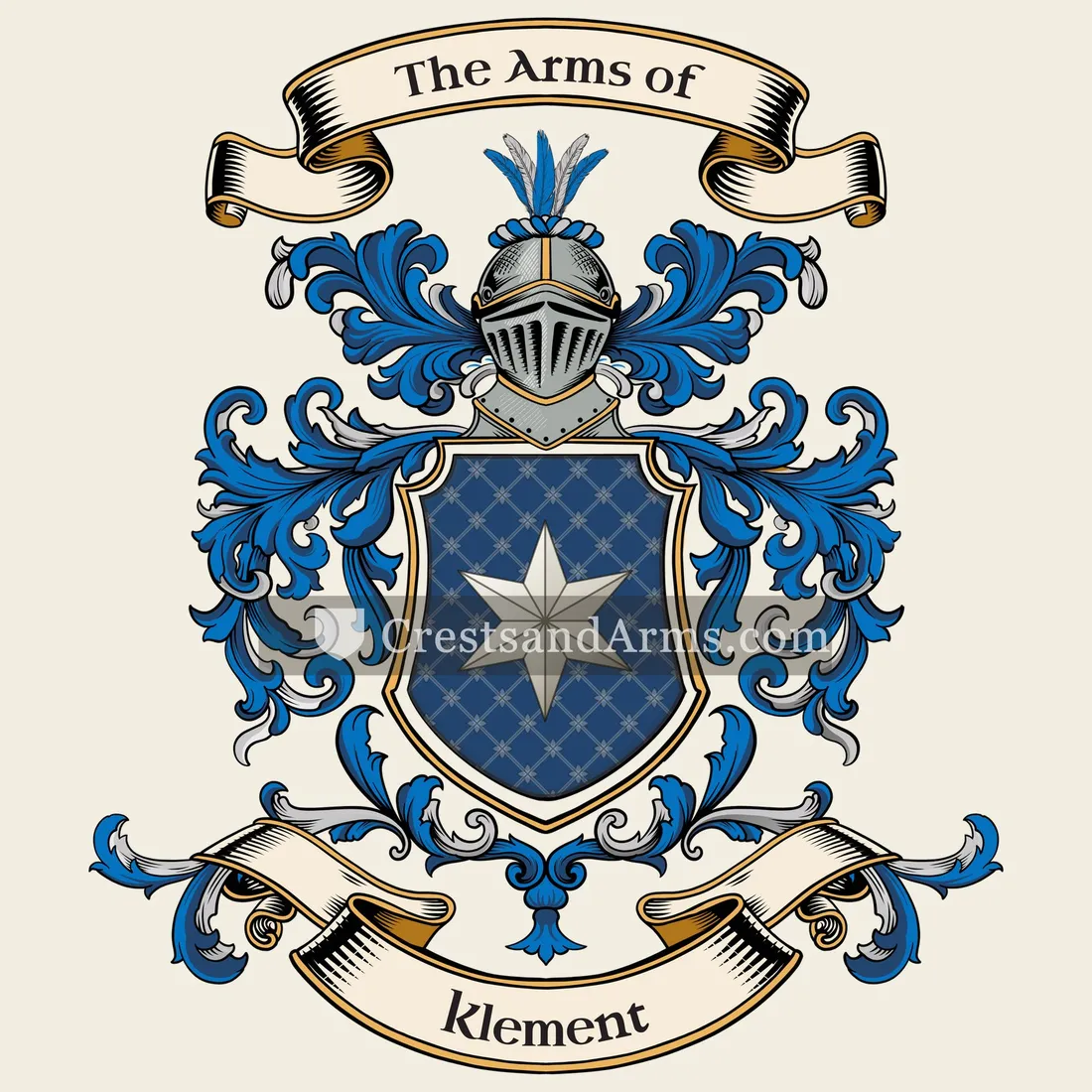


 fessThe military belt, and readiness to serve
 griffinValour and vigilance, guarding great treasure
 mulletThe third son, and a divine quality from above
 batonAuthority and office held under the crown