A record of documented arms, meaning and origin, researched for the Klingenberg family lines. Documented in 3 countries.
Reg. 5852 · German, J–L
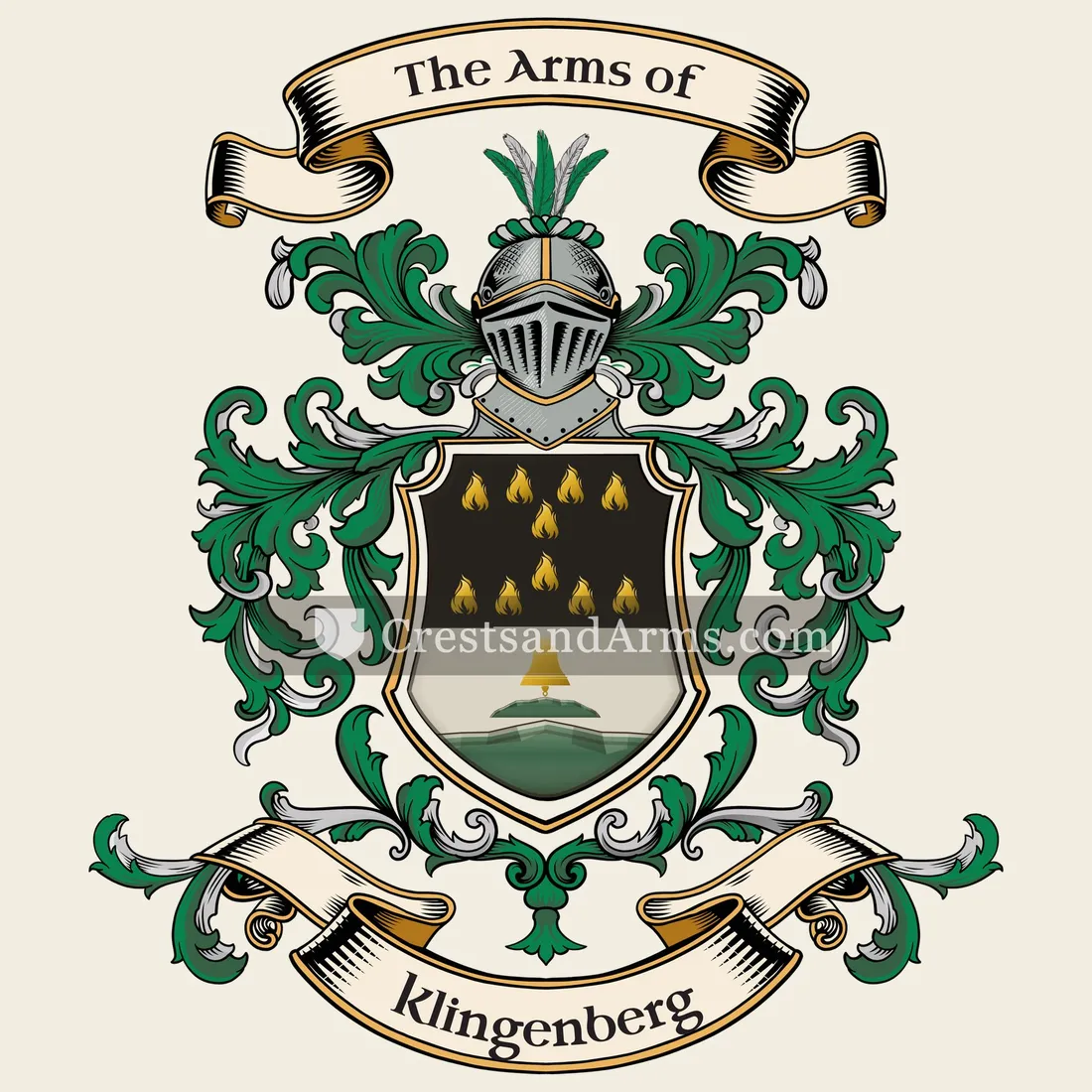
Meaning of the Klingenberg family crest colors & symbols
Symbols on this shield
mountThe ground held, and steadfastness upon it
fireZeal and purification
bellA call to prayer, and a warning given
Colours
Black (Sable)Means: Constancy
Silver (Argent)Means: Peace and sincerity
Green (Vert)Means: Hope
Gold (Or)Means: Generosity
Historical info
Source
J. B. Rietstap, Armorial Général, Gouda: G. B. van Goor Zonen, 1884–87
Blazon (the actual original written record)
“Coupé: au 1 de sa. à dix flammes d'or, 5 et 5; au 2 d'arg. à une cloche d'or, posée sur une colline de sin. Deux cq., le 2 cour. C.: 1° une roue d'or, sommée de plumes de coq de sa. et soutenue d'un coussin de gu., houppé d'or: l. d'arg. et de sa.: 2° une queue de paon au nat., entre deux prob. coupées alt. de sa. et d'or; l. d'or et de sa.”
SaxonySaxony, c. 1741
Digital archive packCoat of arms PNG, gold border print PDF, vector SVG and the certificate of authenticity. Sent to your email in minutes.
Map of Germany showing where the Klingenberg arms are recorded
The Klingenberg arms were recorded in Saxony, c. 1741.
Saxony had mines, trade and old landed families all at once. Silver made some fortunes and land held others, and both sorts of family kept arms, which is why Saxon names appear so often in the registers.
This is where the arms were entered in the register. Families often moved to other parts of the country, so the same name can turn up in more than one region.
The body that granted and recorded arms in Germany in this period.
How Arms Worked in Germany
In the Holy Roman Empire, coats of arms were often granted to individuals by the Emperor or his representatives. These arms were then passed down through the generations to all legitimate descendants of the original holder. Younger branches of a family usually kept the same shield design without needing to change it, as the arms belonged to the entire lineage.
Granting authority
The Holy Roman Emperor held the sole power to grant new coats of arms throughout his vast imperial territories.
How they got arms
Families typically obtained their coats of arms through a formal imperial grant or by proving their noble status to the authorities.
Where arms were recorded
These grants were officially recorded in the Imperial Chancery registers, which began keeping formal records of such honors during the Middle Ages.
The family's standing
Recorded among the armigerous families of Saxony.
Origin & History of the Klingenberg Family in Germany
The surname Klingenberg originates from the German language and is a topographic name, meaning it was originally given to people who lived near a specific geographical feature. The name is composed of two parts: *Klinge*, which refers to a narrow valley or a ravine, and *Berg*, which means a mountain or a hill. Families bearing this name likely settled in areas where these steep, rugged landscapes were common. By 1741, records confirm that members of the Klingenberg family were well-established in the region of Saxony. During this period, Saxony was a center for trade, mining, and agriculture, providing a stable environment for families to grow and expand their influence. The presence of the family in this area suggests they were part of the local social fabric, likely contributing to the rural or town life that defined the German states in the eighteenth century.
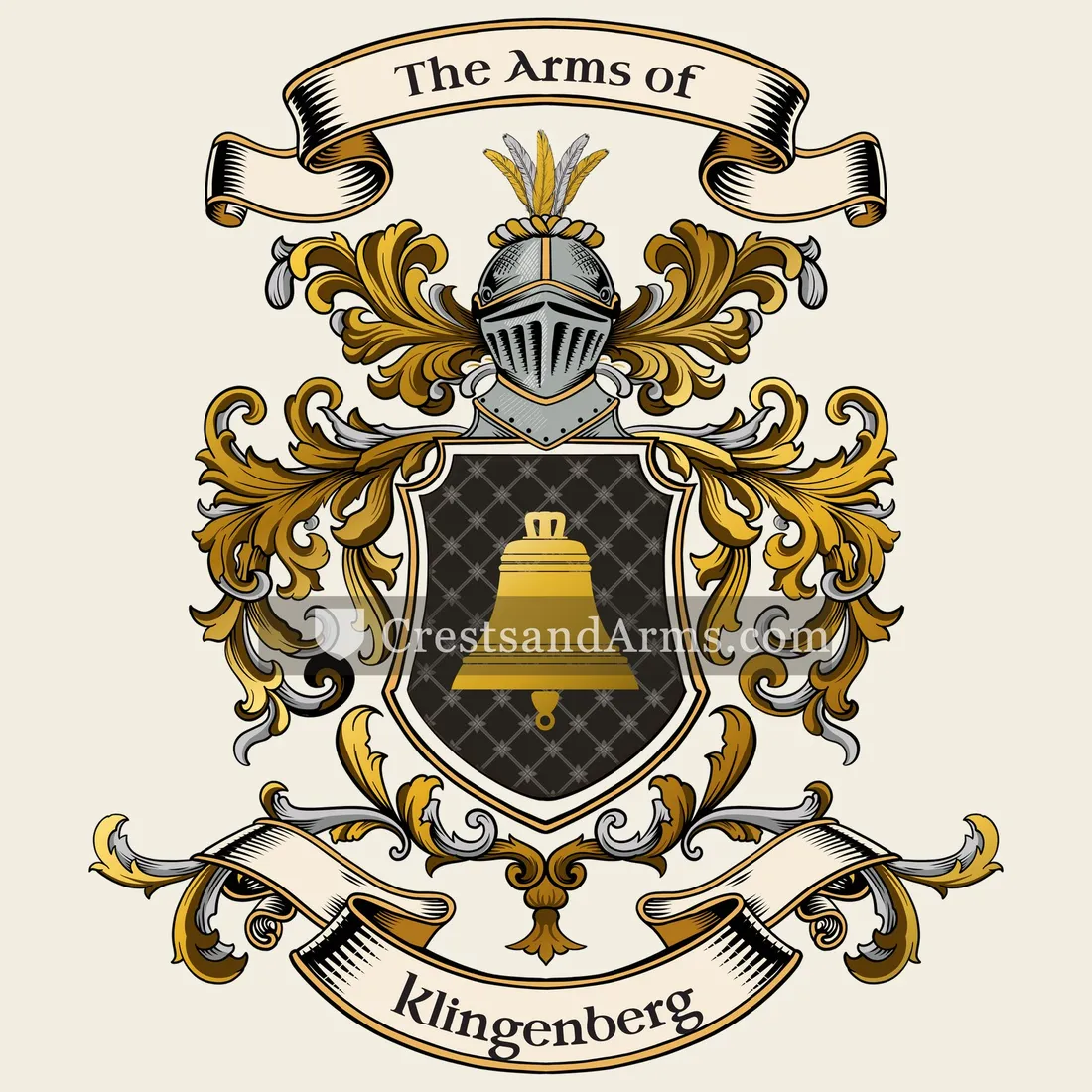
Meaning of the Klingenberg family crest colors & symbols
Symbols on this shield
bellA call to prayer, and a warning given
Colours
Black (Sable)Means: Constancy
Gold (Or)Means: Generosity
Historical info
Source
J. B. Rietstap, Armorial Général, Gouda: G. B. van Goor Zonen, 1884–87
Blazon (the actual original written record)
“De sa. à une cloche d'or, cour. du même.”
Denmarkc. 1669
Digital archive packCoat of arms PNG, gold border print PDF, vector SVG and the certificate of authenticity. Sent to your email in minutes.
Map of Denmark showing where the Klingenberg arms are recorded
The Klingenberg arms were recorded in Denmark, c. 1669.
Arms such as these were typically recorded in Sjaælland.
Zealand held the Danish court, the crown's offices and Copenhagen itself. Families who served the king kept estates within reach of it, and royal service was the ordinary route to a coat of arms.
This is where the arms were entered in the register. Families often moved to other parts of the country, so the same name can turn up in more than one region.
The body that granted and recorded arms in Denmark in this period.
Frederick III of Denmark
Sovereign of the period
Frederick III of Denmark
1648–1670
Reigning in Germany when the Klingenberg arms are first recorded.
How Arms Worked in Denmark
Danish heraldry during this period was closely tied to noble status and royal favor rather than being open to all citizens. Arms were typically granted by the monarch to individuals, and these symbols were then shared by all members of the noble house. If a family line died out, the right to use those specific arms ended with them.
Granting authority
The Danish royal chancery held the power to issue and regulate official coats of arms for the kingdom.
How they got arms
Families usually received their arms through a formal royal grant that confirmed their noble status and rights.
Where arms were recorded
These grants were officially recorded in the Danish Royal Chancery records starting in the sixteenth century.
The family's standing
Recorded among the armigerous families of Denmark.
Origin & History of the Klingenberg Family in Denmark
The history of the Klingenberg family in Denmark begins to emerge clearly in the late seventeenth century, specifically with records placing family members on the island of Sjælland by 1669. During this period, the name was associated with individuals who served in various administrative and military roles within the Danish state. As the family established itself in the region, they became part of the growing class of officials who helped manage the lands and interests of the Danish crown. Their presence in Sjælland suggests they were well-integrated into the local social structure of the time. Over the following decades, the family continued to play a role in the professional life of the kingdom, moving through different districts as their duties required. By focusing on these early years in Sjælland, we see a family that was deeply rooted in the practical governance and development of early modern Denmark.
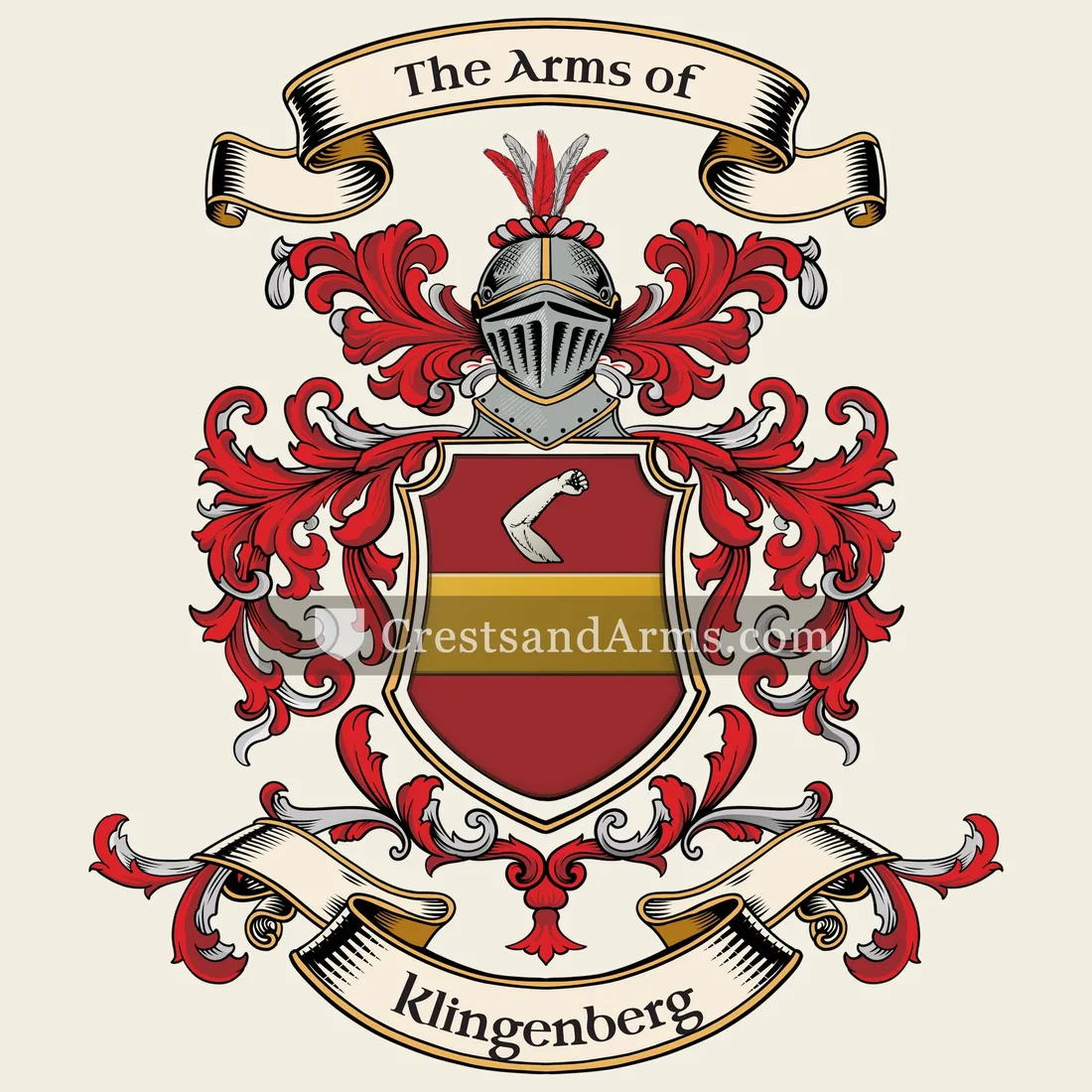
Meaning of the Klingenberg family crest colors & symbols
Symbols on this shield
armA person of action, industrious and laborious
Colours
Red (Gules)Means: Military strength
Gold (Or)Means: Generosity
Historical info
Source
J. B. Rietstap, Armorial Général, Gouda: G. B. van Goor Zonen, 1884–87
Blazon (the actual original written record)
“De gu. à un senestrochère, arm. au nat., iss. d'une nuée au nat. mouv. du flanc, la main de carn. brandissant une épée d'arg. garnie d'or. Brl. d'or, d'azur et de gu. C.: une épée d'arg., garnie d'or, entre deux petites bannières, d'azur et de gu., frangées et houppées d'or, attachées à des lances de tournoi du même. L.: à dextre d'or et de gu., à sen. d'or et d'azur.”
Swedenc. 1646
Digital archive packCoat of arms PNG, gold border print PDF, vector SVG and the certificate of authenticity. Sent to your email in minutes.
Map of Sweden showing where the Klingenberg arms are recorded
The Klingenberg arms were recorded in Sweden, c. 1646.
Arms such as these were typically recorded in Stockholm.
Stockholm held the Swedish court and the House of Nobility, where every noble family's arms were entered and kept. Families ennobled for service registered there, which is why so many are recorded around the city.
This is where the arms were entered in the register. Families often moved to other parts of the country, so the same name can turn up in more than one region.
The body that granted and recorded arms in Sweden in this period.
Christina of Sweden
Sovereign of the period
Christina of Sweden
1632–1654
Reigning in Germany when the Klingenberg arms are first recorded.
How Arms Worked in Sweden
In Sweden, a coat of arms belonged to a noble family as a whole rather than just one individual. These arms were passed down through the generations to all legitimate descendants. Younger branches of the family used the same shield without needing to change it. This system ensured that the entire lineage shared the same identity and status under the law.
Granting authority
The Riddarhuset, or House of Nobility, regulated all noble coats of arms in Sweden under royal authority.
How they got arms
Families received their coats of arms through royal grants of nobility which were then officially registered with the House.
Where arms were recorded
Coats of arms were officially recorded in the Swedish House of Nobility register starting in the year 1626.
The family's standing
Recorded among the armigerous families of Sweden.
Origin & History of the Klingenberg Family in Sweden
The history of the Klingenberg family in Sweden begins in the mid-seventeenth century, with records confirming their presence in Stockholm by 1646. During this era, Sweden was a rising power in Europe, and the city of Stockholm served as a bustling hub for merchants, military officers, and skilled professionals. Families like the Klingenbergs often moved within these urban circles to support the growing administrative and commercial needs of the Swedish state. By establishing themselves in the capital during this period, the family became part of the social fabric of a city undergoing rapid expansion and modernization. Their early residence in Stockholm suggests they were likely involved in the professional or trade networks that defined the life of the city during the reign of Queen Christina. This foundation allowed the family name to persist through generations as they integrated into the evolving Swedish society.
Klingenberg Meaning & Related Branches
Root word
Klinge and Berg
A blade or narrow ravine and a mountain or hill.
This name
KlingenbergRefers to someone who lived near a mountain or hill by a narrow ravine.
also spelled
Klingenberk
Related arms
Adamisimilar arms
Aissema d'Alszheimsimilar arms
Christsimilar arms
Clingenbergvariant spelling
Documented Sources
J. B. Rietstap, Armorial Général, Gouda: G. B. van Goor Zonen, 1884–87
Bahlow, Hans, Deutsches Namenlexikon: Familien- und Vornamen nach Ursprung und Sinn erklärt, 1967
Heintze, Albert, Die deutschen Familiennamen: geschichtlich, geographisch, sprachlich, 1903
Sächsisches Staatsarchiv, Kirchenbücher der Evangelisch-Lutherischen Landeskirche Sachsens, 1741
Digital archive packCoat of arms PNG, gold border print PDF, vector SVG and the certificate of authenticity. Sent to your email in minutes.


 mountThe ground held, and steadfastness upon it
 fireZeal and purification
 bellA call to prayer, and a warning given
 mountThe ground held, and steadfastness upon it
 fireZeal and purification
 bellA call to prayer, and a warning given



 armA person of action, industrious and laborious