Map of Germany showing where the Knack arms are recorded
The Knack arms were recorded in Ostfrise, c. 1765.
This is where the arms were entered in the register. Families often moved to other parts of the country, so the same name can turn up in more than one region.
The body that granted and recorded arms in Germany in this period.
Francis I, Holy Roman Emperor
Sovereign of the period
Francis I, Holy Roman Emperor
1745–1765
Reigning in Germany when the Knack arms are first recorded.
How Arms Worked in Germany
In the Holy Roman Empire, coats of arms were often granted to individuals by the Emperor or his representatives. These arms were then passed down through the generations to all legitimate descendants of the original holder. Younger branches of a family usually kept the same shield design without needing to change it, as the arms belonged to the entire lineage.
Granting authority
The Holy Roman Emperor held the sole power to grant new coats of arms throughout his vast imperial territories.
How they got arms
Families typically obtained their coats of arms through a formal imperial grant or by proving their noble status to the authorities.
Where arms were recorded
These grants were officially recorded in the Imperial Chancery registers, which began keeping formal records of such honors during the Middle Ages.
The family's standing
Recorded among the armigerous families of Germany.
Origin & History of the Knack Family in Germany
The surname Knack originates from the northern regions of Germany, specifically within the coastal area of East Frisia. By 1765, records confirm that families bearing this name were well-established in this flat, windswept landscape near the North Sea. The name itself is likely derived from Middle Low German roots, where the term often described someone who was clever, quick-witted, or skilled in a particular craft. During the eighteenth century, the people of East Frisia were primarily farmers, artisans, and sailors who navigated the complex network of dikes and canals. Life in this region required a resilient spirit, and the Knack family members were part of a tight-knit community that maintained strong local traditions and a distinct dialect. As the family grew, they remained deeply connected to the rural economy and the unique social structures of the Frisian countryside.
Related Branches & Arms
Root word
knacken
To crack, snap, or make a sharp sound.
This name
KnackA nickname for a person who was sharp, quick, or made a cracking sound.
also spelled
Cnock
Knocke
Knok
Documented Sources
J. B. Rietstap, Armorial Général, Gouda: G. B. van Goor Zonen, 1884–87
Beninga, Eggerik. Cronica der Fresen. 1706
Niedersächsisches Landesarchiv (Aurich). Kirchenbücher der evangelisch-lutherischen Kirchengemeinden in Ostfriesland. 1765
Ubbo Emmius. Rerum Frisicarum Historia. 1616
Digital archive packCoat of arms PNG, gold border print PDF, vector SVG and the certificate of authenticity. Sent to your email in minutes.


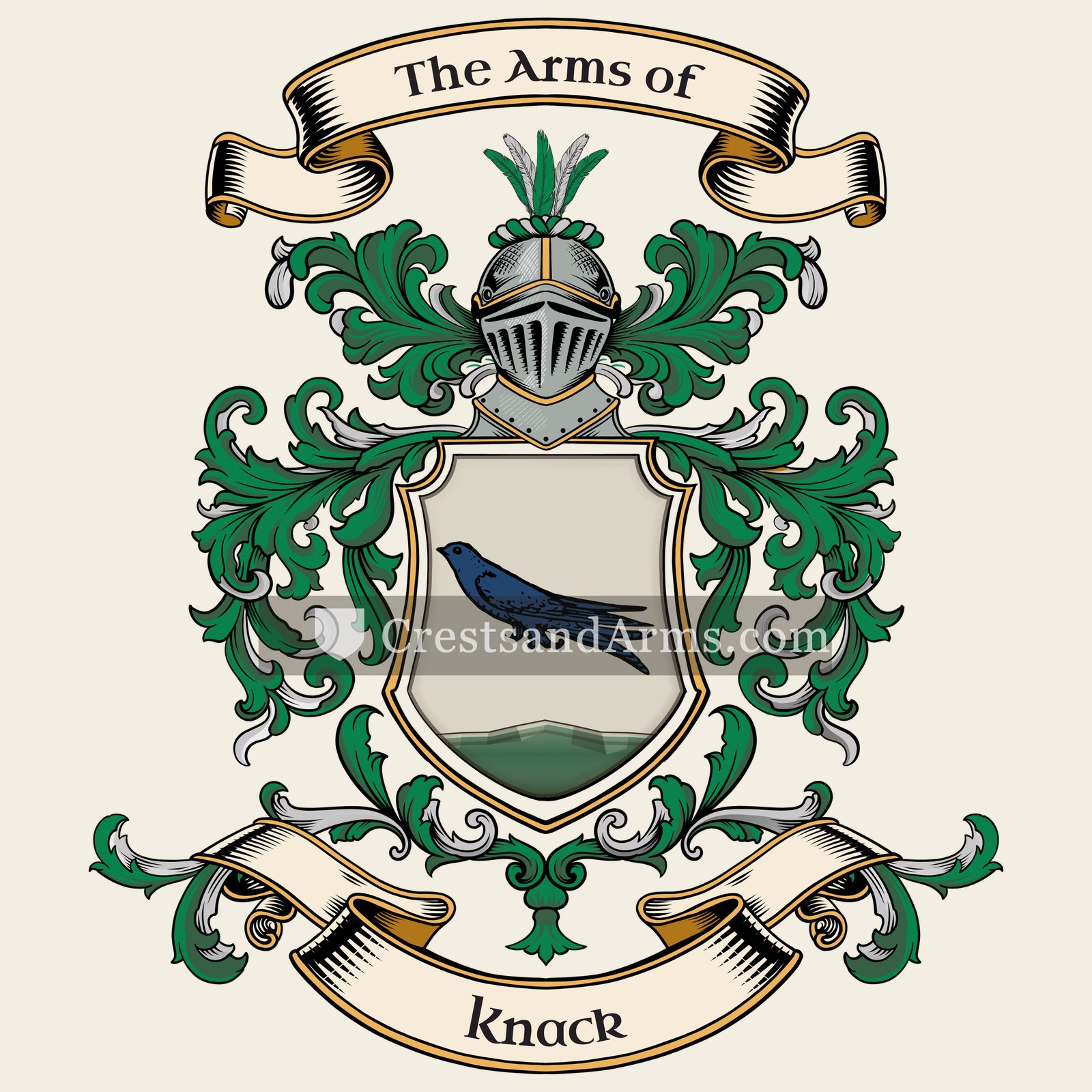
 mountThe ground held, and steadfastness upon it
 martletA younger son, who must win his own land
 mountThe ground held, and steadfastness upon it
 martletA younger son, who must win his own land