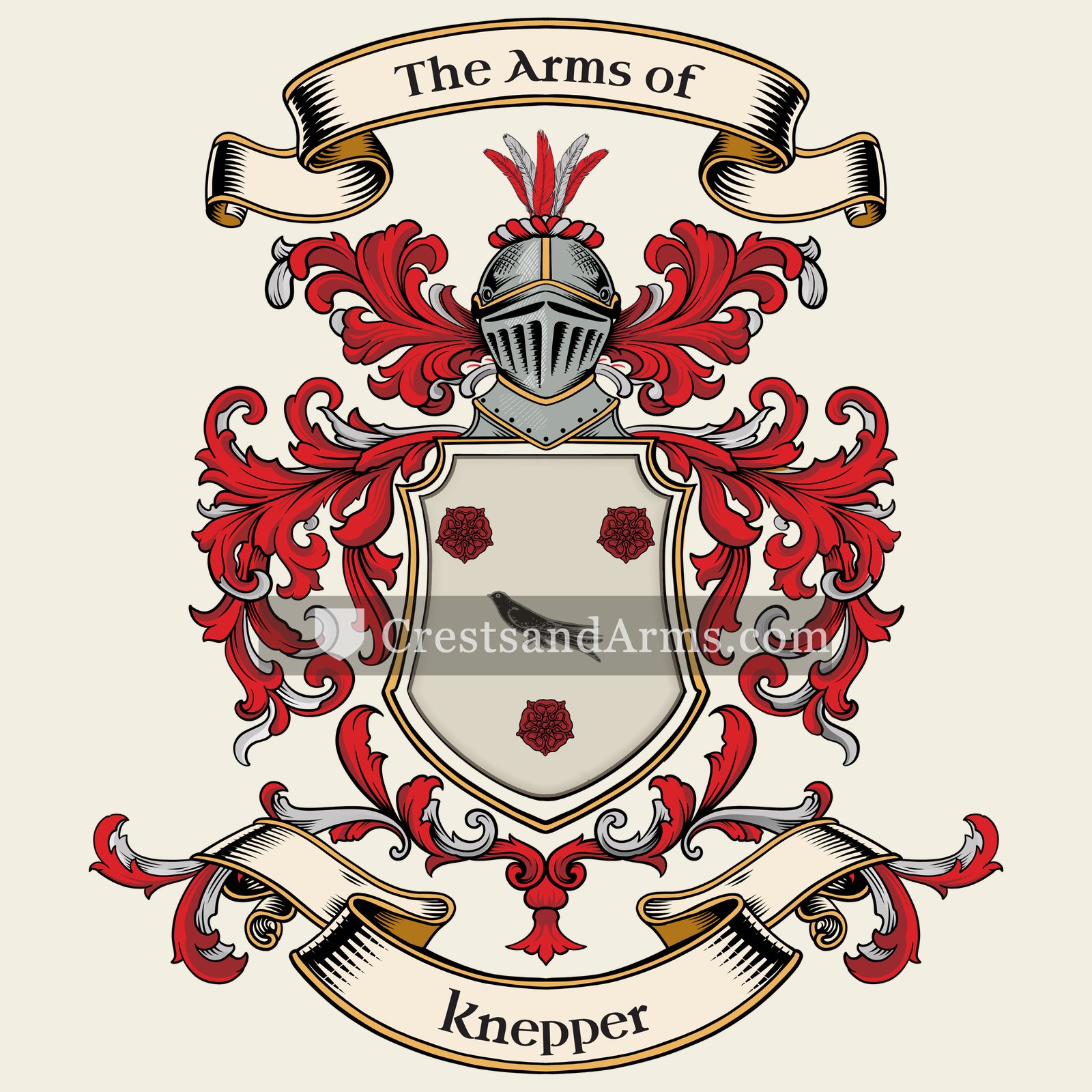
A record of documented arms, meaning and origin, researched for the Knepper family of Belgium.
Reg. 6433 · Belgian, J–L
Coat of Arms & Family Crest Details
Symbols on this shield
martletA younger son, who must win his own land
roseThe seventh son, and beauty with grace
Colours
Silver (Argent)Means: Peace and sincerity
Black (Sable)Means: Constancy
Red (Gules)Means: Military strength
Historical info
Source
J. B. Rietstap, Armorial Général, Gouda: G. B. van Goor Zonen, 1884–87
Blazon (the actual original written record)
“D'arg. à une merlette de sa., acc. de trois roses de gu. Cq. cour. C.: une merlette de sa.; entre un vol, d'arg. et de gu. S.: deux léopards lionnés d'or.”
BelgiumLuxemb, c. 1712
Digital archive packCoat of arms PNG, gold border print PDF, vector SVG and the certificate of authenticity. Sent to your email in minutes.
Map of Belgium showing where the Knepper arms are recorded
The Knepper arms were recorded in Luxemb, c. 1712.
This is where the arms were entered in the register. Families often moved to other parts of the country, so the same name can turn up in more than one region.
The body that granted and recorded arms in Belgium in this period.
Philip V of Spain
Sovereign of the period
Philip V of Spain
1700–1714
Reigning in Belgium when the Knepper arms are first recorded.
How Arms Worked in Belgium
In Belgium, a coat of arms is considered personal property that is passed down through the male line to legitimate descendants. Families often use the same shield design across generations to show their shared heritage. If a branch of the family wants to change the design, they must apply for an official update to their specific version of the arms.
Granting authority
The Conseil héraldique is the official body that regulates and approves all coats of arms in Belgium.
How they got arms
Families obtain their coats of arms through formal royal grants or by confirming their historical right to use existing designs.
Where arms were recorded
All approved coats of arms are officially recorded in the public registers of the Conseil héraldique since 1844.
The family's standing
Recorded among the armigerous families of Belgium.
Origin & History of the Knepper Family in Belgium
The surname Knepper is rooted in the linguistic traditions of the German-speaking regions of Europe, specifically within the areas surrounding the modern borders of Luxembourg and Germany. The name is generally considered an occupational surname, likely derived from the Middle High German word "kneppe," which referred to a button-maker or a craftsman who worked with small fasteners. By the early 18th century, families bearing this name were well-established in the Luxembourgish countryside, where they lived as part of the agrarian and artisan classes. These early ancestors were often documented in local parish registers as they navigated the social and economic shifts of the Holy Roman Empire. Because these families were deeply integrated into their local communities, their history is closely tied to the development of village life and the transition from feudal craftsmanship to more specialized trades in the region.
Related Branches & Arms
Root word
knap
Middle High German term for a young man or servant.
This name
KnepperAn occupational surname for a young assistant, apprentice, or a page.
also spelled
Kneper
Nepper
Documented Sources
J. B. Rietstap, Armorial Général, Gouda: G. B. van Goor Zonen, 1884–87
Heintz, Joseph, Luxemburger Familiennamen, 1993
Kohlheim, Rosa and Volker Kohlheim, Duden Familiennamen: Herkunft und Bedeutung von 20.000 Nachnamen, 2005
Archives nationales de Luxembourg, État civil et registres paroissiaux
Digital archive packCoat of arms PNG, gold border print PDF, vector SVG and the certificate of authenticity. Sent to your email in minutes.


 martletA younger son, who must win his own land
 roseThe seventh son, and beauty with grace
 martletA younger son, who must win his own land
 roseThe seventh son, and beauty with grace