Map of Sweden showing where the Knutson arms are recorded
The Knutson arms were recorded in Sweden, c. 1700.
Arms such as these were typically recorded in Stockholm.
Stockholm held the Swedish court and the House of Nobility, where every noble family's arms were entered and kept. Families ennobled for service registered there, which is why so many are recorded around the city.
This is where the arms were entered in the register. Families often moved to other parts of the country, so the same name can turn up in more than one region.
The body that granted and recorded arms in Sweden in this period.
Carl XII of Sweden
Sovereign of the period
Carl XII of Sweden
1697–1718
Reigning in Sweden when the Knutson arms are first recorded.
How Arms Worked in Sweden
In Sweden, a coat of arms belonged to a noble family as a whole rather than just one individual. These arms were passed down through the generations to all legitimate descendants. Younger branches of the family used the same shield without needing to change it. This system ensured that the entire lineage shared the same identity and status under the law.
Granting authority
The Riddarhuset, or House of Nobility, regulated all noble coats of arms in Sweden under royal authority.
How they got arms
Families received their coats of arms through royal grants of nobility which were then officially registered with the House.
Where arms were recorded
Coats of arms were officially recorded in the Swedish House of Nobility register starting in the year 1626.
The family's standing
Recorded among the armigerous families of Sweden.
Origin & History of the Knutson Family in Sweden
The surname Knutson is a patronymic name, which means it was originally formed by adding "son" to the given name Knut. In the Swedish tradition, this name identifies a person as the son of a man named Knut. By the year 1700, families carrying this name were already established in Stockholm. During this period, Stockholm was a growing center of trade and administration, and individuals with patronymic names often worked as craftsmen, merchants, or laborers within the city walls. Because the name was based on a father’s first name rather than a fixed family title, it was common for the surname to change with each new generation. The presence of the Knutson name in Stockholm records from the early 18th century reflects the transition of many families into urban life during a time of significant social change in the Swedish Empire.
Knutson Meaning & Related Branches
Root word
Knut
Derived from the Old Norse word for knot or node.
This name
KnutsonA patronymic surname meaning son of Knut, signifying a descendant of the knot.
also spelled
Knutsen
Nutson
Documented Sources
J. B. Rietstap, Armorial Général, Gouda: G. B. van Goor Zonen, 1884–87
Otterbjörk, Roland. Svenska förnamn: kortfattat namnlexikon. 1964
Brylla, Eva. Förnamn i Sverige: kortfattat namnlexikon. 2004
Stockholms stadsarkiv, Mantalslängder för Stockholms stad
Riksarkivet, Kyrkoarkiv: Födelse- och dopböcker
Digital archive packCoat of arms PNG, gold border print PDF, vector SVG and the certificate of authenticity. Sent to your email in minutes.


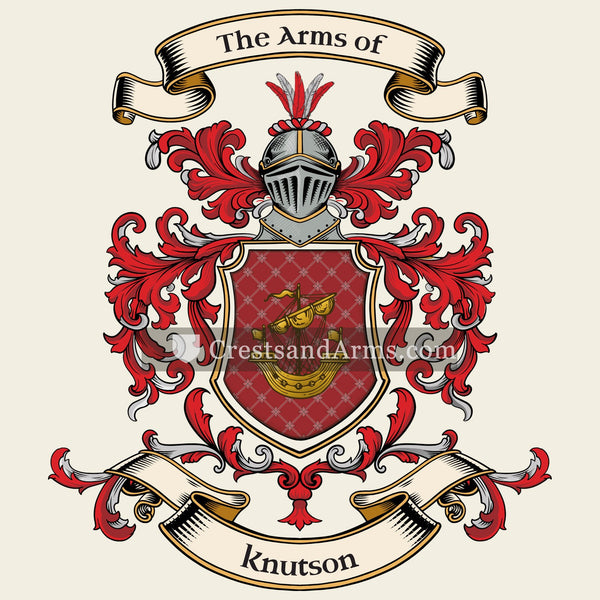
 shipEnterprise, and a great voyage undertaken
 shipEnterprise, and a great voyage undertaken