Map of Sweden showing where the Knutsson arms are recorded
The Knutsson arms were recorded in Sweden, c. 1700.
Arms such as these were typically recorded in Stockholm.
Stockholm held the Swedish court and the House of Nobility, where every noble family's arms were entered and kept. Families ennobled for service registered there, which is why so many are recorded around the city.
This is where the arms were entered in the register. Families often moved to other parts of the country, so the same name can turn up in more than one region.
The body that granted and recorded arms in Sweden in this period.
Carl XII of Sweden
Sovereign of the period
Carl XII of Sweden
1697–1718
Reigning in Sweden when the Knutsson arms are first recorded.
How Arms Worked in Sweden
In Sweden, a coat of arms belonged to a noble family as a whole rather than just one individual. These arms were passed down through the generations to all legitimate descendants. Younger branches of the family used the same shield without needing to change it. This system ensured that the entire lineage shared the same identity and status under the law.
Granting authority
The Riddarhuset, or House of Nobility, regulated all noble coats of arms in Sweden under royal authority.
How they got arms
Families received their coats of arms through royal grants of nobility which were then officially registered with the House.
Where arms were recorded
Coats of arms were officially recorded in the Swedish House of Nobility register starting in the year 1626.
The family's standing
Recorded among the armigerous families of Sweden.
Origin & History of the Knutsson Family in Sweden
The surname Knutsson is a classic example of a patronymic naming system, which was the standard way people identified themselves in Sweden for many centuries. The name literally translates to "son of Knut," indicating that the earliest ancestors to carry this name were defined by their father’s given name. By the year 1700, the family was well-established in Stockholm, a city that was rapidly growing into a major center of trade and government during the Swedish Empire. During this era, families living in the capital often worked as skilled craftsmen, merchants, or civil servants who helped maintain the city's infrastructure. Because surnames like Knutsson were not strictly hereditary at the time, individuals often adopted them to show their lineage within the tight-knit urban communities of old Stockholm. This practice created a lasting link between the family name and the historical development of the Swedish capital.
Knutsson Meaning & Related Branches
Root word
Knut
Derived from the Old Norse word for knot.
This name
KnutssonA patronymic surname meaning the son of Knut.
also spelled
Knutsen
Nutson
Documented Sources
J. B. Rietstap, Armorial Général, Gouda: G. B. van Goor Zonen, 1884–87
Otterbjörk, Roland. Svenska förnamn: Kortfattat namnlexikon. 1964
Wilk, Stephen. Svenska släktnamn: Deras ursprung och utbredning. 1998
Stockholm City Archives (Stockholms stadsarkiv), Mantalslängder för Stockholms stad
Digital archive packCoat of arms PNG, gold border print PDF, vector SVG and the certificate of authenticity. Sent to your email in minutes.


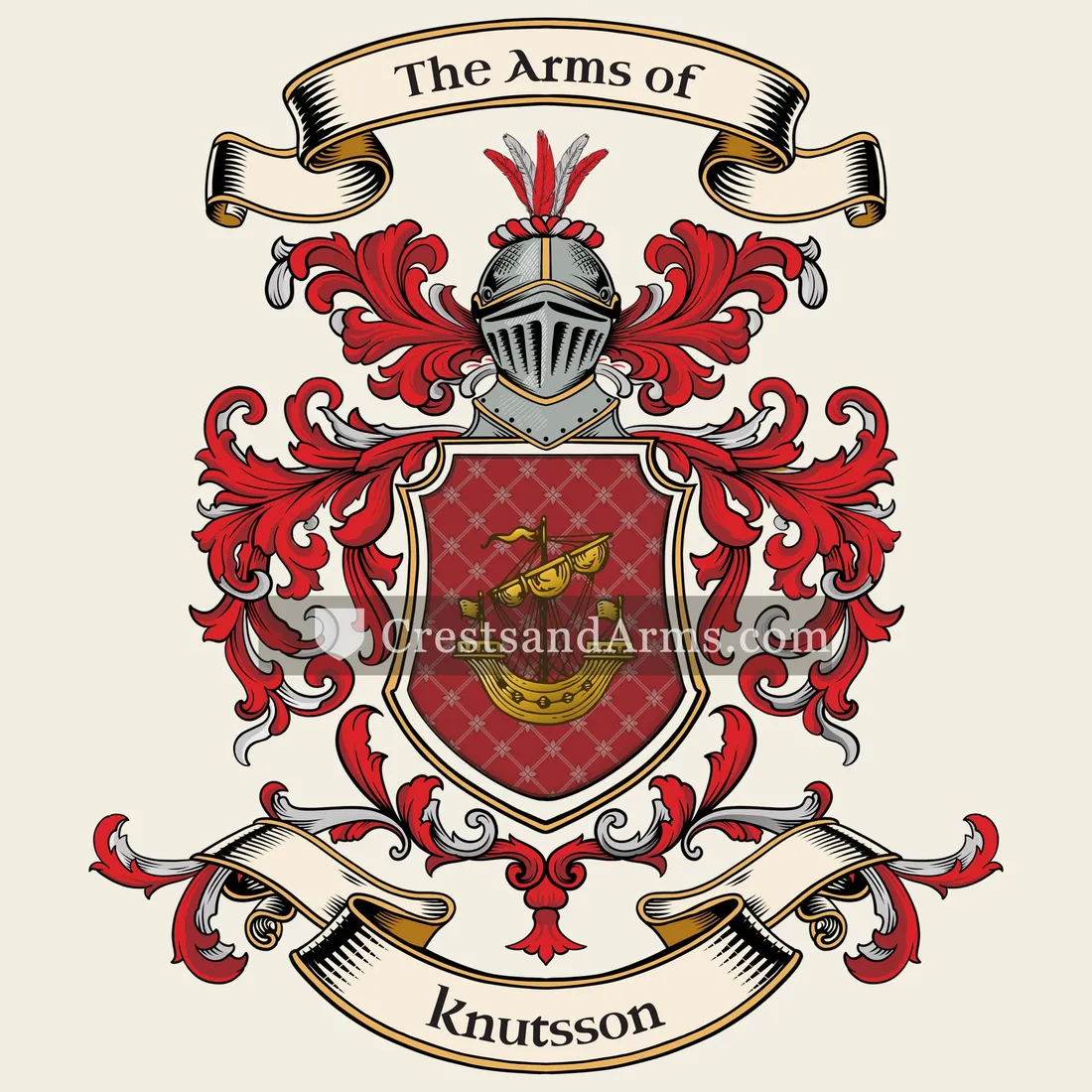
 shipEnterprise, and a great voyage undertaken
 shipEnterprise, and a great voyage undertaken