Map of Sweden showing where the Koenig arms are recorded
The Koenig arms were recorded in Sweden, c. 1582.
Arms such as these were typically recorded in Stockholm.
Stockholm held the Swedish court and the House of Nobility, where every noble family's arms were entered and kept. Families ennobled for service registered there, which is why so many are recorded around the city.
This is where the arms were entered in the register. Families often moved to other parts of the country, so the same name can turn up in more than one region.
The body that granted and recorded arms in Sweden in this period.
John III of Sweden
Sovereign of the period
John III of Sweden
1568–1592
Reigning in Sweden when the Koenig arms are first recorded.
How Arms Worked in Sweden
In Sweden, a coat of arms belonged to a noble family as a whole rather than just one individual. These arms were passed down through the generations to all legitimate descendants. Younger branches of the family used the same shield without needing to change it. This system ensured that the entire lineage shared the same identity and status under the law.
Granting authority
The Riddarhuset, or House of Nobility, regulated all noble coats of arms in Sweden under royal authority.
How they got arms
Families received their coats of arms through royal grants of nobility which were then officially registered with the House.
Where arms were recorded
Coats of arms were officially recorded in the Swedish House of Nobility register starting in the year 1626.
The family's standing
Recorded among the armigerous families of Sweden.
Origin & History of the Koenig Family in Sweden
The family name Koenig carries a deep connection to the administrative and social growth of Stockholm during the late sixteenth century. By 1582, records confirm that members of the family were already established within the city, a time when Sweden was transitioning into a major European power under the Vasa dynasty. Because the name is derived from the Germanic word for king, it often identified individuals who served in official capacities or held positions of trust within the royal bureaucracy. Living in Stockholm during this era meant the family was likely involved in the bustling trade networks or the expanding government offices that defined the capital. As the city grew from a medieval town into a political center, the Koenig family became part of the urban fabric that supported the crown and helped shape the early modern Swedish state.
Coat of Arms & Family Crest Details
Symbols on this shield
mountThe ground held, and steadfastness upon it
knightChivalry and service in arms
swordJustice, and military honour
Colours
Blue (Azure)Means: Loyalty and truth
Green (Vert)Means: Hope
Gold (Or)Means: Generosity
Silver (Argent)Means: Peace and sincerity
Historical info
Source
J. B. Rietstap, Armorial Général, Gouda: G. B. van Goor Zonen, 1884–87
Blazon (the actual original written record)
“D'azur à un roi d'or, cour. du meme, ceint d'une toile aux bouts flottants d'arg., posé, les jambes écartées, sur un tertre de sin., les mains levées, tenant de sa main dextre une épée d'arg., gar-”
BavariaBavaria, c. 1531
Digital archive packCoat of arms PNG, gold border print PDF, vector SVG and the certificate of authenticity. Sent to your email in minutes.
Map of Germany showing where the Koenig arms are recorded
The Koenig arms were recorded in Bavaria, c. 1531.
Bavaria was a country of old landed families and walled market towns. Estates passed down the same line for centuries, and both the landowners and the leading townsmen kept arms, which is why so many Bavarian names sit in the registers.
This is where the arms were entered in the register. Families often moved to other parts of the country, so the same name can turn up in more than one region.
The body that granted and recorded arms in Germany in this period.
Charles V
Sovereign of the period
Charles V
1519–1556
Reigning in Sweden when the Koenig arms are first recorded.
How Arms Worked in Germany
In the Holy Roman Empire, coats of arms were often granted to individuals by the Emperor or his representatives. These arms were then passed down through the generations to all legitimate descendants of the original holder. Younger branches of a family usually kept the same shield design without needing to change it, as the arms belonged to the entire lineage.
Granting authority
The Holy Roman Emperor held the sole power to grant new coats of arms throughout his vast imperial territories.
How they got arms
Families typically obtained their coats of arms through a formal imperial grant or by proving their noble status to the authorities.
Where arms were recorded
These grants were officially recorded in the Imperial Chancery registers, which began keeping formal records of such honors during the Middle Ages.
The family's standing
Recorded among the armigerous families of Bavaria.
Origin & History of the Koenig Family in Germany
The surname Koenig, which translates to king in German, originated as a descriptive nickname or a title-based occupational name during the Middle Ages. In the German-speaking regions, such names were often given to individuals who played the role of a king in local festivals or to those who served in the household of a royal figure. By the time the name appears in Bavarian records in 1531, it was already well-established as a hereditary surname within the region. During this period, the family likely lived in a society structured by strict social hierarchies where surnames helped officials track tax obligations and land ownership. The presence of the Koenig family in Bavaria suggests they were part of a settled community that valued record-keeping, as the transition from simple first names to permanent family names became increasingly necessary for legal and administrative purposes in the sixteenth century.
Coat of Arms & Family Crest Details
Symbols on this shield
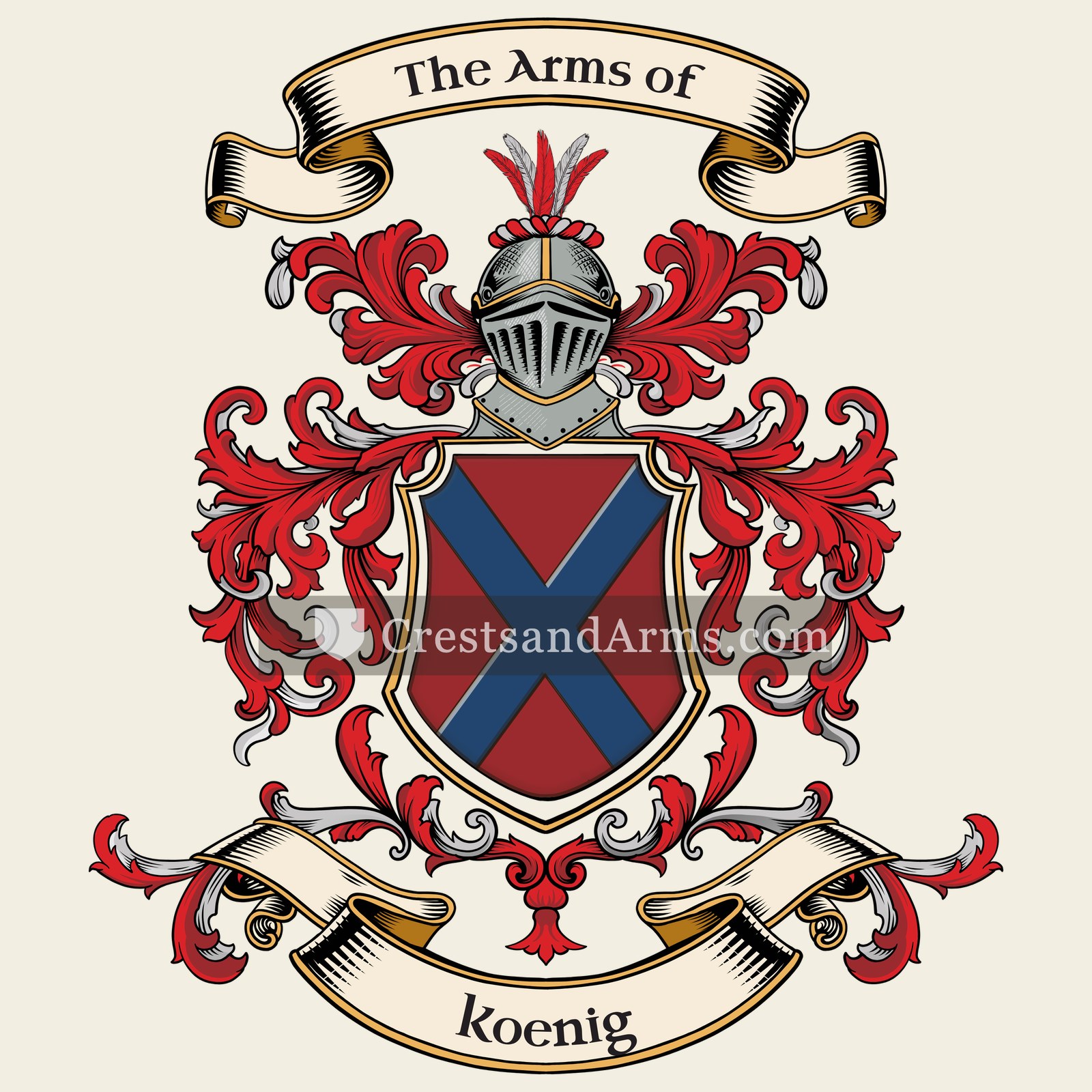
saltireResolution, and St Andrew's cross
Colours
Red (Gules)Means: Military strength
Blue (Azure)Means: Loyalty and truth
Historical info
Source
J. B. Rietstap, Armorial Général, Gouda: G. B. van Goor Zonen, 1884–87
Blazon (the actual original written record)
“De gu. au saut. d'azur. Cq. cour. C.: un buste d'homme barbu, hab. aux armes de l'écu, cour. d'or. L. de gu. et d'azur.”
SwitzerlandBâle, c. 1745
Digital archive packCoat of arms PNG, gold border print PDF, vector SVG and the certificate of authenticity. Sent to your email in minutes.
Map of Switzerland showing where the Koenig arms are recorded
The Koenig arms were recorded in Bâle, c. 1745.
This is where the arms were entered in the register. Families often moved to other parts of the country, so the same name can turn up in more than one region.
The body that granted and recorded arms in Switzerland in this period.
How Arms Worked in Switzerland
In Switzerland, coats of arms were not restricted to the nobility and were often adopted by common citizens and families. These symbols were passed down through generations to show family identity. When branches of a family grew, they often changed small details of the design to distinguish their own line from the original group.
Granting authority
Cantonal and civic authorities managed the use of coats of arms within their specific regions and local jurisdictions.
How they got arms
Families typically assumed their own coats of arms based on local custom rather than receiving them from a central monarch.
Where arms were recorded
Arms were recorded in various cantonal and civic registers starting from the fourteenth century throughout the Swiss region.
The family's standing
Recorded among the armigerous families of Switzerland.
Origin & History of the Koenig Family in Switzerland
The surname Koenig traces its roots back to the Germanic word for king, often serving as a descriptive nickname for a person who acted with authority or perhaps played the role of a king in local festivals. By the time the family established a documented presence in Basel in 1745, they were already part of a long tradition of families bearing this name across the German-speaking regions of Switzerland. In the social structure of eighteenth-century Basel, families like the Koenigs were often integrated into the city’s active mercantile and civic life. They lived in a period of significant transition where the city served as a major crossroads for trade and intellectual exchange. Because Basel was a hub for printing and commerce, the family likely benefited from the city’s reputation for stability and economic opportunity. Their presence in the city records during this era reflects a broader movement of families who settled in Swiss urban centers to participate in the growing professional classes of the Enlightenment period.
Related Branches & Arms
Root word
kuningaz
Proto-Germanic term for a tribal leader or king.
This name
KoenigA status-based occupational surname denoting a person who served the king or held royal authority.
also spelled
Koenig
King
Documented Sources
J. B. Rietstap, Armorial Général, Gouda: G. B. van Goor Zonen, 1884–87
Lundkvist, Sven, Gustav Vasa och Europa: Svensk handels- och utrikespolitik 1534–1557, 1960
Nilsson, Sven A., På väg mot militärstaten: Krigsbefälets etablering i den äldre Vasatidens Sverige, 1989
Stockholm City Archives (Stockholms stadsarkiv), Tänkeböcker från Stockholms rådhusrätt
Digital archive packCoat of arms PNG, gold border print PDF, vector SVG and the certificate of authenticity. Sent to your email in minutes.


 chevronProtection, and faithful service completed
 martletA younger son, who must win his own land
 sceptreRoyal authority and justice
 chevronProtection, and faithful service completed
 martletA younger son, who must win his own land
 sceptreRoyal authority and justice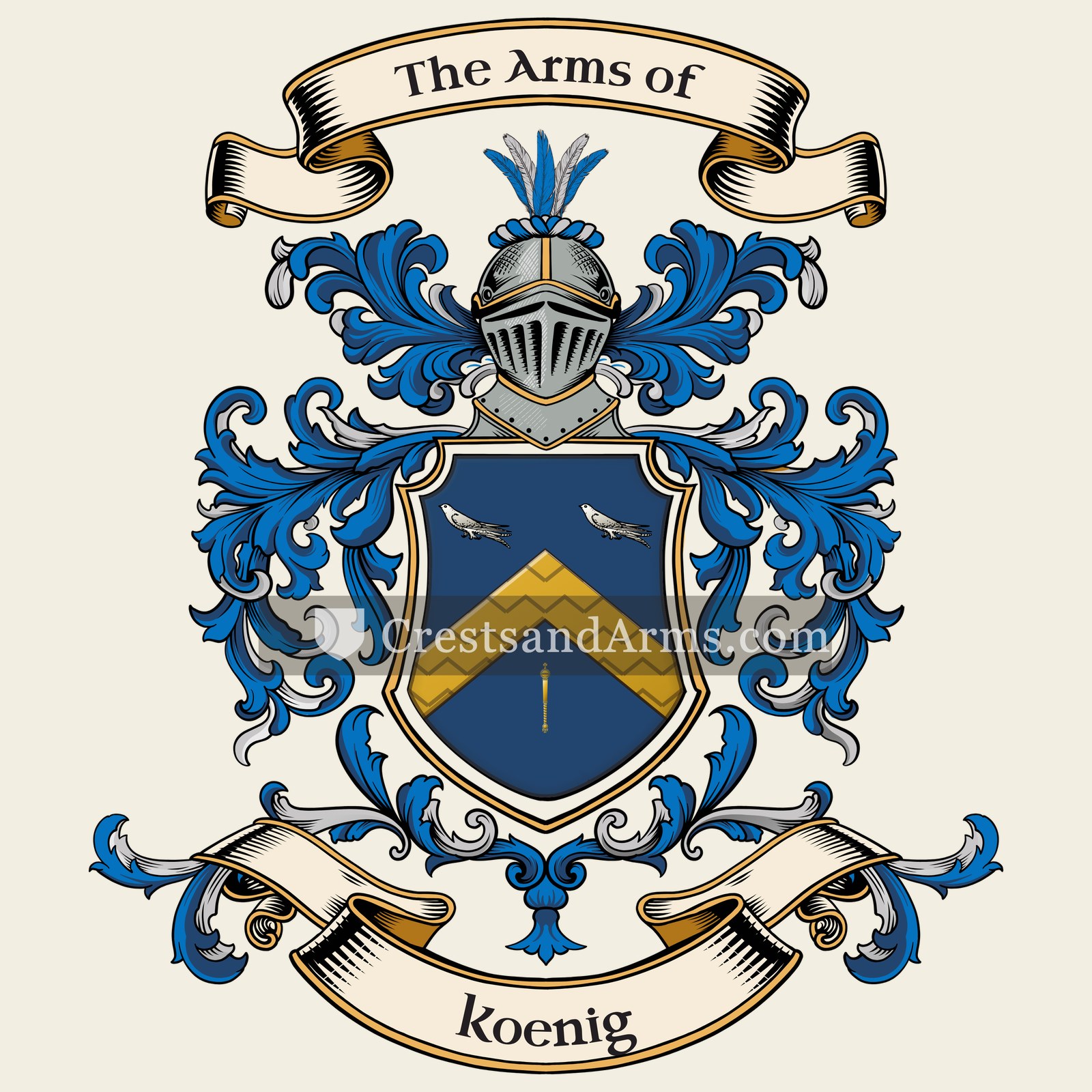


 mountThe ground held, and steadfastness upon it
 knightChivalry and service in arms
 swordJustice, and military honour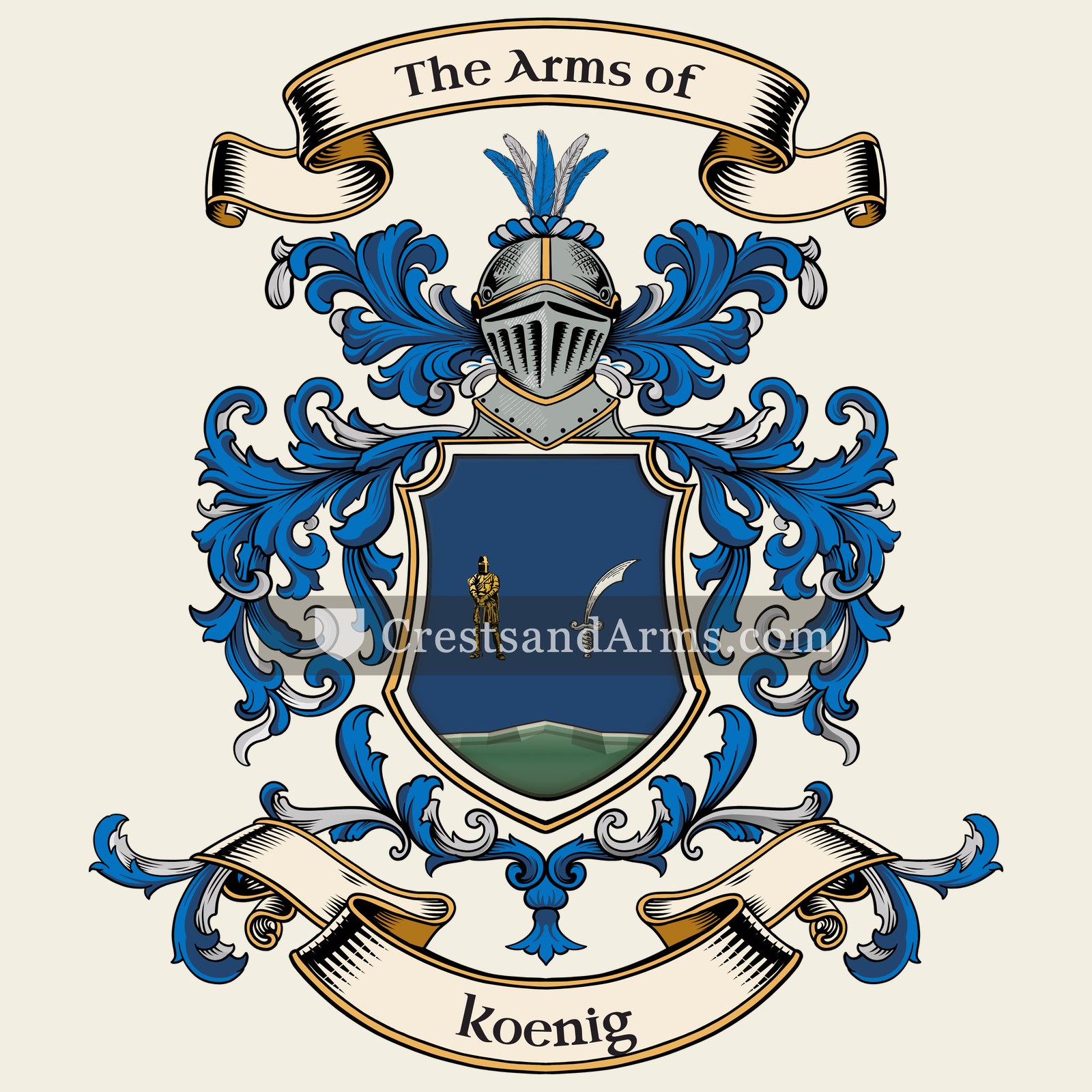


 saltireResolution, and St Andrew's cross