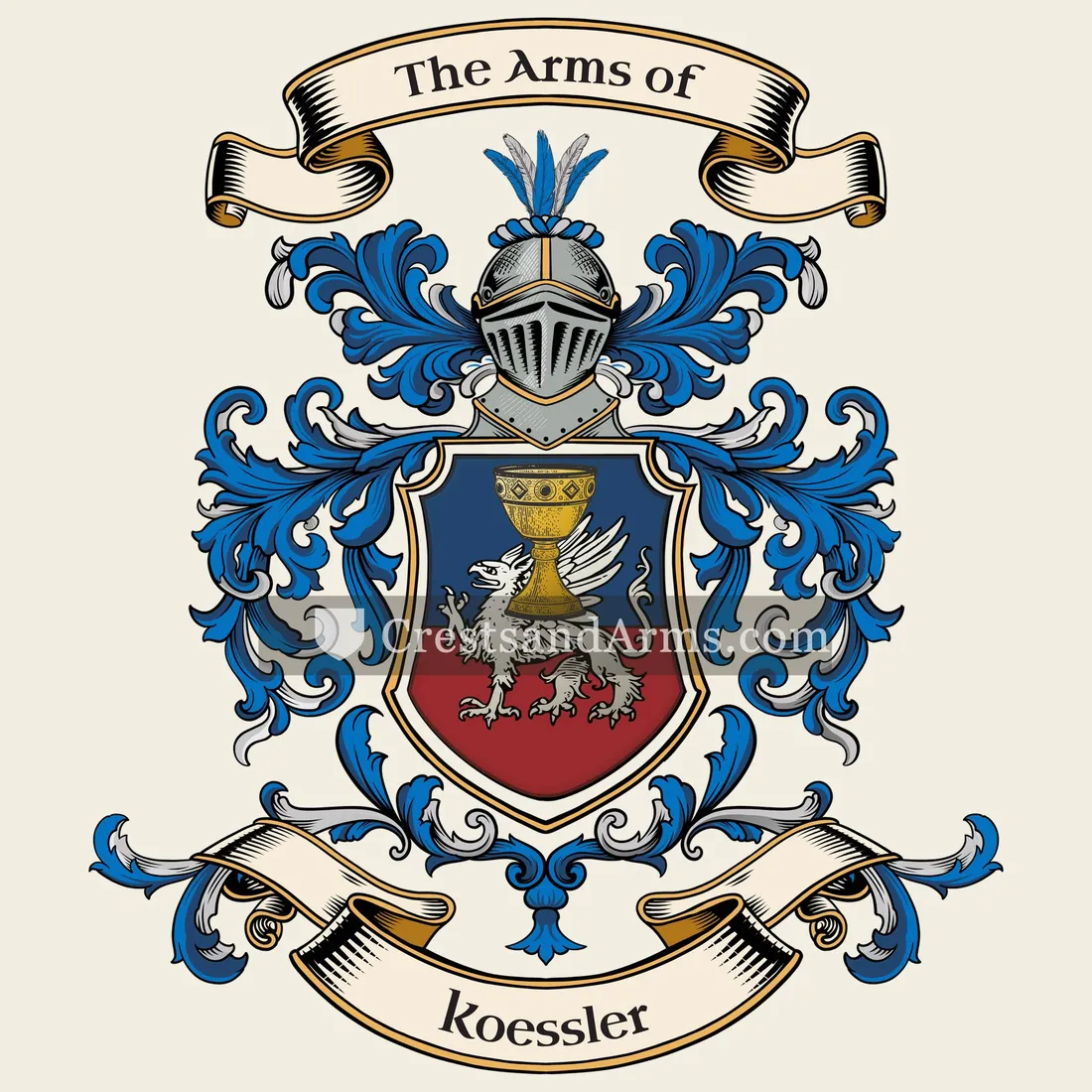
A record of documented arms, meaning and origin, researched for the Koessler family lines. Documented in 2 countries.
Reg. 0344 · German, J–L
Meaning of the Koessler family crest colors & symbols
Symbols on this shield
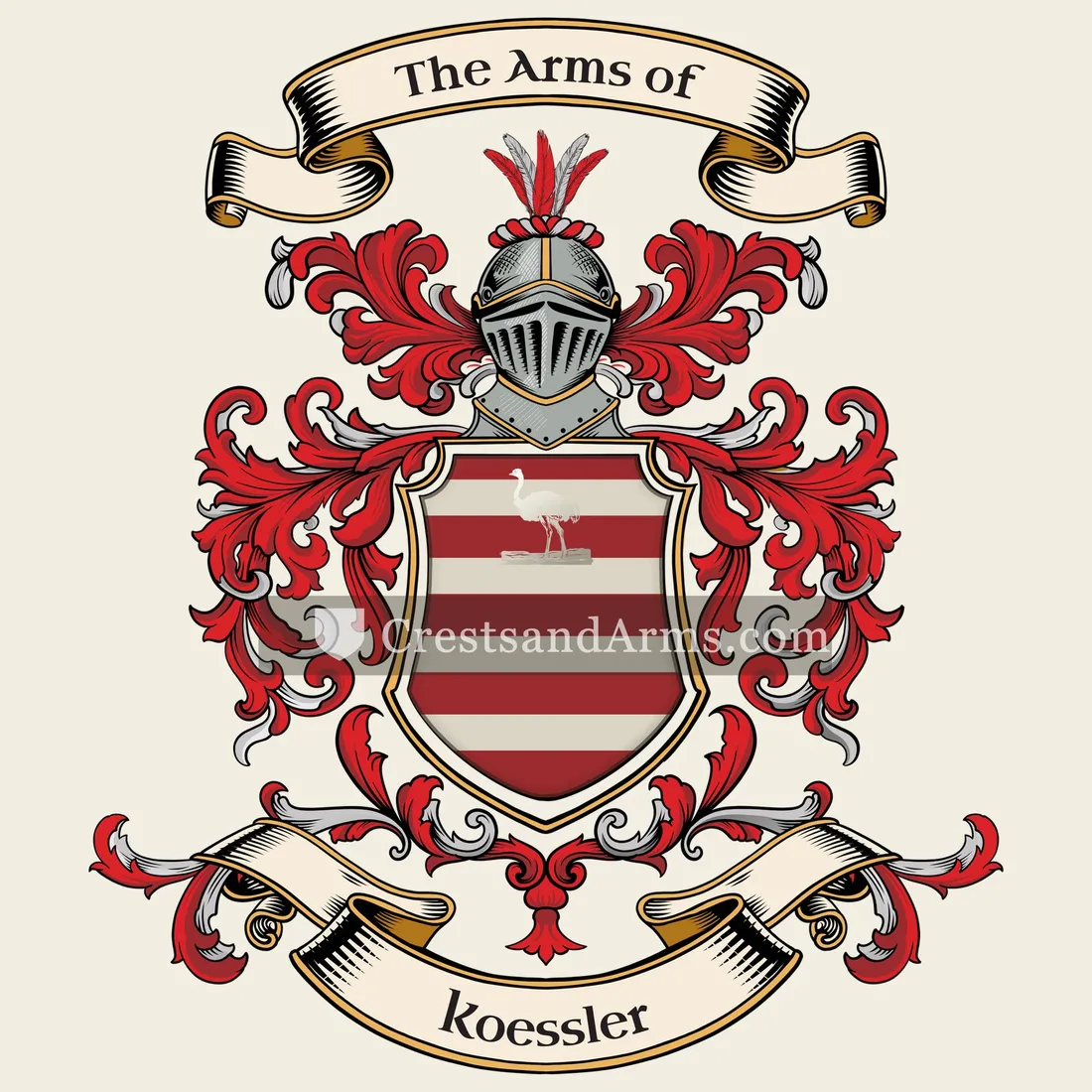
ostrichWilling obedience and serious thought
Colours
Red (Gules)Means: Military strength
Silver (Argent)Means: Peace and sincerity
Historical info
Source
J. B. Rietstap, Armorial Général, Gouda: G. B. van Goor Zonen, 1884–87
Blazon (the actual original written record)
“De gu. à quatre burèles d'arg.; à une autruche du même, br. sur le tout, tenant en son bec un fer-à-cheval d'or. C.: une pl. d'aut. d'arg., entre un vol de gu., chaque aile ch. de deux burèles d'arg.”
SilesiaSilesia, c. 1534
Digital archive packCoat of arms PNG, gold border print PDF, vector SVG and the certificate of authenticity. Sent to your email in minutes.
Map of Germany showing where the Koessler arms are recorded
The Koessler arms were recorded in Silesia, c. 1534.
Silesia was farming country in the east of the German lands, held in large estates by families who stayed put for generations. Owning land was what entitled a family to arms, so the region fills a good deal of the register.
This is where the arms were entered in the register. Families often moved to other parts of the country, so the same name can turn up in more than one region.
The body that granted and recorded arms in Germany in this period.
Charles V
Sovereign of the period
Charles V
1519–1556
Reigning in Germany when the Koessler arms are first recorded.
How Arms Worked in Germany
In the Holy Roman Empire, coats of arms were often granted to individuals by the Emperor or his representatives. These arms were then passed down through the generations to all legitimate descendants of the original holder. Younger branches of a family usually kept the same shield design without needing to change it, as the arms belonged to the entire lineage.
Granting authority
The Holy Roman Emperor held the sole power to grant new coats of arms throughout his vast imperial territories.
How they got arms
Families typically obtained their coats of arms through a formal imperial grant or by proving their noble status to the authorities.
Where arms were recorded
These grants were officially recorded in the Imperial Chancery registers, which began keeping formal records of such honors during the Middle Ages.
The family's standing
Recorded among the armigerous families of Silesia.
Origin & History of the Koessler Family in Germany
The surname Koessler originated in the German-speaking regions of Central Europe as a descriptive occupational name. It is derived from the Middle High German word "kessel," which translates to kettle or cauldron. This suggests that the earliest ancestors bearing this name were likely coppersmiths or metalsmiths who specialized in crafting large cooking vessels. By the sixteenth century, the family had established a notable presence in the region of Silesia. Historical records confirm that members of the Koessler family were living in this area as early as 1534. During this period, Silesia was a vibrant center of trade and craftsmanship, providing a logical environment for families associated with metalworking to thrive. As the family grew, they moved across different German territories, carrying their trade and their name into new communities throughout the Holy Roman Empire.
Meaning of the Koessler family crest colors & symbols
Symbols on this shield
griffinValour and vigilance, guarding great treasure
cupFaith, office, and a trust discharged
Colours
Blue (Azure)Means: Loyalty and truth
Red (Gules)Means: Military strength
Silver (Argent)Means: Peace and sincerity
Gold (Or)Means: Generosity
Historical info
Source
J. B. Rietstap, Armorial Général, Gouda: G. B. van Goor Zonen, 1884–87
Blazon (the actual original written record)
“Coupé d'azur sur gu., au griffon d'arg., br. sur le coupé, tenant de sa patte dextre une grappe de raisins au nat. et acc. en p. à dextre d'un chaudron sans cornière d'or, rempli de grappes de raisins au nat. C.: le griffon, iss. L.: à dextre d'arg. et d'azur, à sen. d'arg. et de gu.”
Austriac. 1772
Digital archive packCoat of arms PNG, gold border print PDF, vector SVG and the certificate of authenticity. Sent to your email in minutes.
Map of Austria showing where the Koessler arms are recorded
The Koessler arms were recorded in Austria, c. 1772.
Arms such as these were typically recorded in Tyrol.
Tyrol was mountain country in western Austria, where the valleys were held by families who had been there a very long time. Old tenure counted for more than money, and old families carried arms.
This is where the arms were entered in the register. Families often moved to other parts of the country, so the same name can turn up in more than one region.
Region
Tyrol
First recorded
1772
Granting Authority for the Koessler Arms
Imperial and Royal chancery
Sodacan · CC BY-SA 3.0
The body that granted and recorded arms in Austria in this period.
Joseph II, Holy Roman Emperor
Sovereign of the period
Joseph II, Holy Roman Emperor
1765–1790
Reigning in Germany when the Koessler arms are first recorded.
How Arms Worked in Austria
Austrian coats of arms were often linked directly to noble titles granted by the Emperor. These symbols belonged to the entire family line rather than just one individual. When a family grew, new branches kept the original design without needing to change it. This system allowed all members of a noble house to share the same identity across many generations.
Granting authority
The Imperial and Royal chancery managed all heraldic matters and controlled the official granting of arms throughout the Austrian lands.
How they got arms
Families typically received their arms through a formal imperial decree that often accompanied the elevation of a person to noble status.
Where arms were recorded
Official records of these grants were kept in the Imperial Register of Nobility which began its formal documentation process in 1453.
The family's standing
Recorded among the armigerous families of Austria.
Origin & History of the Koessler Family in Austria
The family name Koessler traces its roots back to the mountainous landscapes of Tyrol, Austria, where it emerged as a topographical surname. In the German language, the name is derived from the word "Kessel," which refers to a deep, bowl-shaped valley or a mountain basin. This suggests that the earliest members of the family likely lived near or within these distinct geological features, which are common throughout the Tyrolean Alps. By the time official records confirm their presence in the region in 1772, the family had already established deep ties to the local agricultural and rural communities. Life in these high-altitude valleys required great resilience, and the name became a marker of those who navigated the challenging terrain of Western Austria. Over generations, the Koessler name moved from being a simple description of a person's home to a permanent family identifier that persisted as families settled into the villages and towns of the Austrian countryside.
Koessler Meaning & Related Branches
Root word
Kessel
A kettle or a deep valley basin.
This name
KoesslerAn occupational name for a maker or seller of kettles and metal vessels.
also spelled
Kosler
Documented Sources
J. B. Rietstap, Armorial Général, Gouda: G. B. van Goor Zonen, 1884–87
Bahlow, Hans. Deutsches Namenlexikon: Familien- und Vornamen nach Ursprung und Sinn erklärt. 1967
Heintze, Albert. Die deutschen Familien-Namen: geschichtlich, geographisch, sprachlich. 1903
State Archive in Wroclaw (Archiwum Państwowe we Wrocławiu), Akta miasta Wrocławia (Records of the city of Breslau/Wrocław)
Digital archive packCoat of arms PNG, gold border print PDF, vector SVG and the certificate of authenticity. Sent to your email in minutes.


 ostrichWilling obedience and serious thought
 ostrichWilling obedience and serious thought


 griffinValour and vigilance, guarding great treasure
 cupFaith, office, and a trust discharged