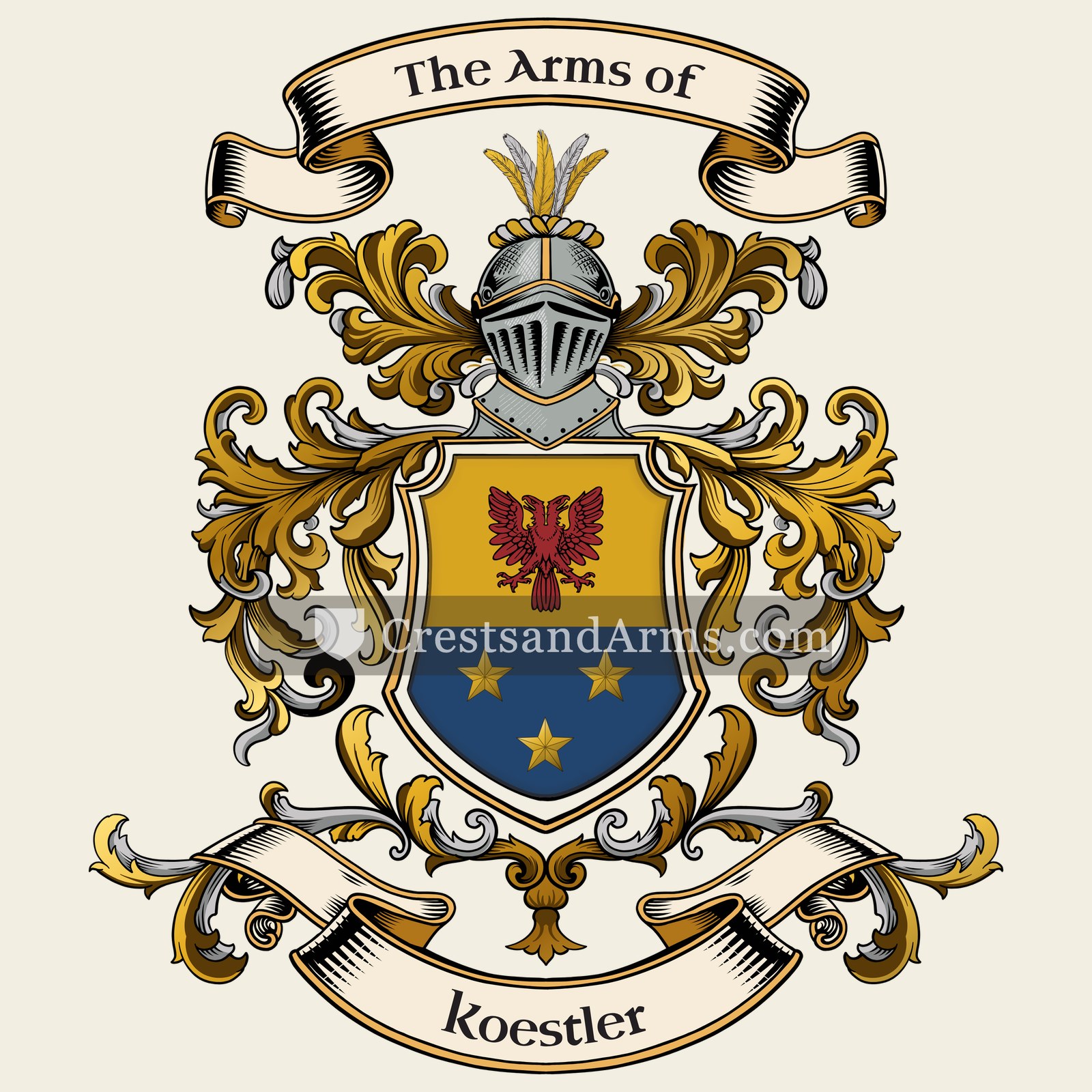
A record of documented arms, meaning and origin, researched for the Koestler family of Germany.
Reg. 7046 · German, J–L
Coat of Arms & Family Crest Details
Symbols on this shield
eagleNobility, strength and a keen mind
mulletThe third son, and a divine quality from above
Colours
Gold (Or)Means: Generosity
Blue (Azure)Means: Loyalty and truth
Red (Gules)Means: Military strength
Historical info
Source
J. B. Rietstap, Armorial Général, Gouda: G. B. van Goor Zonen, 1884–87
Blazon (the actual original written record)
“Coupé: au 1 d'or à l'aigle de gu.; au 2 d'azur à trois étoiles d'or. Cq. cour. C.: l'aigle, la tête sommée d'une étoile d'or; entre un vol coupé d'or sur azur, chaque aile ch. d'une étoile d'or sur l'azur. L.: à dextre d'or et de gu., à sen. d'or et d'azur.”
Germanyc. 1792
Digital archive packCoat of arms PNG, gold border print PDF, vector SVG and the certificate of authenticity. Sent to your email in minutes.
Map of Germany showing where the Koestler arms are recorded
The Koestler arms were recorded in Germany, c. 1792.
Arms such as these were typically recorded in Bavaria.
Bavaria was a country of old landed families and walled market towns. Estates passed down the same line for centuries, and both the landowners and the leading townsmen kept arms, which is why so many Bavarian names sit in the registers.
This is where the arms were entered in the register. Families often moved to other parts of the country, so the same name can turn up in more than one region.
The body that granted and recorded arms in Germany in this period.
Leopold II, Holy Roman Emperor
Sovereign of the period
Leopold II, Holy Roman Emperor
1790–1792
Reigning in Germany when the Koestler arms are first recorded.
How Arms Worked in Germany
In the Holy Roman Empire, coats of arms were often granted to individuals by the Emperor or his representatives. These arms were then passed down through the generations to all legitimate descendants of the original holder. Younger branches of a family usually kept the same shield design without needing to change it, as the arms belonged to the entire lineage.
Granting authority
The Holy Roman Emperor held the sole power to grant new coats of arms throughout his vast imperial territories.
How they got arms
Families typically obtained their coats of arms through a formal imperial grant or by proving their noble status to the authorities.
Where arms were recorded
These grants were officially recorded in the Imperial Chancery registers, which began keeping formal records of such honors during the Middle Ages.
The family's standing
Recorded among the armigerous families of Germany.
Origin & History of the Koestler Family in Germany
The surname Koestler originates from the German-speaking regions of Central Europe, specifically emerging as a descriptive occupational name. The root of the word is linked to the Middle High German term "koste," which often referred to a person who managed provisions, acted as a food steward, or worked in a kitchen. By the time members of the family were documented in Bavaria in 1792, the name had become well-established among the local population. During this period, the family likely lived as part of the agrarian or artisan classes that defined the Bavarian landscape. As the name spread through the region, it evolved in spelling based on local dialects, eventually settling into the form recognized today. These early ancestors were part of a society transitioning through the late eighteenth century, where family names became essential for tracking tax records, church registrations, and community roles within the Bavarian state.
Related Branches & Arms
Root word
Köstler
A person who makes or sells cheese.
This name
KoestlerAn occupational surname for a cheesemaker or a merchant dealing in dairy products.
also spelled
Koestler
Documented Sources
J. B. Rietstap, Armorial Général, Gouda: G. B. van Goor Zonen, 1884–87
Bahlow, Hans, Deutsches Namenlexikon: Familien- und Vornamen nach Ursprung und Sinn erklärt, 1967


 eagleNobility, strength and a keen mind
 mulletThe third son, and a divine quality from above
 eagleNobility, strength and a keen mind
 mulletThe third son, and a divine quality from above