Map of Germany showing where the Kofler arms are recorded
The Kofler arms were recorded in Germany, c. 1765.
Arms such as these were typically recorded in Bavaria.
Bavaria was a country of old landed families and walled market towns. Estates passed down the same line for centuries, and both the landowners and the leading townsmen kept arms, which is why so many Bavarian names sit in the registers.
This is where the arms were entered in the register. Families often moved to other parts of the country, so the same name can turn up in more than one region.
The body that granted and recorded arms in Germany in this period.
Francis I, Holy Roman Emperor
Sovereign of the period
Francis I, Holy Roman Emperor
1745–1765
Reigning in Germany when the Kofler arms are first recorded.
How Arms Worked in Germany
In the Holy Roman Empire, coats of arms were often granted to individuals by the Emperor or his representatives. These arms were then passed down through the generations to all legitimate descendants of the original holder. Younger branches of a family usually kept the same shield design without needing to change it, as the arms belonged to the entire lineage.
Granting authority
The Holy Roman Emperor held the sole power to grant new coats of arms throughout his vast imperial territories.
How they got arms
Families typically obtained their coats of arms through a formal imperial grant or by proving their noble status to the authorities.
Where arms were recorded
These grants were officially recorded in the Imperial Chancery registers, which began keeping formal records of such honors during the Middle Ages.
The family's standing
Recorded among the armigerous families of Germany.
Origin & History of the Kofler Family in Germany
The family name Kofler originates from the mountainous regions of southern Germany and the neighboring Tyrol area. The name is topographic, meaning it was derived from the geographical features where the earliest ancestors lived. In the German language, the word Kofel refers to a sharp, rocky peak or a rounded mountain summit. People who lived near these distinct landmarks began to be identified by their location, eventually adopting the name as a permanent family identifier. By 1765, records confirm that members of the Kofler family were well-established in Bavaria. During this period, the family was likely integrated into the rural agricultural society of the region, where they worked the land near the foothills of the Alps. This connection to the landscape defined their identity for generations, linking their surname directly to the rugged terrain of their homeland.
Coat of Arms & Family Crest Details
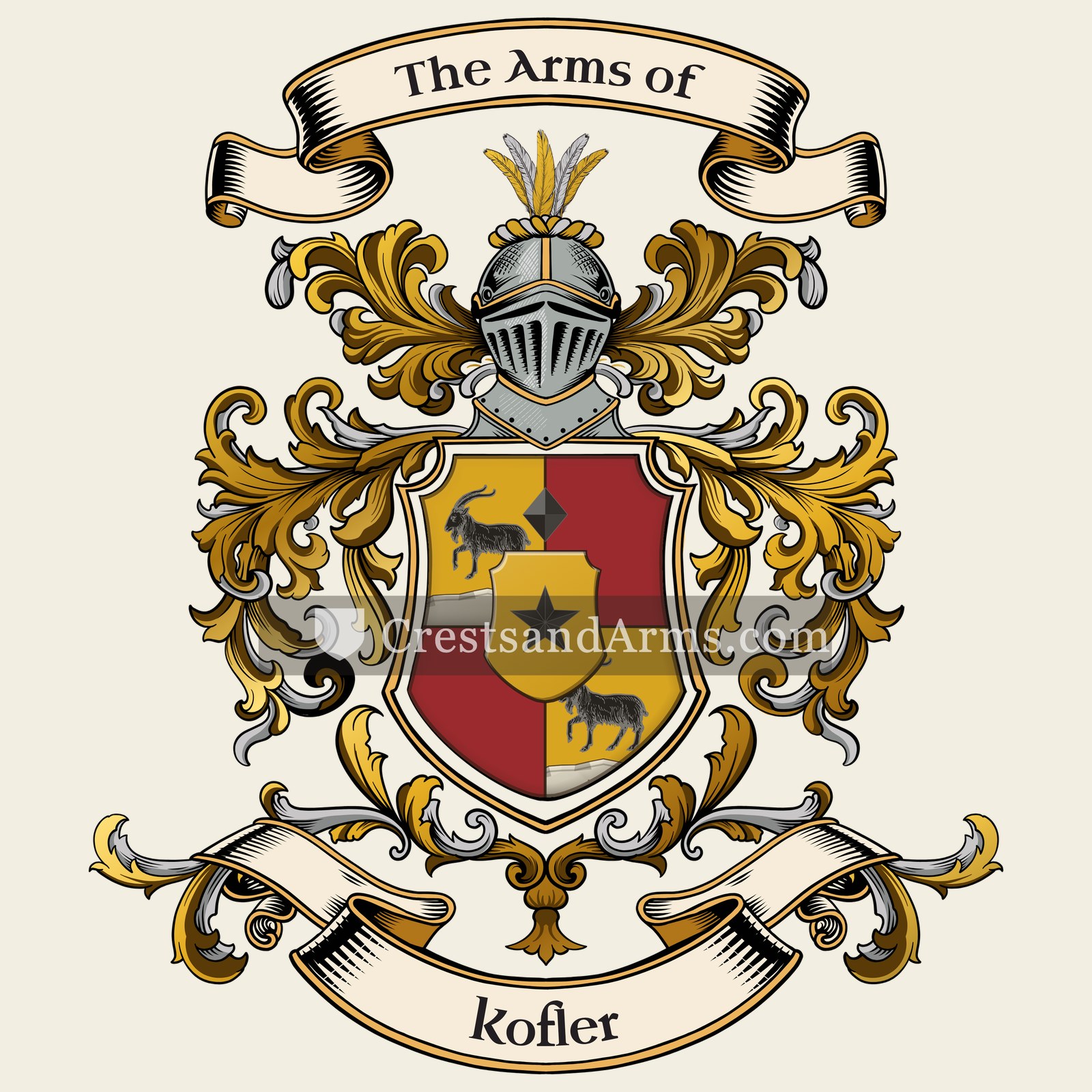
Symbols on this shield
mountThe ground held, and steadfastness upon it
lozengeHonour and nobility, and the arms of a woman
mulletThe third son, and a divine quality from above
goatOne who wins by diplomacy rather than force
Colours
Gold (Or)Means: Generosity
Red (Gules)Means: Military strength
Silver (Argent)Means: Peace and sincerity
Black (Sable)Means: Constancy
Historical info
Source
J. B. Rietstap, Armorial Général, Gouda: G. B. van Goor Zonen, 1884–87
Blazon (the actual original written record)
“Ec.: aux 1 et 4 d'or à un bouquetin de sa., pass. sur un tertre d'arg.; aux 2 et 3 parti de gu. et d'arg.; à une grande los. de sa., ch. d'une étoile d'or et touchant les bords du quartier. Sur le tout d'or à l'aigle de sa. Cq. cour. C.: un bouquetin iss. de de sa. entre un vol coupé alt. de gu. et d'arg., chaque aile ch. de la los. du 2. L.: à dextre d'or et de sa., à sen. d'arg. et de gu.”
StyriaStyria, c. 1772
Digital archive packCoat of arms PNG, gold border print PDF, vector SVG and the certificate of authenticity. Sent to your email in minutes.
Map of Austria showing where the Kofler arms are recorded
The Kofler arms were recorded in Styria, c. 1772.
Styria was mountain and forest country in southern Austria, with iron in its hills. Mining and landholding both made money, and families who held either kind of property took arms to seal their papers with.
This is where the arms were entered in the register. Families often moved to other parts of the country, so the same name can turn up in more than one region.
Region
Styria
First recorded
1772
Granting Authority for the Kofler Arms
Imperial and Royal chancery
Sodacan · CC BY-SA 3.0
The body that granted and recorded arms in Austria in this period.
Joseph II, Holy Roman Emperor
Sovereign of the period
Joseph II, Holy Roman Emperor
1765–1790
Reigning in Germany when the Kofler arms are first recorded.
How Arms Worked in Austria
Austrian coats of arms were often linked directly to noble titles granted by the Emperor. These symbols belonged to the entire family line rather than just one individual. When a family grew, new branches kept the original design without needing to change it. This system allowed all members of a noble house to share the same identity across many generations.
Granting authority
The Imperial and Royal chancery managed all heraldic matters and controlled the official granting of arms throughout the Austrian lands.
How they got arms
Families typically received their arms through a formal imperial decree that often accompanied the elevation of a person to noble status.
Where arms were recorded
Official records of these grants were kept in the Imperial Register of Nobility which began its formal documentation process in 1453.
The family's standing
Recorded among the armigerous families of Styria.
Origin & History of the Kofler Family in Austria
The family name Kofler is deeply rooted in the Alpine regions of Austria, where it originated as a topographic surname. In the German language, the name is derived from the word "Kofel," which refers to a rocky peak or a rounded mountain summit. Early members of the family likely lived near or on these distinct geographical features, leading their neighbors to identify them by their location. By the time the family was documented in Styria in 1772, they were already part of a long-standing tradition of mountain-dwelling communities. These early Koflers were often farmers or foresters who adapted to the rugged terrain of the Austrian landscape. Over many generations, the name transitioned from a simple description of a person’s home into a permanent family identifier that spread across the various provinces of the Austrian Empire.
Related Branches & Arms
Root word
Kofel
A mountain peak or a steep, rocky hill.
This name
KoflerRefers to someone who lived near a prominent mountain peak or rocky outcrop.
also spelled
Koflere
Koflerr
Koflerh
Koflerre
Koffler
Related arms
Köflllervariant spelling
Documented Sources
J. B. Rietstap, Armorial Général, Gouda: G. B. van Goor Zonen, 1884–87
Kohlheim, Rosa and Volker Kohlheim. Duden Familiennamen: Herkunft und Bedeutung von 20.000 Nachnamen. 2005


 unicornPurity, and extreme courage in defence of honour
 unicornPurity, and extreme courage in defence of honour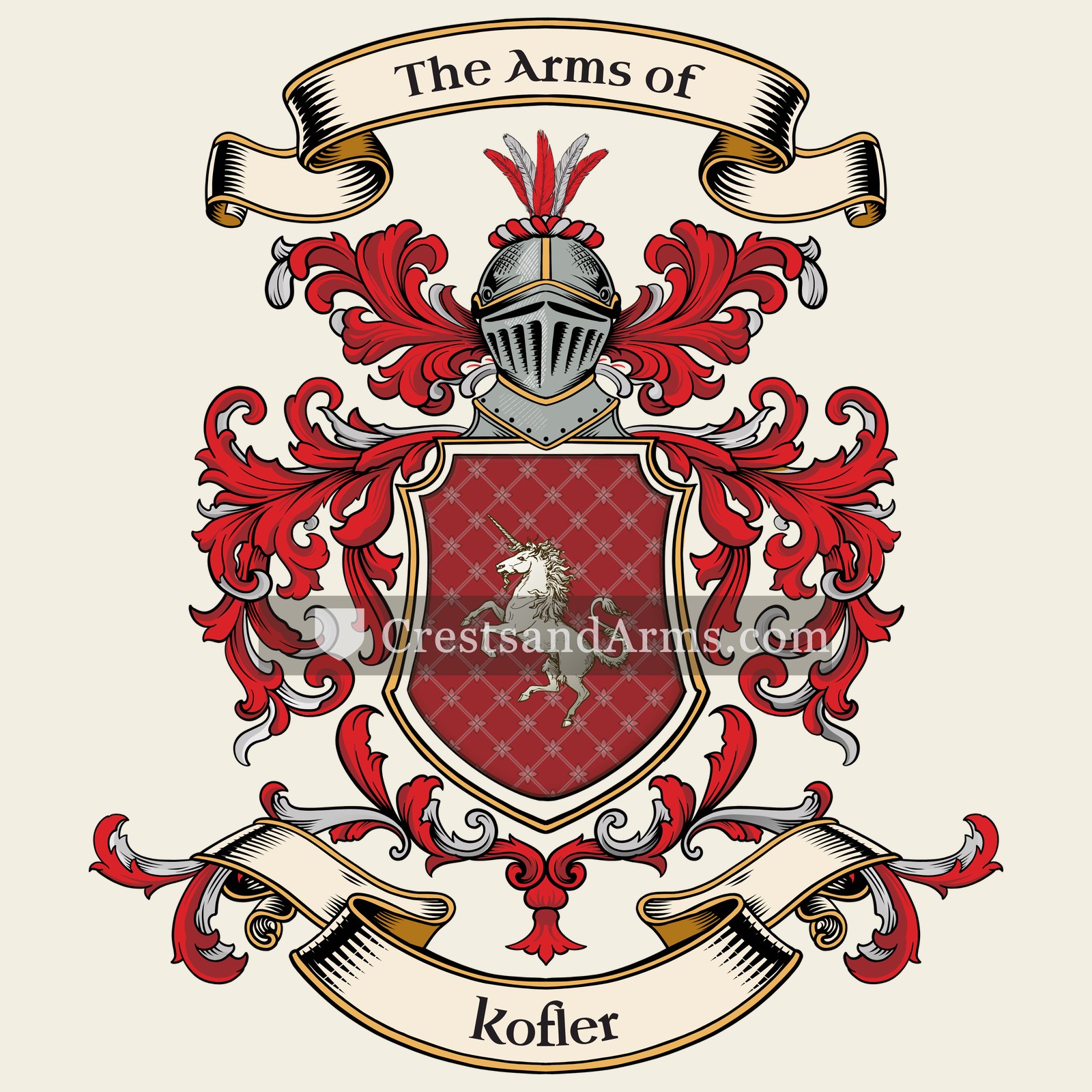


 mountThe ground held, and steadfastness upon it
 lozengeHonour and nobility, and the arms of a woman
 mulletThe third son, and a divine quality from above
 goatOne who wins by diplomacy rather than force