A record of documented arms, meaning and origin, researched for the Köhler family lines. Documented in 3 countries.
Reg. 7504 · German, J–L
Coat of Arms & Family Crest Details
Symbols on this shield
fessThe military belt, and readiness to serve
cramponFirm hold on what has been gained
Colours
Red (Gules)Means: Military strength
Gold (Or)Means: Generosity
Silver (Argent)Means: Peace and sincerity
Historical info
Source
J. B. Rietstap, Armorial Général, Gouda: G. B. van Goor Zonen, 1884–87
Blazon (the actual original written record)
“Parti: au 1 de gu. à trois crampons d'arg.; au 2 d'or à trois fasces de sa. Cq. cour. C.: un vol d'arg. L.: à dextre d'arg. et de gu., à sen. d'or et de sa.”
Germanyc. 1735
Digital archive packCoat of arms PNG, gold border print PDF, vector SVG and the certificate of authenticity. Sent to your email in minutes.
Map of Germany showing where the Köhler arms are recorded
The Köhler arms were recorded in Germany, c. 1735.
Arms such as these were typically recorded in Bavaria.
Bavaria was a country of old landed families and walled market towns. Estates passed down the same line for centuries, and both the landowners and the leading townsmen kept arms, which is why so many Bavarian names sit in the registers.
This is where the arms were entered in the register. Families often moved to other parts of the country, so the same name can turn up in more than one region.
The body that granted and recorded arms in Germany in this period.
Charles VI, Holy Roman Emperor
Sovereign of the period
Charles VI, Holy Roman Emperor
1711–1740
Reigning in Germany when the Köhler arms are first recorded.
How Arms Worked in Germany
In the Holy Roman Empire, coats of arms were often granted to individuals by the Emperor or his representatives. These arms were then passed down through the generations to all legitimate descendants of the original holder. Younger branches of a family usually kept the same shield design without needing to change it, as the arms belonged to the entire lineage.
Granting authority
The Holy Roman Emperor held the sole power to grant new coats of arms throughout his vast imperial territories.
How they got arms
Families typically obtained their coats of arms through a formal imperial grant or by proving their noble status to the authorities.
Where arms were recorded
These grants were officially recorded in the Imperial Chancery registers, which began keeping formal records of such honors during the Middle Ages.
The family's standing
Recorded among the armigerous families of Germany.
Origin & History of the Köhler Family in Germany
The surname Köhler is a classic example of an occupational name that emerged from the dense forests of medieval Germany. It is derived from the Middle High German word *koler*, which refers to a charcoal burner. In the centuries before modern industrialization, these individuals played a vital role in the economy by heating wood in oxygen-deprived pits to create charcoal, a fuel source essential for blacksmiths and metalworkers. By the time your ancestors were documented in Bavaria in 1735, the name had become well-established across German-speaking lands as families settled into these specialized forest trades. Because charcoal production required living near timber sources, families with this name were often found in rural, wooded regions where they maintained a steady and necessary connection to the local iron and steel industries. Over generations, the name transitioned from a simple job description into a permanent family identifier that tracked the movement of skilled laborers across the German countryside.
Coat of Arms & Family Crest Details
Symbols on this shield
saltireResolution, and St Andrew's cross
chevronProtection, and faithful service completed
lionCourage, strength and royalty
mulletThe third son, and a divine quality from above
swordJustice, and military honour
horseReadiness to serve king and country
Colours
Red (Gules)Means: Military strength
Silver (Argent)Means: Peace and sincerity
Gold (Or)Means: Generosity
Blue (Azure)Means: Loyalty and truth
Black (Sable)Means: Constancy
Historical info
Source
J. B. Rietstap, Armorial Général, Gouda: G. B. van Goor Zonen, 1884–87
Blazon (the actual original written record)
“Ec.: au 1 de gu. au lion d'or, supp. de sa patte dextre une molette d'arg.; au 2 d'arg. à une épée d'azur, garnie d'or, et deux bannières passées en saut., br. sur l'épée; celle à dextre d'azur, bordée d'or et attachée à une lance du même; celle à sen. d'azur sans bord. et attachée à une pique d'or; au 3 d'arg. à un charbonnier, hab. de sa., coiffé d'un chapeau du même, tenant une épée d'arg., monté sur un cheval galopant de sa., houssé de gu., bridé et sanglé d'arg.; au 4 d'azur au lion d'or, tenant de ses pattes un tube de canon d'arg., en barre. Sur le tout coupé: a. d'or à un charbonnier iss., mouv. du coupé, hab. de sa., coiffé d'un chapeau du même, tenant un brandon de sa.; b. de sa. au chev. d'or, ch. de deux brandons du champ. Deux cq. cour. C.: 1° trois plumes de paon au nat., entre un vol coupé, à dextre d'or sur sa., à sen. de gu. sur arg.; l. d'or et d'azur; 2° un lion iss. d'or, tenant une bannière d'azur, attachée à une pique d'or: l. d'or et de gu. S.: à dextre un lion d'or, à sen. un griffon du même.”
Polandc. 1719
Digital archive packCoat of arms PNG, gold border print PDF, vector SVG and the certificate of authenticity. Sent to your email in minutes.
Map of Poland showing where the Köhler arms are recorded
The Köhler arms were recorded in Poland, c. 1719.
Arms such as these were typically recorded in Mazovia.
Mazovia held Warsaw, the Polish court and the assemblies where the szlachta met. Poland's nobles were unusually numerous and every one of them bore arms, and Warsaw is where those arms were argued over and recorded.
This is where the arms were entered in the register. Families often moved to other parts of the country, so the same name can turn up in more than one region.
Region
Mazovia
First recorded
1719
Granting Authority for the Köhler Arms
Ennoblement by the Sejm
Author: Olek Remesz · CC BY-SA 3.0
The body that granted and recorded arms in Poland in this period.
Augustus II the Strong
Sovereign of the period
Augustus II the Strong
1709–1733
Reigning in Germany when the Köhler arms are first recorded.
How Arms Worked in Poland
Polish noble families shared a single coat of arms across many different surnames, creating large clans rather than individual designs. These symbols were held collectively by all members of the clan regardless of their specific family name. When a new family joined the nobility, they were adopted into an existing clan and began using that group's established shield.
Granting authority
The Sejm, which was the Polish parliament, held the power to grant noble status and the right to bear arms.
How they got arms
Families typically received their coat of arms through a formal act of ennoblement granted by the Sejm for distinguished service.
Where arms were recorded
These grants were officially recorded in the Crown Metrica, which served as the central archive for state documents starting in the sixteenth century.
The family's standing
Recorded among the armigerous families of Poland.
Origin & History of the Köhler Family in Poland
The surname Köhler originates from the German word for a charcoal burner, reflecting the historical profession of ancestors who lived near forests and produced fuel for iron smelting or heating. By the early eighteenth century, members of the Köhler family had established a presence in the Mazovia region of Poland. This migration was part of a broader movement of skilled tradespeople and settlers who moved eastward into Polish lands to help develop local industries and agriculture. Living in Mazovia, these families often integrated into the local social structure while maintaining their distinct occupational identity. Over time, the name became embedded in the local records of the region, marking the transition of the family from itinerant workers in the woods to settled residents of the Polish countryside.
Coat of Arms & Family Crest Details
Symbols on this shield
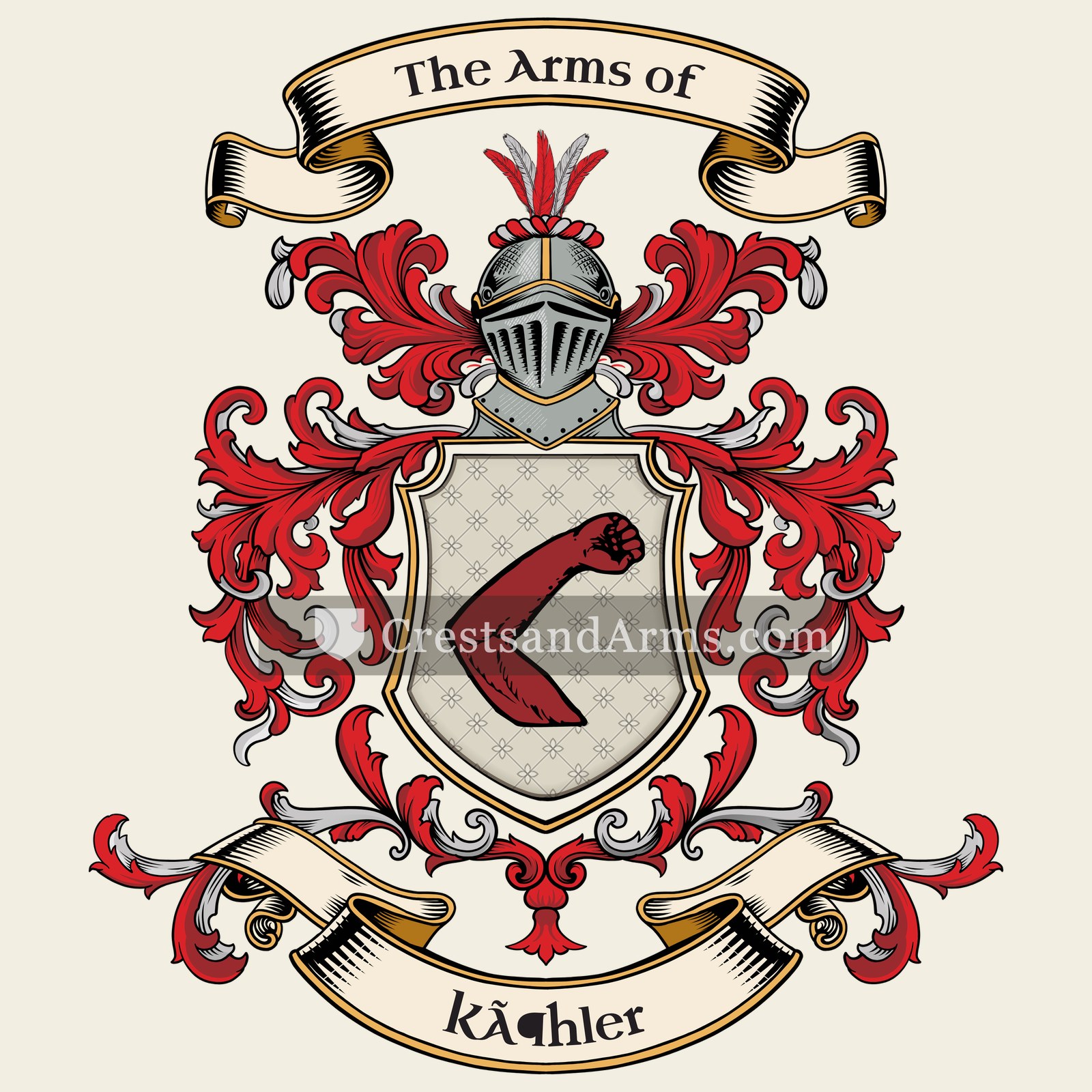
armA person of action, industrious and laborious
Colours
Silver (Argent)Means: Peace and sincerity
Red (Gules)Means: Military strength
Historical info
Source
J. B. Rietstap, Armorial Général, Gouda: G. B. van Goor Zonen, 1884–87
Blazon (the actual original written record)
“D'arg. à un senestrochère, paré de gu., mouv. du flanc, la main de carn. tenant un trèfle de sin. C.: un garçon iss., hab. de gu., tenant de chaque main un trèfle de sin.”
SwitzerlandBerne, c. 1745
Digital archive packCoat of arms PNG, gold border print PDF, vector SVG and the certificate of authenticity. Sent to your email in minutes.
Map of Switzerland showing where the Köhler arms are recorded
The Köhler arms were recorded in Berne, c. 1745.
This is where the arms were entered in the register. Families often moved to other parts of the country, so the same name can turn up in more than one region.
The body that granted and recorded arms in Switzerland in this period.
How Arms Worked in Switzerland
In Switzerland, coats of arms were not restricted to the nobility and were often adopted by common citizens and families. These symbols were passed down through generations to show family identity. When branches of a family grew, they often changed small details of the design to distinguish their own line from the original group.
Granting authority
Cantonal and civic authorities managed the use of coats of arms within their specific regions and local jurisdictions.
How they got arms
Families typically assumed their own coats of arms based on local custom rather than receiving them from a central monarch.
Where arms were recorded
Arms were recorded in various cantonal and civic registers starting from the fourteenth century throughout the Swiss region.
The family's standing
Recorded among the armigerous families of Switzerland.
Origin & History of the Köhler Family in Switzerland
The surname Köhler is an occupational name that originated from the Middle High German word *koler*, which refers to a charcoal burner. In the dense forests of medieval Europe, these individuals were essential members of society because they produced the charcoal needed for iron smelting and heating. By the time members of the Köhler family were documented in Berne in 1745, the name had been established for centuries across German-speaking regions. In the Swiss context, families with this name often settled in areas where forestry and metalworking were vital to the local economy. As the family integrated into the life of Berne during the mid-18th century, they became part of a long tradition of skilled laborers who helped sustain the growing urban centers of the Swiss Confederation. Over generations, the name evolved from a simple job description into a permanent family identity that reflected the hard work and practical skills of their ancestors.
Related Branches & Arms
Root word
Kohle
A solid carbonaceous material used as fuel.
This name
KöhlerAn occupational surname for a charcoal burner or a coal merchant.
also spelled
Koler
Kehler
Coler
Related arms
Arquolesisimilar arms
Avenentisimilar arms
Buduasimilar arms
Cölervariant spelling
Documented Sources
J. B. Rietstap, Armorial Général, Gouda: G. B. van Goor Zonen, 1884–87
Bahlow, Hans, Deutsches Namenlexikon: Familien- und Vornamen nach Ursprung und Sinn erklärt, 1967
Heintze, Albert, Die deutschen Familiennamen: geschichtlich, geographisch, sprachlich, 1903


 fessThe military belt, and readiness to serve
 cramponFirm hold on what has been gained
 fessThe military belt, and readiness to serve
 cramponFirm hold on what has been gained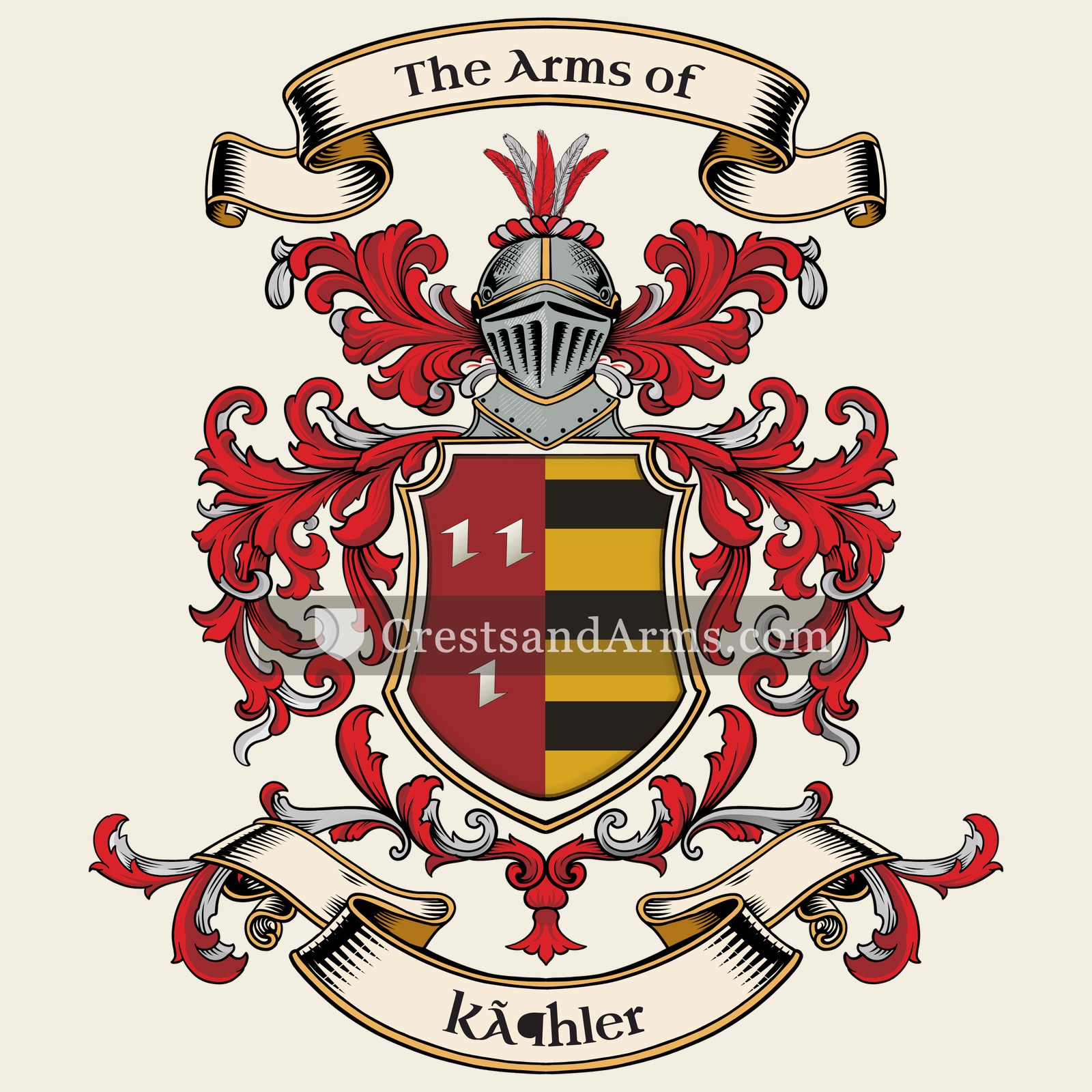


 saltireResolution, and St Andrew's cross
 chevronProtection, and faithful service completed
 lionCourage, strength and royalty
 mulletThe third son, and a divine quality from above
 swordJustice, and military honour
 horseReadiness to serve king and country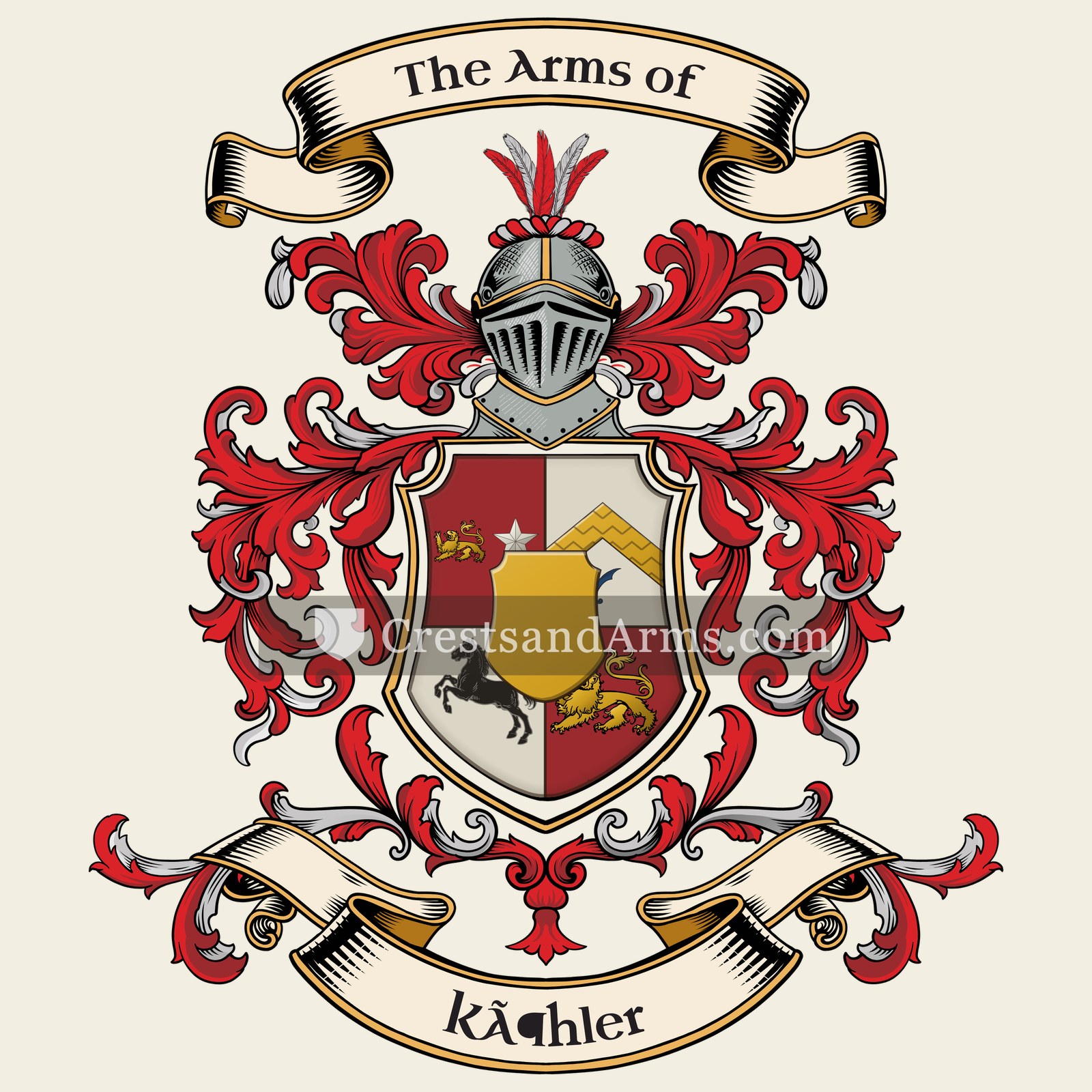


 armA person of action, industrious and laborious