A record of documented arms, meaning and origin, researched for the Kok family lines. Documented in 2 countries.
Reg. 0714 · German, J–L
Coat of Arms & Family Crest Details
Symbols on this shield
saltireResolution, and St Andrew's cross
eagleNobility, strength and a keen mind
lanceKnightly service and the tilt
stagPeace and harmony, and one who will not fight unprovoked
Colours
Red (Gules)Means: Military strength
Silver (Argent)Means: Peace and sincerity
Gold (Or)Means: Generosity
Black (Sable)Means: Constancy
Historical info
Source
J. B. Rietstap, Armorial Général, Gouda: G. B. van Goor Zonen, 1884–87
Blazon (the actual original written record)
“Ec.: aux 1 et 4 de gu. à deux épieux d'arg., emm. d'or, passés en saut.; aux 2 et 3 d'arg. à une ramure de cerf de gu. Sur le tout d'or à l'aigle de sa. Trois cq. cour. C.: 1º l'aigle, cont.; 2º un homme iss., hab. d'azur, coiffé d'un bonnet pointu du même, retr. d'or, tenant de chaque main un épieu d'arg., emm. d'or; 3º la ramure. L.: à dextre d'arg. et de gu., à sen. d'arg. et d'azur.”
GermanySchwarzbourg-Sondershausen, c. 1802
Digital archive packCoat of arms PNG, gold border print PDF, vector SVG and the certificate of authenticity. Sent to your email in minutes.
Map of Germany showing where the Kok arms are recorded
The Kok arms were recorded in Schwarzbourg-Sondershausen, c. 1802.
This is where the arms were entered in the register. Families often moved to other parts of the country, so the same name can turn up in more than one region.
The body that granted and recorded arms in Germany in this period.
Francis II, Holy Roman Emperor
Sovereign of the period
Francis II, Holy Roman Emperor
1792–1806
Reigning in Germany when the Kok arms are first recorded.
How Arms Worked in Germany
In the Holy Roman Empire, coats of arms were often granted to individuals by the Emperor or his representatives. These arms were then passed down through the generations to all legitimate descendants of the original holder. Younger branches of a family usually kept the same shield design without needing to change it, as the arms belonged to the entire lineage.
Granting authority
The Holy Roman Emperor held the sole power to grant new coats of arms throughout his vast imperial territories.
How they got arms
Families typically obtained their coats of arms through a formal imperial grant or by proving their noble status to the authorities.
Where arms were recorded
These grants were officially recorded in the Imperial Chancery registers, which began keeping formal records of such honors during the Middle Ages.
The family's standing
Recorded among the armigerous families of Germany.
Origin & History of the Kok Family in Germany
The surname Kok has deep roots in the German-speaking regions of Central Europe, where it likely originated as a descriptive nickname or an occupational identifier. In the early 19th century, members of the family were documented as residents of the Principality of Schwarzburg-Sondershausen. During this period, the region was a collection of small, independent territories where families often stayed in the same villages for generations. The name itself is closely linked to the Middle High German word for a cook or a kitchen overseer, suggesting that an early ancestor may have held a position of responsibility within a local household or a communal kitchen. By 1802, the family was well-established within the social fabric of Sondershausen, living through a time of significant political change as the Holy Roman Empire began to dissolve. These early ancestors were likely craftsmen or small-scale farmers who contributed to the local economy of the Thuringian forest region.
Coat of Arms & Family Crest Details
Symbols on this shield
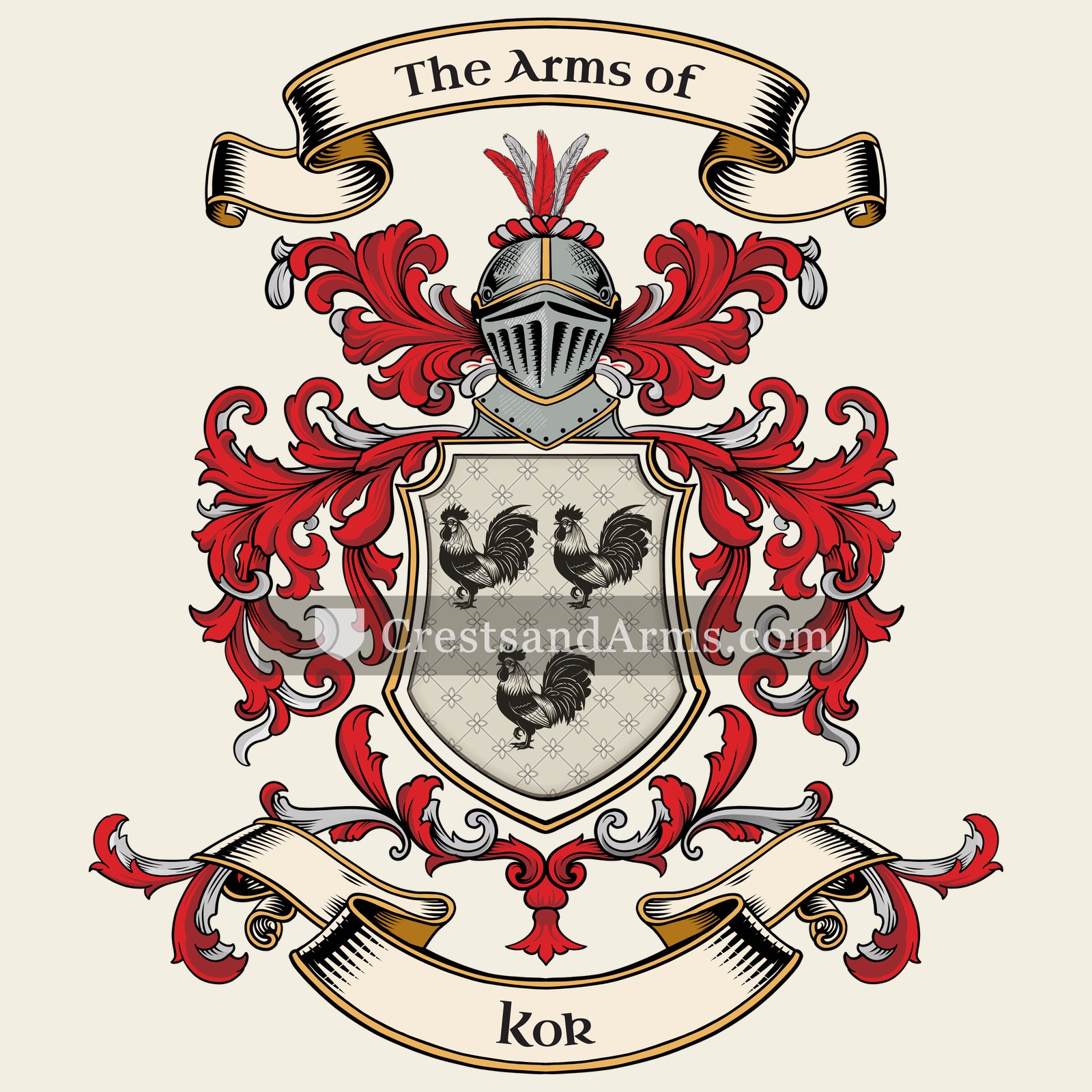
cockCourage, vigilance and readiness for battle
Colours
Silver (Argent)Means: Peace and sincerity
Black (Sable)Means: Constancy
Historical info
Source
J. B. Rietstap, Armorial Général, Gouda: G. B. van Goor Zonen, 1884–87
Blazon (the actual original written record)
“D'arg. à trois coqs de sa., crêtés et barbés de gu.”
Netherlandsc. 1815
Digital archive packCoat of arms PNG, gold border print PDF, vector SVG and the certificate of authenticity. Sent to your email in minutes.
Map of Netherlands showing where the Kok arms are recorded
The Kok arms were recorded in Netherlands, c. 1815.
Arms such as these were typically recorded in Friesland.
Friesland was low, wet country on the northern coast of the Netherlands, farmed by families who had held the same land for centuries. Free landholders were unusually common there, and a free landholder could carry arms.
This is where the arms were entered in the register. Families often moved to other parts of the country, so the same name can turn up in more than one region.
Region
Friesland
First recorded
1815
Granting Authority for the Kok Arms
Hoge Raad van Adel
Photograph made by me · CC BY-SA 3.0
The body that granted and recorded arms in Netherlands in this period.
William I of the Netherlands
Sovereign of the period
William I of the Netherlands
1815–1840
Reigning in Germany when the Kok arms are first recorded.
How Arms Worked in Netherlands
In the Netherlands, coats of arms were often used by noble families and those who held specific public offices. These arms were passed down through the generations to legitimate descendants. Younger branches of a family usually kept the original design without needing to add special marks. This system ensured that the family identity remained clear and consistent over many years.
Granting authority
The Hoge Raad van Adel is the official body that regulates and manages noble titles and coats of arms in the Netherlands.
How they got arms
Families typically obtained their coats of arms through official royal grants or by proving their long-standing historical use of the symbols.
Where arms were recorded
Coats of arms are officially recorded in the registers held by the Hoge Raad van Adel, which began its work in 1814.
The family's standing
Recorded among the armigerous families of Netherlands.
Origin & History of the Kok Family in Netherlands
The surname Kok is a classic example of a descriptive occupational name that emerged in the Netherlands during the Middle Ages. In the Dutch language, the word "kok" translates directly to "cook," suggesting that the earliest ancestors to carry this name likely worked in professional kitchens for wealthy households, monasteries, or local inns. Because surnames became a necessity for tax and census purposes as populations grew, many individuals adopted the name based on their daily trade. By the time the family was formally recorded in the province of Friesland in 1815, the name had already been established for centuries across various Dutch regions. The presence of the Kok family in Friesland during the early nineteenth century coincides with the implementation of the Civil Registry under Napoleonic rule, which required all citizens to register their permanent family names. This period transformed the name from a simple professional label into a hereditary identity that linked the family to the historical labor traditions of the Dutch people.
Related Branches & Arms
Root word
Koch
A person who prepares food for consumption.
This name
KokAn occupational surname for a cook or a chef.
also spelled
Kock
Koc
Cook
Related arms
Fasshebersame arms
Kockvariant spelling
Documented Sources
J. B. Rietstap, Armorial Général, Gouda: G. B. van Goor Zonen, 1884–87


 saltireResolution, and St Andrew's cross
 eagleNobility, strength and a keen mind
 lanceKnightly service and the tilt
 stagPeace and harmony, and one who will not fight unprovoked
 saltireResolution, and St Andrew's cross
 eagleNobility, strength and a keen mind
 lanceKnightly service and the tilt
 stagPeace and harmony, and one who will not fight unprovoked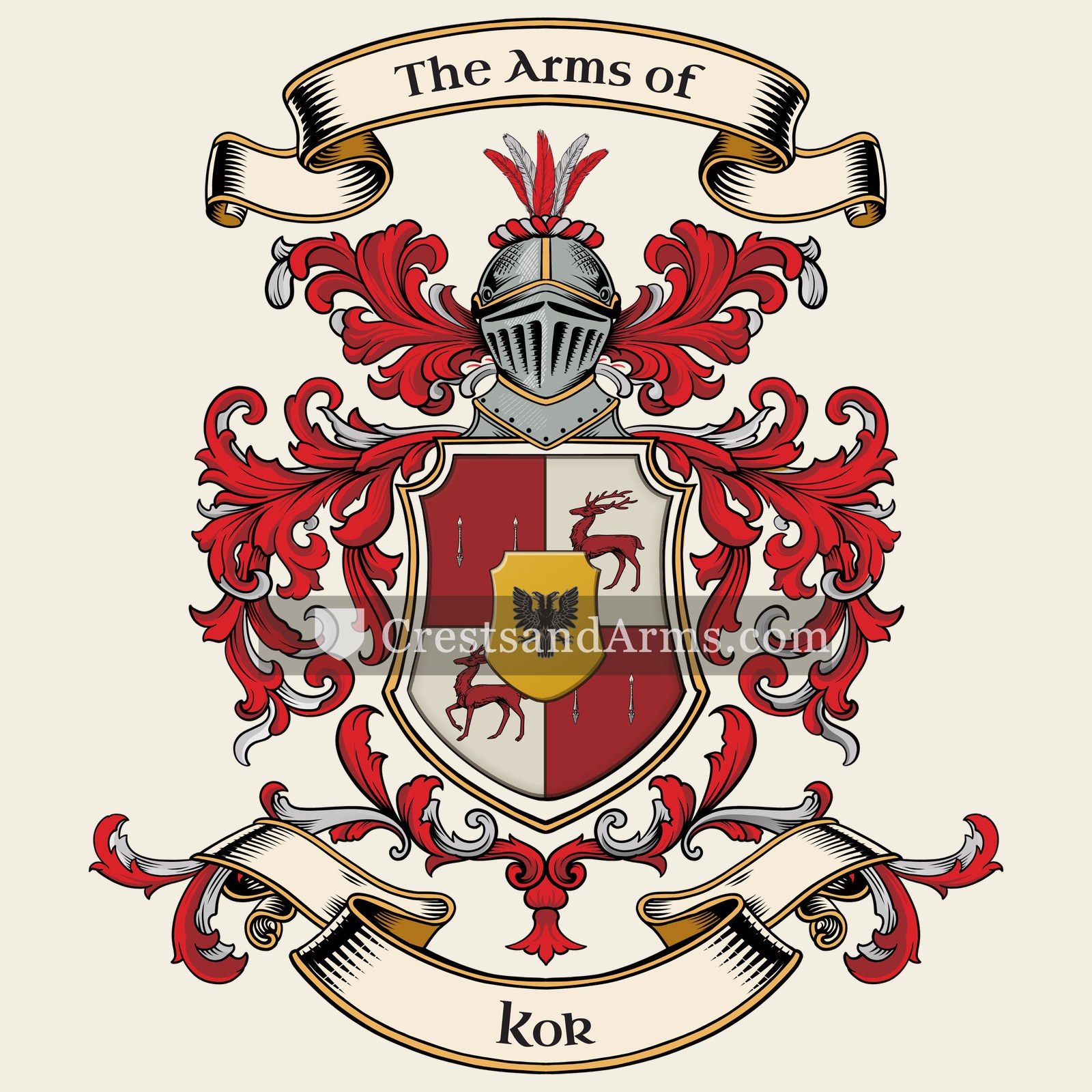


 cockCourage, vigilance and readiness for battle