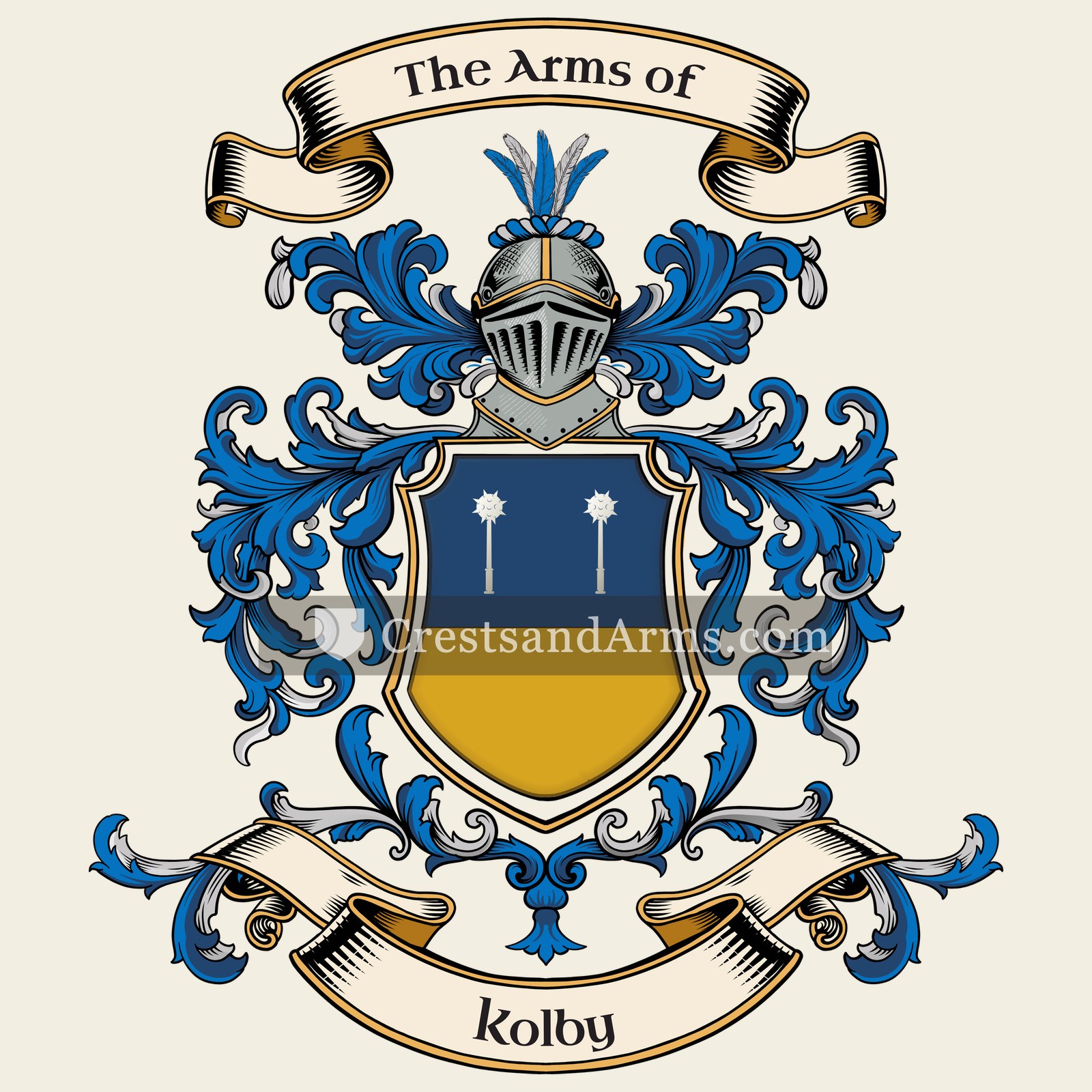
A record of documented arms, meaning and origin, researched for the Kolby family of Germany.
Reg. 2601 · German, J–L
Coat of Arms & Family Crest Details
Symbols on this shield
saltireResolution, and St Andrew's cross
maceAuthority, and the officer who bears it
Colours
Blue (Azure)Means: Loyalty and truth
Gold (Or)Means: Generosity
Historical info
Source
J. B. Rietstap, Armorial Général, Gouda: G. B. van Goor Zonen, 1884–87
Blazon (the actual original written record)
“Coupé-enclavé: au 1 d'azur à deux massues au nat., passées en saut., le gros bout en haut: au 2 d'or plein. C.: un avant-bras, en pal, paré d'azur, la main de carn. brandissant une massue au nat.”
FranconiaFranconia, c. 1765
Digital archive packCoat of arms PNG, gold border print PDF, vector SVG and the certificate of authenticity. Sent to your email in minutes.
Map of Germany showing where the Kolby arms are recorded
The Kolby arms were recorded in Franconia, c. 1765.
Franconia was a patchwork of small territories in central Germany, full of minor landowners and prosperous market towns. So many separate households held land there that the region produced a great many coats of arms.
This is where the arms were entered in the register. Families often moved to other parts of the country, so the same name can turn up in more than one region.
The body that granted and recorded arms in Germany in this period.
Francis I, Holy Roman Emperor
Sovereign of the period
Francis I, Holy Roman Emperor
1745–1765
Reigning in Germany when the Kolby arms are first recorded.
How Arms Worked in Germany
In the Holy Roman Empire, coats of arms were often granted to individuals by the Emperor or his representatives. These arms were then passed down through the generations to all legitimate descendants of the original holder. Younger branches of a family usually kept the same shield design without needing to change it, as the arms belonged to the entire lineage.
Granting authority
The Holy Roman Emperor held the sole power to grant new coats of arms throughout his vast imperial territories.
How they got arms
Families typically obtained their coats of arms through a formal imperial grant or by proving their noble status to the authorities.
Where arms were recorded
These grants were officially recorded in the Imperial Chancery registers, which began keeping formal records of such honors during the Middle Ages.
The family's standing
Recorded among the armigerous families of Franconia.
Origin & History of the Kolby Family in Germany
The family name Kolby traces its roots to the historical region of Franconia, where records confirm members of the family were established by 1765. The name likely originated as a descriptive term or a topographic identifier, often linked to individuals who lived near a specific landmark or worked in a particular trade common to the Germanic lands. During the eighteenth century, Franconia was a diverse area characterized by a mix of rural farming communities and growing market towns. Families like the Kolbys were typically integrated into these local social structures, often serving as artisans, tradespeople, or landowners who contributed to the regional economy. As the family grew, they maintained deep ties to the local traditions and customs of their home, reflecting the broader patterns of migration and settlement that defined life in central Europe during this era.
Related Branches & Arms
Root word
Kohl
A German term referring to cabbage or a cabbage patch.
This name
KolbyDerived from a topographic name for someone who lived near a cabbage field.
also spelled
Colbe
Kolby
Colby
Documented Sources
J. B. Rietstap, Armorial Général, Gouda: G. B. van Goor Zonen, 1884–87
Bader, Karl Siegfried, Der deutsche Südwesten in seiner territorialstaatlichen Entwicklung, 1950
Bayerisches Hauptstaatsarchiv, Regierungsakten der fränkischen Reichskreise, 1765
Dudenredaktion, Duden Familiennamen: Herkunft und Bedeutung, 2005
Stadtarchiv Nürnberg, Bürgerbücher und Einwohnerverzeichnisse, 1765
Digital archive packCoat of arms PNG, gold border print PDF, vector SVG and the certificate of authenticity. Sent to your email in minutes.


 saltireResolution, and St Andrew's cross
 maceAuthority, and the officer who bears it
 saltireResolution, and St Andrew's cross
 maceAuthority, and the officer who bears it