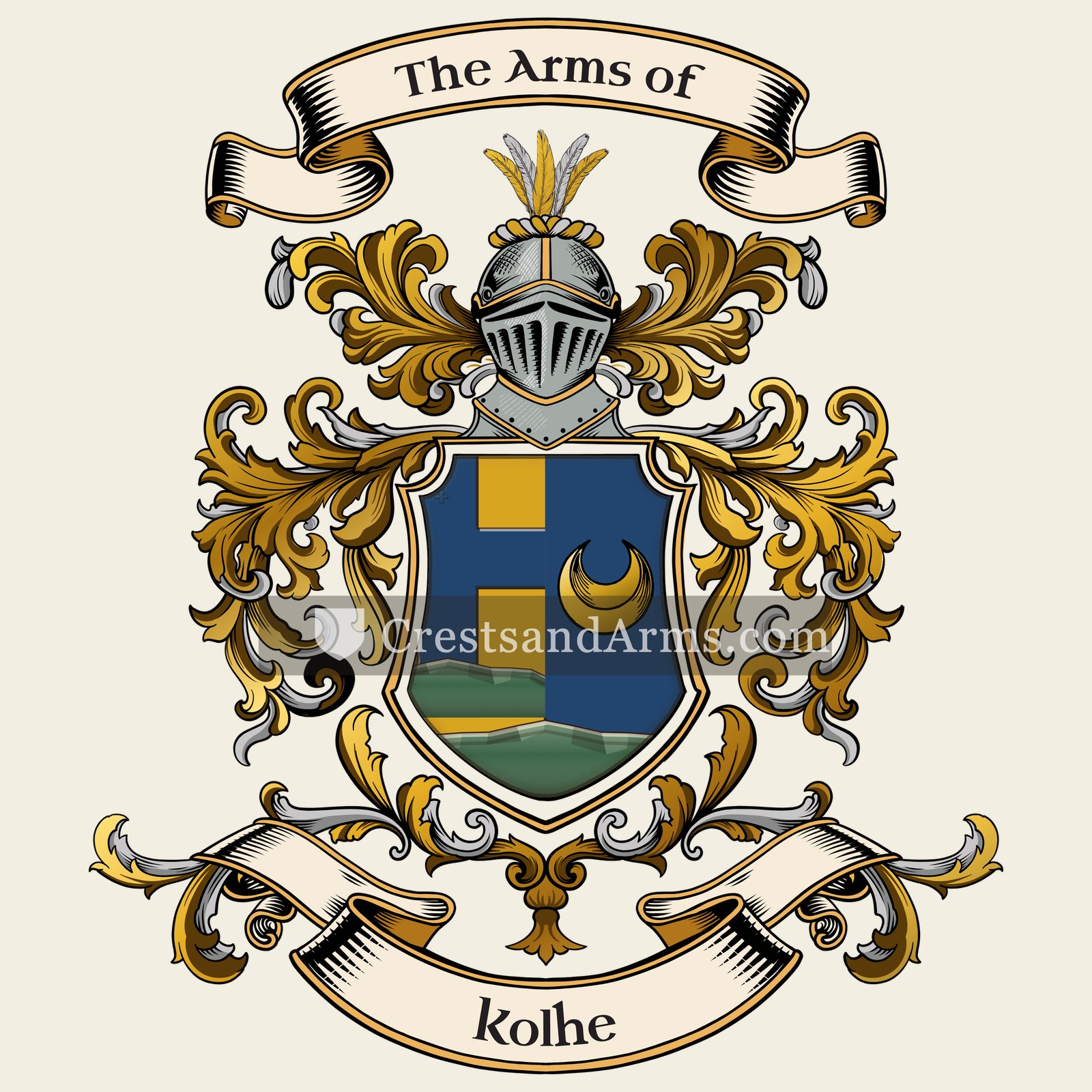
A record of documented arms, meaning and origin, researched for the Kolhe family of Germany.
Reg. 9366 · German, J–L
Coat of Arms & Family Crest Details
Symbols on this shield
cross symbolChristian faith and service
mountThe ground held, and steadfastness upon it
crescentHonour by the sovereign, and the second son
Colours
Gold (Or)Means: Generosity
Blue (Azure)Means: Loyalty and truth
Green (Vert)Means: Hope
Historical info
Source
J. B. Rietstap, Armorial Général, Gouda: G. B. van Goor Zonen, 1884–87
Blazon (the actual original written record)
“Parti: au 1 d'or à la croix de Lorraine d'azur, posée sur un tertre de sin.; au 2 d'azur à un croiss. figuré cont. d'or. C.: un homme iss., hab. d'un parti d'azur et d'or, coiffé d'un bonnet pareil, les bras étendus, tenant de sa main dextre un croiss. figuré tourné d'or, et de sa sen. une croix de Lorraine d'azur. L. d'or et d'azur.”
GermanyRatisbonne, c. 1765
Digital archive packCoat of arms PNG, gold border print PDF, vector SVG and the certificate of authenticity. Sent to your email in minutes.
Map of Germany showing where the Kolhe arms are recorded
The Kolhe arms were recorded in Ratisbonne, c. 1765.
This is where the arms were entered in the register. Families often moved to other parts of the country, so the same name can turn up in more than one region.
The body that granted and recorded arms in Germany in this period.
Francis I, Holy Roman Emperor
Sovereign of the period
Francis I, Holy Roman Emperor
1745–1765
Reigning in Germany when the Kolhe arms are first recorded.
How Arms Worked in Germany
In the Holy Roman Empire, coats of arms were often granted to individuals by the Emperor or his representatives. These arms were then passed down through the generations to all legitimate descendants of the original holder. Younger branches of a family usually kept the same shield design without needing to change it, as the arms belonged to the entire lineage.
Granting authority
The Holy Roman Emperor held the sole power to grant new coats of arms throughout his vast imperial territories.
How they got arms
Families typically obtained their coats of arms through a formal imperial grant or by proving their noble status to the authorities.
Where arms were recorded
These grants were officially recorded in the Imperial Chancery registers, which began keeping formal records of such honors during the Middle Ages.
The family's standing
Recorded among the armigerous families of Germany.
Origin & History of the Kolhe Family in Germany
The family name Kolhe has deep roots in the historical landscape of Central Europe, with documented evidence placing early family members in the city of Ratisbonne, known today as Regensburg, by the year 1765. During the eighteenth century, Ratisbonne served as a vital political hub as the permanent seat of the Perpetual Diet of the Holy Roman Empire. Families living in this city often occupied roles linked to the bustling trade routes along the Danube River or provided essential services to the imperial administration. The name Kolhe likely emerged from these local linguistic traditions, reflecting the professional or regional identities common among residents of the Bavarian region at that time. As members of this family navigated the social and economic shifts of the late 1700s, they became part of the enduring history of a city that acted as a crossroads for European culture and governance.
Related Branches & Arms
Root word
Kohl
A cabbage or a person who grew or sold cabbage.
This name
KolheA topographic or occupational name for someone who cultivated or traded in cabbage.
also spelled
Koelle
Kolleh
Documented Sources
J. B. Rietstap, Armorial Général, Gouda: G. B. van Goor Zonen, 1884–87
Bayerisches Hauptstaatsarchiv, Reichsstädtische Akten der Stadt Regensburg
Stadtarchiv Regensburg, Bürgeraufnahme- und Zunftprotokolle der Stadt Regensburg
Böhm, Hermann, Regensburg im 18. Jahrhundert: Eine Stadt zwischen Tradition und Aufbruch, 1982
Digital archive packCoat of arms PNG, gold border print PDF, vector SVG and the certificate of authenticity. Sent to your email in minutes.


 cross symbolChristian faith and service
 mountThe ground held, and steadfastness upon it
 crescentHonour by the sovereign, and the second son
 cross symbolChristian faith and service
 mountThe ground held, and steadfastness upon it
 crescentHonour by the sovereign, and the second son