Map of Netherlands showing where the Koning arms are recorded
The Koning arms were recorded in Amsterdam, c. 1815.
This is where the arms were entered in the register. Families often moved to other parts of the country, so the same name can turn up in more than one region.
Region
Amsterdam
Town
Amsterdam
First recorded
1815
Granting Authority for the Koning Arms
Hoge Raad van Adel
Photograph made by me · CC BY-SA 3.0
The body that granted and recorded arms in Netherlands in this period.
William I of the Netherlands
Sovereign of the period
William I of the Netherlands
1815–1840
Reigning in Netherlands when the Koning arms are first recorded.
How Arms Worked in Netherlands
In the Netherlands, coats of arms were often used by noble families and those who held specific public offices. These arms were passed down through the generations to legitimate descendants. Younger branches of a family usually kept the original design without needing to add special marks. This system ensured that the family identity remained clear and consistent over many years.
Granting authority
The Hoge Raad van Adel is the official body that regulates and manages noble titles and coats of arms in the Netherlands.
How they got arms
Families typically obtained their coats of arms through official royal grants or by proving their long-standing historical use of the symbols.
Where arms were recorded
Coats of arms are officially recorded in the registers held by the Hoge Raad van Adel, which began its work in 1814.
The family's standing
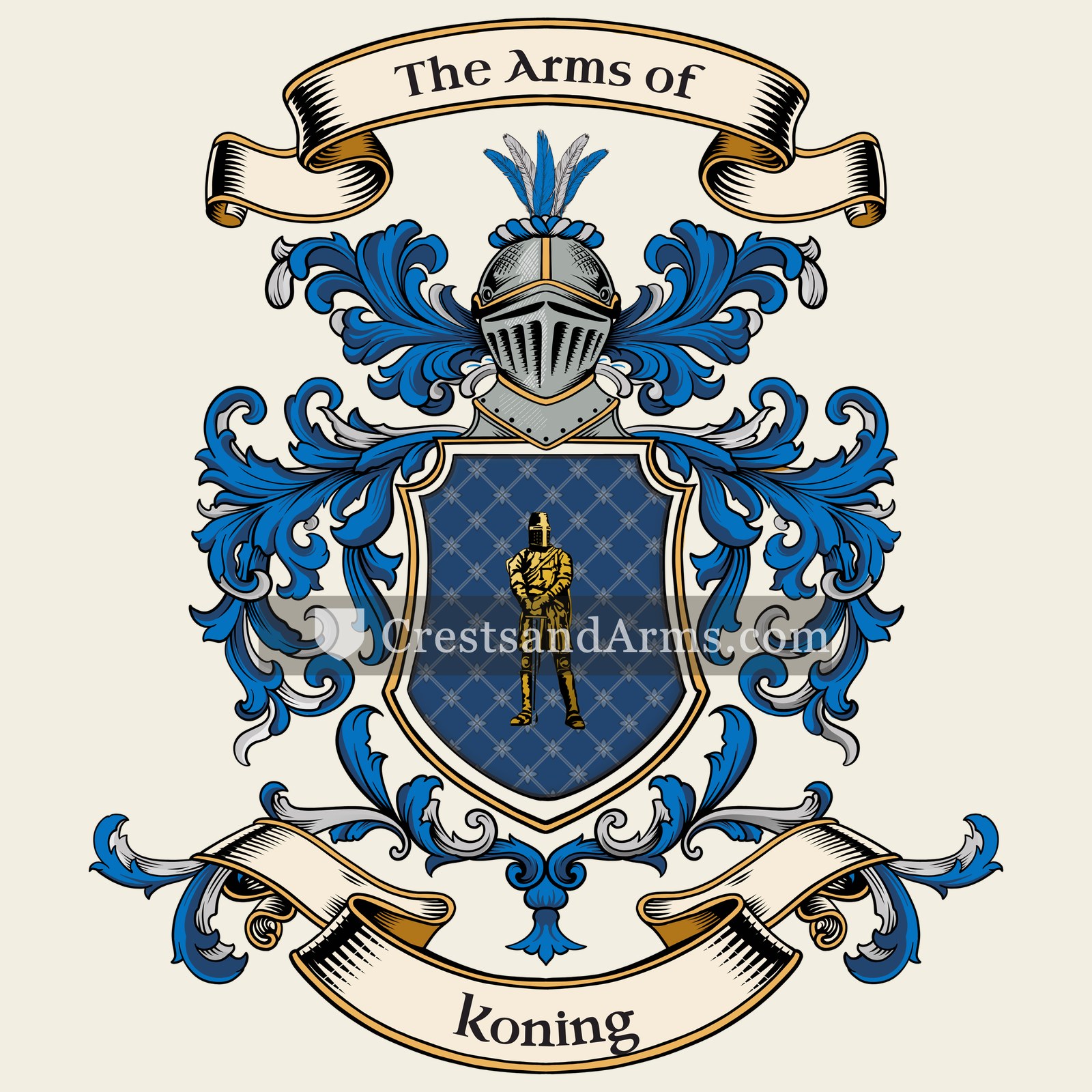
Recorded among the armigerous families of Netherlands.
Origin & History of the Koning Family in Netherlands
The surname Koning is a classic example of a descriptive occupational or status-based name originating from the Dutch word for king. In the medieval period, such names were often given to people who played the role of a king in local festivals, or they served as nicknames for individuals who carried themselves with a regal or authoritative air. By the time your ancestors were documented in Amsterdam in 1815, the name was already well-established throughout the Netherlands as a common identifier for families living in urban centers. During the early nineteenth century, Amsterdam was a bustling hub of trade and industry, and families like the Konings were often part of the growing merchant and artisan classes that defined the city’s character. Because the name was relatively common, it reflects the diverse social landscape of the Dutch capital, where families moved through the city streets to build their lives during a time of significant political and economic change in Europe.
Koning Meaning & Related Branches
Root word
kuningaz
Proto-Germanic term for a tribal leader or king.
This name
KoningAn occupational or descriptive surname for someone who acted like a king or served in a royal household.
also spelled
Koening
King
Related arms
Koeningvariant spelling
Documented Sources
J. B. Rietstap, Armorial Général, Gouda: G. B. van Goor Zonen, 1884–87
Debrabandere, Frans. Woordenboek van de familienamen in België en Noord-Frankrijk. 2003
Meertens, P.J. De betekenis van de Nederlandse familienamen. 1995
Stadsarchief Amsterdam. Bevolkingsregister van Amsterdam. 1815
Digital archive packCoat of arms PNG, gold border print PDF, vector SVG and the certificate of authenticity. Sent to your email in minutes.


 knightChivalry and service in arms
 knightChivalry and service in arms