Map of Germany showing where the Korz arms are recorded
The Korz arms were recorded in Ulm, c. 1765.
This is where the arms were entered in the register. Families often moved to other parts of the country, so the same name can turn up in more than one region.
The body that granted and recorded arms in Germany in this period.
Francis I, Holy Roman Emperor
Sovereign of the period
Francis I, Holy Roman Emperor
1745–1765
Reigning in Germany when the Korz arms are first recorded.
How Arms Worked in Germany
In the Holy Roman Empire, coats of arms were often granted to individuals by the Emperor or his representatives. These arms were then passed down through the generations to all legitimate descendants of the original holder. Younger branches of a family usually kept the same shield design without needing to change it, as the arms belonged to the entire lineage.
Granting authority
The Holy Roman Emperor held the sole power to grant new coats of arms throughout his vast imperial territories.
How they got arms
Families typically obtained their coats of arms through a formal imperial grant or by proving their noble status to the authorities.
Where arms were recorded
These grants were officially recorded in the Imperial Chancery registers, which began keeping formal records of such honors during the Middle Ages.
The family's standing
Recorded among the armigerous families of Germany.
Origin & History of the Korz Family in Germany
The surname Korz is deeply rooted in the historical landscape of southern Germany, with clear documentation placing the family in the city of Ulm by 1765. During the eighteenth century, Ulm was a bustling center of trade and craftsmanship located along the Danube River. Families living in this region often derived their names from local occupations, nicknames, or specific geographic markers. The name Korz likely evolved from Middle High German linguistic roots, potentially serving as a descriptive term for a person of short stature or as a variation of regional shorthand used in local record-keeping. As residents of a free imperial city, the early members of the Korz family would have been part of a structured urban society governed by strict guilds and civic regulations. This environment allowed families to establish deep roots in the community, often passing down trades and property through generations within the city walls.
Related Branches & Arms
Root word
Kort
A short or clipped form of the Germanic name Konrad.
This name
KorzA topographic or occupational surname derived from a shortened form of Conrad, meaning brave counsel.
also spelled
Kurts
Kuurz
Kurtz
Documented Sources
J. B. Rietstap, Armorial Général, Gouda: G. B. van Goor Zonen, 1884–87
Stadtarchiv Ulm, Bürgeraufnahmen und Zunftprotokolle der Reichsstadt Ulm
Künast, Hans-Jörg, Getruckt zu Augspurg: Buchdruck und Buchhandel in Augsburg zwischen 1468 und 1555, 1997. (Provides context on the social and professional structures of the region surrounding Ulm during the period)
Schefold, Max, Historische Ansichten aus Ulm, 1970
Digital archive packCoat of arms PNG, gold border print PDF, vector SVG and the certificate of authenticity. Sent to your email in minutes.


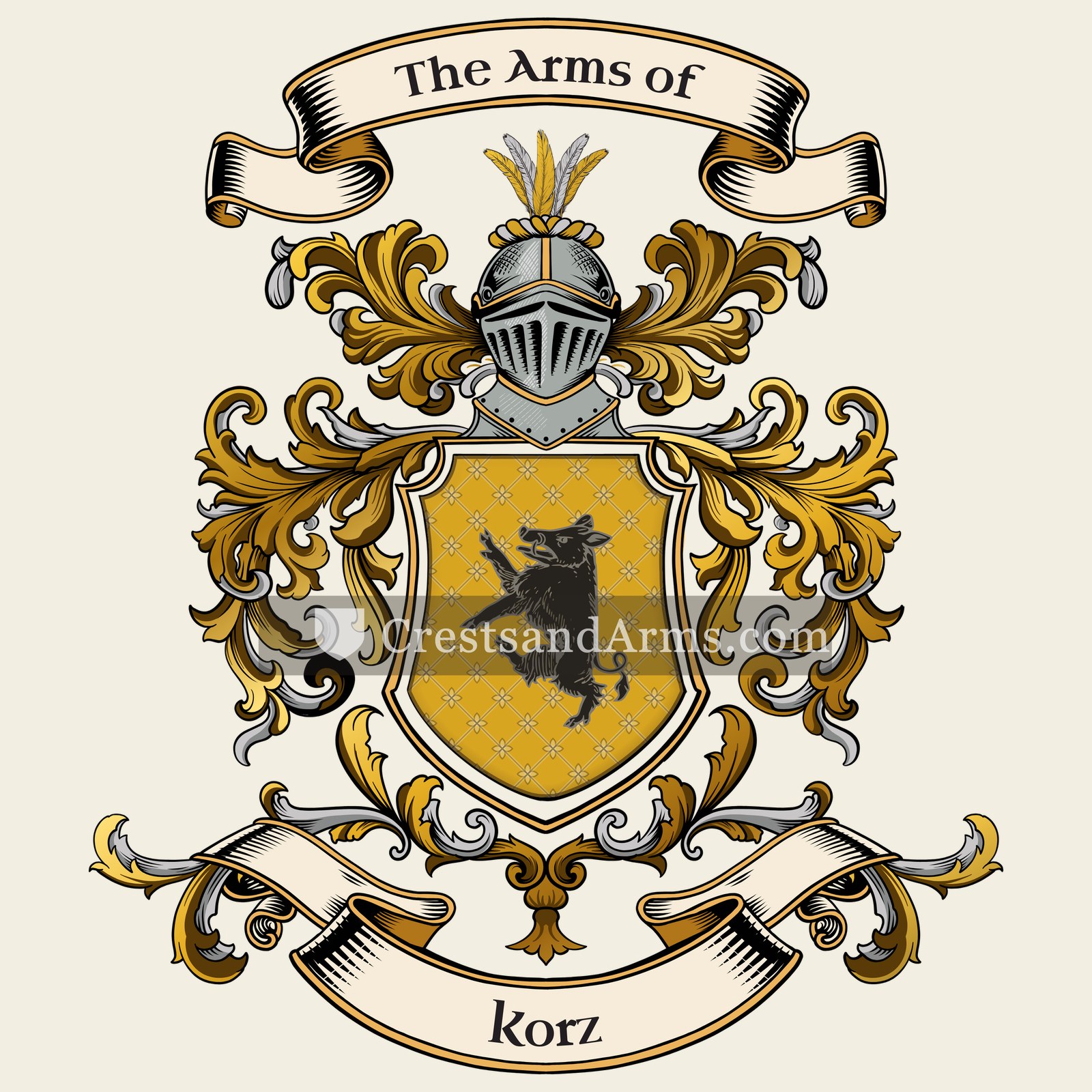
 boarA fierce fighter who battles to the end
 boarA fierce fighter who battles to the end