Map of Poland showing where the Kosko arms are recorded
The Kosko arms were recorded in Poland, c. 1772.
Arms such as these were typically recorded in Mazovia.
Mazovia held Warsaw, the Polish court and the assemblies where the szlachta met. Poland's nobles were unusually numerous and every one of them bore arms, and Warsaw is where those arms were argued over and recorded.
This is where the arms were entered in the register. Families often moved to other parts of the country, so the same name can turn up in more than one region.
Region
Mazovia
First recorded
1772
Granting Authority for the Kosko Arms
Ennoblement by the Sejm
Author: Olek Remesz · CC BY-SA 3.0
The body that granted and recorded arms in Poland in this period.
Stanisław August Poniatowski
Sovereign of the period
Stanisław August Poniatowski
1764–1795
Reigning in Poland when the Kosko arms are first recorded.
How Arms Worked in Poland
Polish noble families shared a single coat of arms across many different surnames, creating large clans rather than individual designs. These symbols were held collectively by all members of the clan regardless of their specific family name. When a new family joined the nobility, they were adopted into an existing clan and began using that group's established shield.
Granting authority
The Sejm, which was the Polish parliament, held the power to grant noble status and the right to bear arms.
How they got arms
Families typically received their coat of arms through a formal act of ennoblement granted by the Sejm for distinguished service.
Where arms were recorded
These grants were officially recorded in the Crown Metrica, which served as the central archive for state documents starting in the sixteenth century.
The family's standing
Recorded among the armigerous families of Poland.
Origin & History of the Kosko Family in Poland
The family name Kosko has deep roots in the Mazovia region of Poland, where records confirm members of the family were living as early as 1772. The name itself likely originated as a descriptive nickname or a shortened form of a longer Slavic given name, which was a common practice for families in rural areas during that period. In the late 18th century, Mazovia was a center of agricultural life and trade, and families like the Koskos were often tied to the land or local village administration. As the family grew, they became part of the social fabric of the region, navigating the significant political changes that swept through Poland during the late 1700s. By staying in the Mazovian heartland, the early generations helped establish a lasting presence that defined the family identity for years to come.
Kosko Meaning & Related Branches
Root word
kos
a blackbird
This name
Koskoa diminutive form referring to a person resembling or associated with a blackbird
also spelled
Koss
Kose
Documented Sources
J. B. Rietstap, Armorial Général, Gouda: G. B. van Goor Zonen, 1884–87
Kozłowski, Ryszard, Nazwiska mieszkańców Mazowsza w XVIII wieku, 1995
Archiwum Główne Akt Dawnych (AGAD), Księgi metrykalne parafii rzymskokatolickich z terenu Mazowsza, 1772
Digital archive packCoat of arms PNG, gold border print PDF, vector SVG and the certificate of authenticity. Sent to your email in minutes.


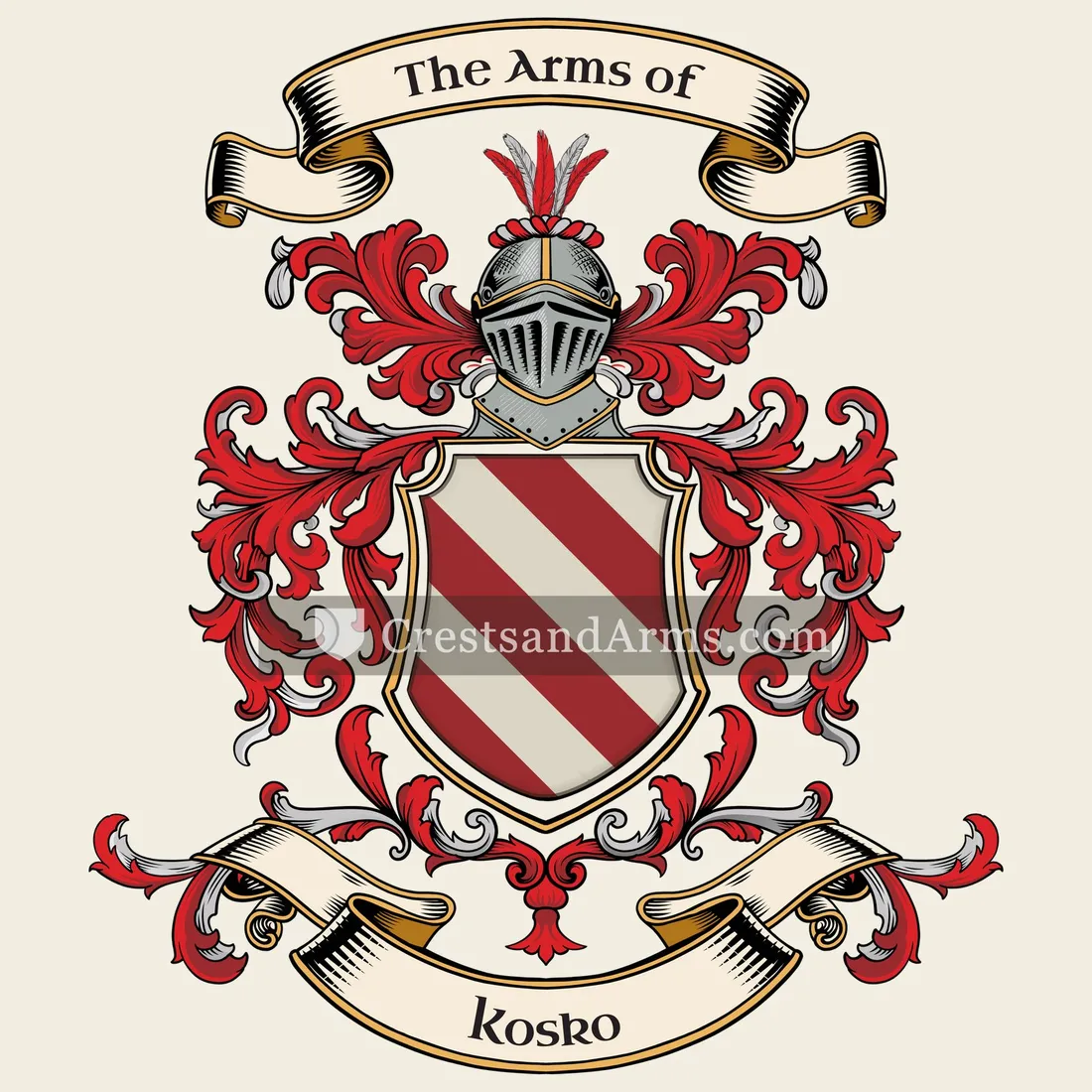
 bendDefence, and the scarf of a commander
 bendDefence, and the scarf of a commander