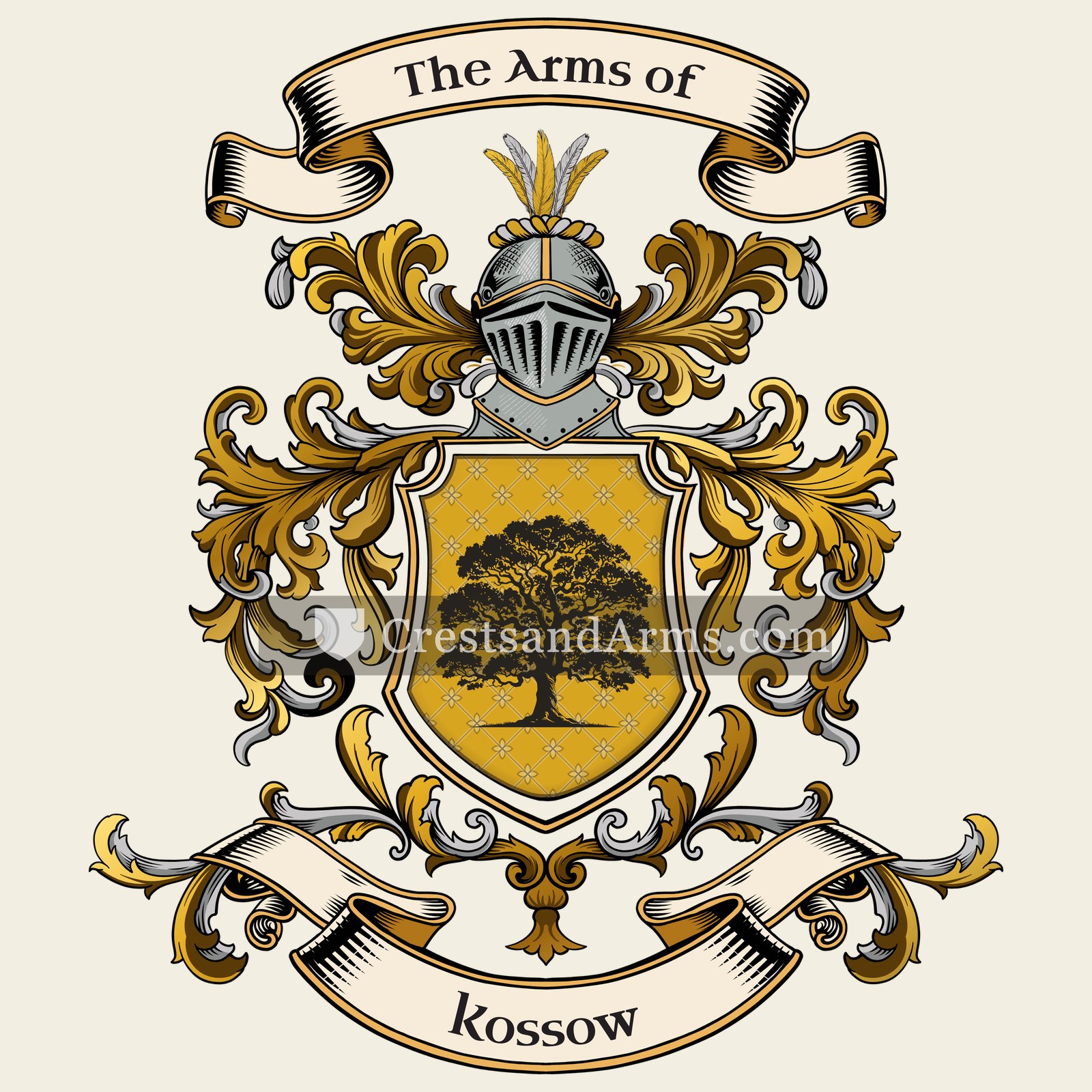
A record of documented arms, meaning and origin, researched for the Kossow family of Germany.
Reg. 5735 · German, J–L
Coat of Arms & Family Crest Details
Symbols on this shield
treeLife, endurance and deep roots
Colours
Gold (Or)Means: Generosity
Black (Sable)Means: Constancy
Historical info
Source
J. B. Rietstap, Armorial Général, Gouda: G. B. van Goor Zonen, 1884–87
Blazon (the actual original written record)
“D'or à un tronc d'arbre arr. de sa., poussant en haut trois feuilles de tilleul de gu. Cq. cour. C.: une femme iss., hab. de gu., cour. d'or, les cheveux épars, sommée d'une feuille de gu., tenant de chaque main une feuille pareille. L. d'or et de gu.”
PomeraniaPomerania, c. 1765
Digital archive packCoat of arms PNG, gold border print PDF, vector SVG and the certificate of authenticity. Sent to your email in minutes.
Map of Germany showing where the Kossow arms are recorded
The Kossow arms were recorded in Pomerania, c. 1765.
Pomerania was flat farming country on the Baltic coast, held in large estates by a small number of families. They kept their land for generations, and generations of landholding is what fills the registers.
This is where the arms were entered in the register. Families often moved to other parts of the country, so the same name can turn up in more than one region.
The body that granted and recorded arms in Germany in this period.
Francis I, Holy Roman Emperor
Sovereign of the period
Francis I, Holy Roman Emperor
1745–1765
Reigning in Germany when the Kossow arms are first recorded.
How Arms Worked in Germany
In the Holy Roman Empire, coats of arms were often granted to individuals by the Emperor or his representatives. These arms were then passed down through the generations to all legitimate descendants of the original holder. Younger branches of a family usually kept the same shield design without needing to change it, as the arms belonged to the entire lineage.
Granting authority
The Holy Roman Emperor held the sole power to grant new coats of arms throughout his vast imperial territories.
How they got arms
Families typically obtained their coats of arms through a formal imperial grant or by proving their noble status to the authorities.
Where arms were recorded
These grants were officially recorded in the Imperial Chancery registers, which began keeping formal records of such honors during the Middle Ages.
The family's standing
Recorded among the armigerous families of Pomerania.
Origin & History of the Kossow Family in Germany
The family name Kossow originates from the historical region of Pomerania, a coastal area along the Baltic Sea that has shifted between German and Polish influence over many centuries. By 1765, records confirm that members of the family were well-established in this territory. The name itself is likely locational, derived from the Slavic word "kosa," which refers to a scythe or a spit of land. This suggests that the earliest ancestors were likely farmers or settlers who lived near a distinctive geographical feature, such as a narrow strip of land or a river bend. As the family grew, they became part of the local social fabric of Pomerania, living through the complex political changes that defined the region during the eighteenth century. Their presence in the area reflects the long history of families who cultivated the land and built communities in the northern reaches of Central Europe.
Related Branches & Arms
Root word
Kos
A Slavic term referring to a blackbird or a scythe.
This name
KossowA habitational name derived from a place name, likely indicating someone from a village of blackbirds.
also spelled
Kussau
Kusow
Kyusow
Documented Sources
J. B. Rietstap, Armorial Général, Gouda: G. B. van Goor Zonen, 1884–87
Berghaus, Heinrich. Landbuch des Herzogthums Pommern und des Fürstenthums Rügen. 1865
Brüggemann, Ludwig Wilhelm. Ausführliche Beschreibung des gegenwärtigen Zustandes des Königl. Preußischen Herzogthums Vor- und Hinter-Pommern. 1779
Landesarchiv Greifswald, Rep 65a (General- und Spezialvisitationen der pommerschen Ämter)
Digital archive packCoat of arms PNG, gold border print PDF, vector SVG and the certificate of authenticity. Sent to your email in minutes.


 treeLife, endurance and deep roots
 treeLife, endurance and deep roots