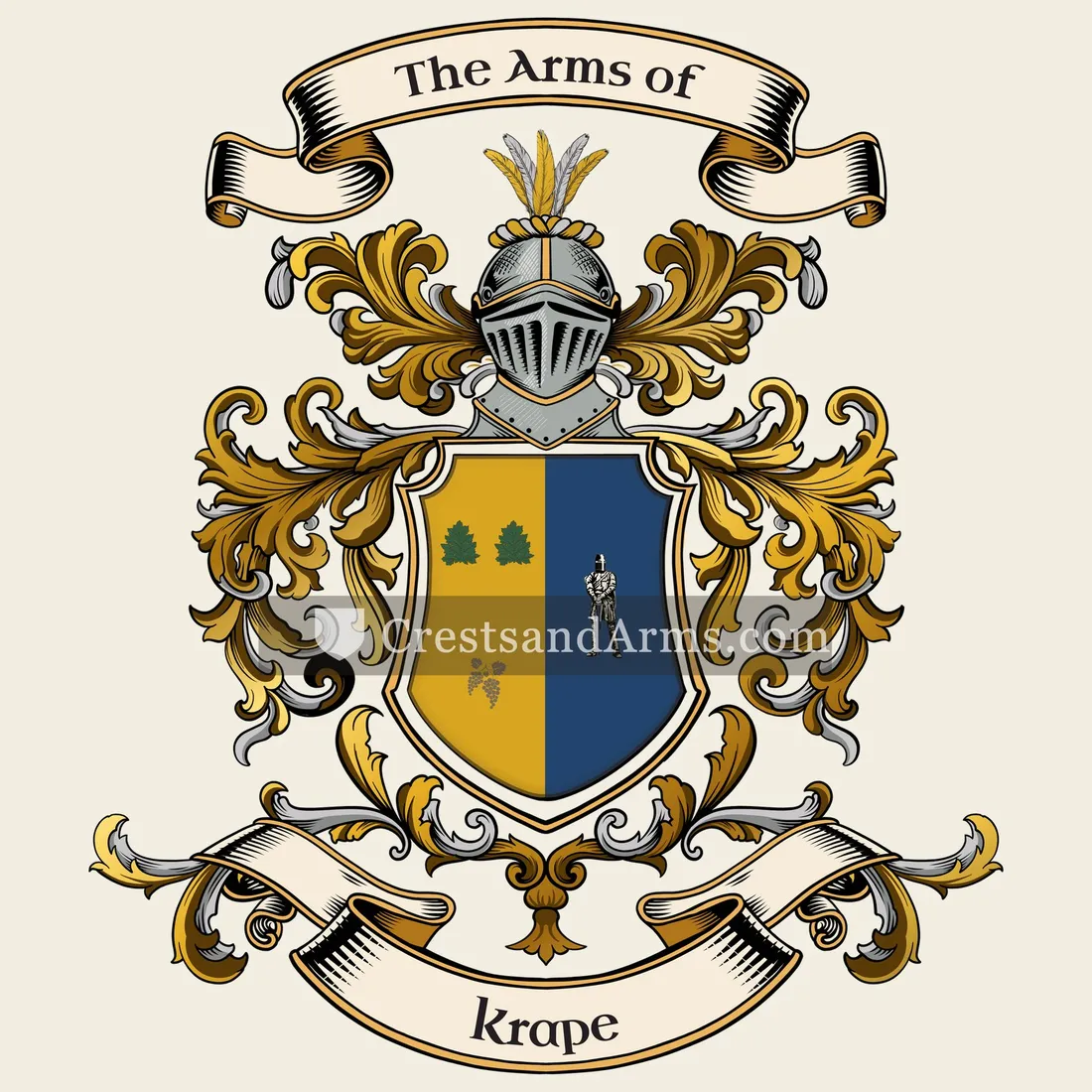
A record of documented arms, meaning and origin, researched for the Krape family of Germany.
Reg. 6690 · German, J–L
Meaning of the Krape family crest colors & symbols
Symbols on this shield
grapesPlenty, and the labour of the vine
leafHappiness and abundance
knightChivalry and service in arms
Colours
Gold (Or)Means: Generosity
Blue (Azure)Means: Loyalty and truth
Green (Vert)Means: Hope
Historical info
Source
J. B. Rietstap, Armorial Général, Gouda: G. B. van Goor Zonen, 1884–87
Blazon (the actual original written record)
“Parti: au 1 d'or à une grappe de raisins au nat., pamprée de deux pièces de sin.; au 2 d'azur à un Hercule de carn., enveloppé d'une toile en guise de baudrier et de ceinture, et tenant de sa main dextre une massue abaissée. Cq. cour. C.: un bras de carn., brandissant une massue en fasce. L. d'arg. et d'azur.”
BavariaBavaria, c. 1833
Digital archive packCoat of arms PNG, gold border print PDF, vector SVG and the certificate of authenticity. Sent to your email in minutes.
Map of Germany showing where the Krape arms are recorded
The Krape arms were recorded in Bavaria, c. 1833.
Bavaria was a country of old landed families and walled market towns. Estates passed down the same line for centuries, and both the landowners and the leading townsmen kept arms, which is why so many Bavarian names sit in the registers.
This is where the arms were entered in the register. Families often moved to other parts of the country, so the same name can turn up in more than one region.
The body that granted and recorded arms in Germany in this period.
Frederick William III of Prussia
Sovereign of the period
Frederick William III of Prussia
1797–1840
Reigning in Germany when the Krape arms are first recorded.
How Arms Worked in Germany
Prussian heraldry was strictly tied to social rank and noble status rather than being a free choice for every citizen. These symbols were treated as permanent family property that moved through the generations to all legitimate heirs. If a family branch wanted to change their design to stand out, they had to apply for official permission to alter their specific version of the shield.
Granting authority
The Prussian Heroldsamt acted as the central state office that managed and strictly controlled all noble titles and coats of arms.
How they got arms
Families usually obtained their arms through formal royal grants or by proving their long-standing noble status to the state authorities.
Where arms were recorded
All official coats of arms were kept in the rolls of the Prussian Heroldsamt, which functioned from 1706 until 1918.
The family's standing
Recorded among the armigerous families of Bavaria.
Origin & History of the Krape Family in Germany
The surname Krape finds its historical roots in the southern regions of Germany, particularly within the state of Bavaria. By the early 19th century, families bearing this name were well-established in the Bavarian landscape, living through a period of significant social and political transition as the region integrated into the newly formed German Confederation. The name itself is thought to be linked to regional dialects, potentially serving as a descriptive term or a topographic identifier for those who lived near specific landmarks or worked in local trades. As the family grew in Bavaria during the 1830s, they participated in the traditional agricultural and artisan life that defined the era. These early generations helped shape the local community, leaving behind a legacy that reflects the broader history of the German people before the massive waves of migration that would later spread the name across the globe.
Krape Meaning & Related Branches
Root word
Krapf
A hook or a claw used for grasping or holding.
This name
KrapeA nickname for a person with a hooked nose or a grasping nature.
also spelled
Krap
Krapf
Documented Sources
J. B. Rietstap, Armorial Général, Gouda: G. B. van Goor Zonen, 1884–87


 grapesPlenty, and the labour of the vine
 leafHappiness and abundance
 knightChivalry and service in arms
 grapesPlenty, and the labour of the vine
 leafHappiness and abundance
 knightChivalry and service in arms