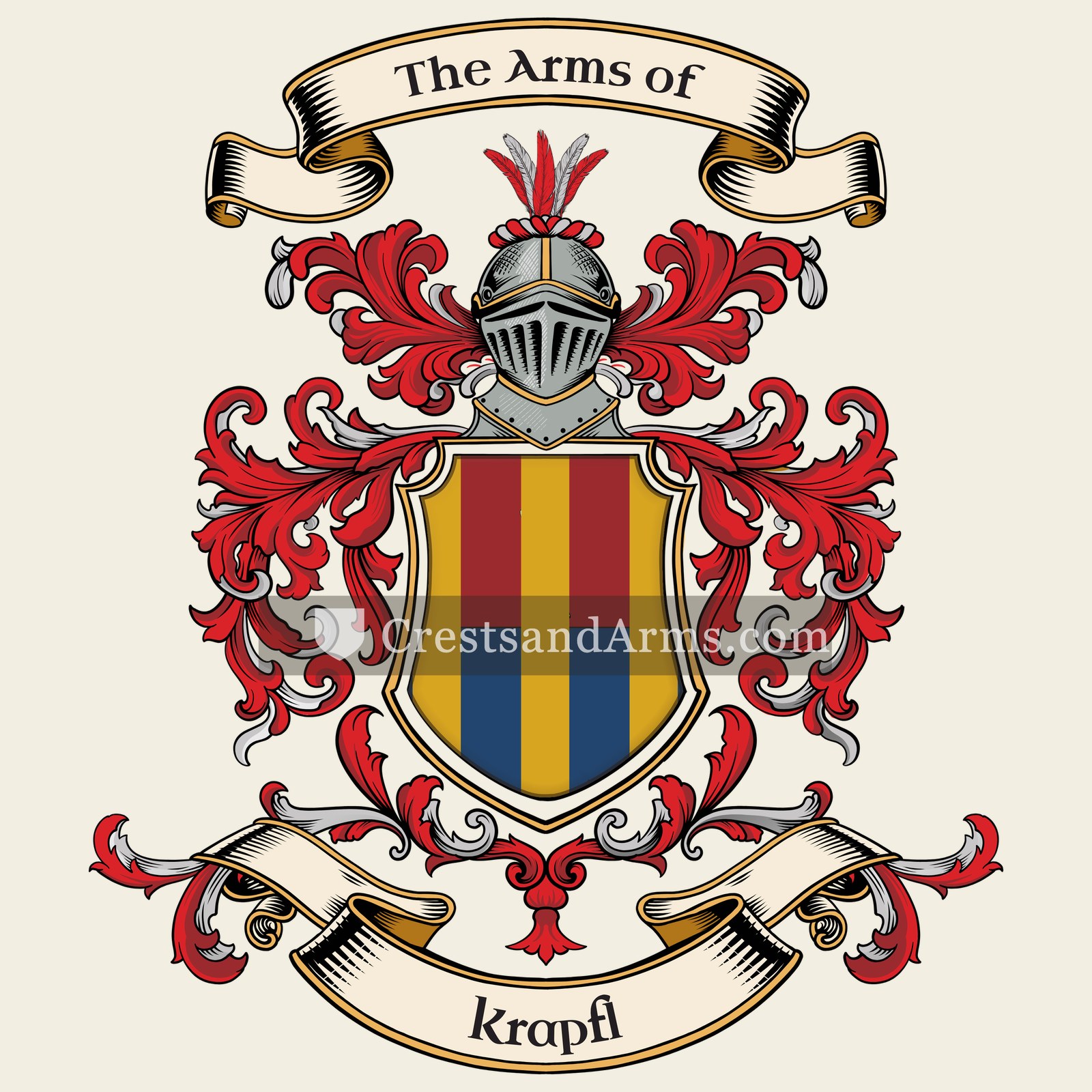
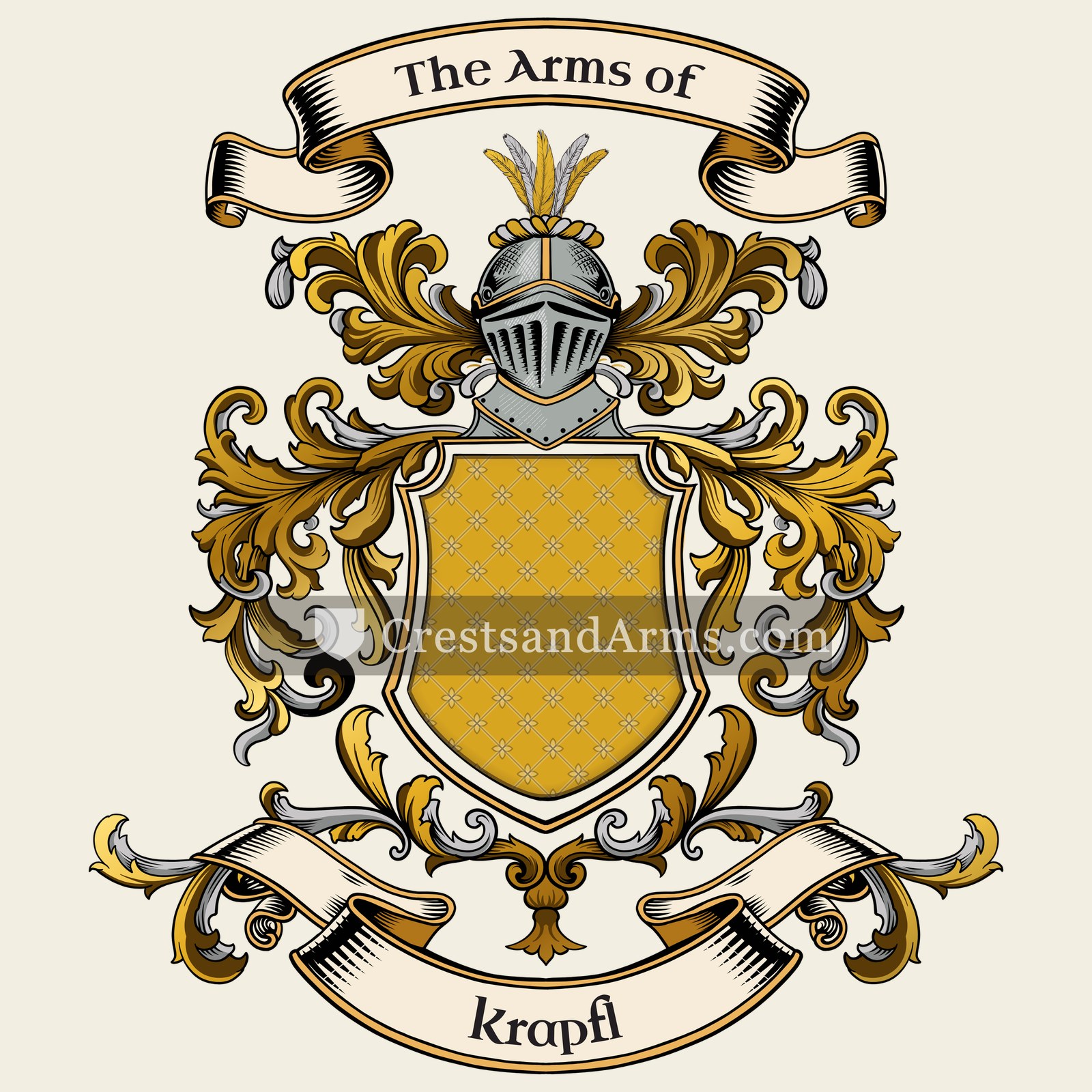
A record of documented arms, meaning and origin, researched for the Krapfl family lines. Documented in 2 countries.
Reg. 3784 · German, J–L
Coat of Arms & Family Crest Details
Symbols on this shield
paleMilitary strength, and a fortified defence
knightChivalry and service in arms
Colours
Red (Gules)Means: Military strength
Blue (Azure)Means: Loyalty and truth
Gold (Or)Means: Generosity
Historical info
Source
J. B. Rietstap, Armorial Général, Gouda: G. B. van Goor Zonen, 1884–87
Blazon (the actual original written record)
“Coupé: au 1 de gu. à un homme d'armes iss., arm. au nat., tenant de sa main dextre une flèche en barre, la pointe en bas, et de sa sen. trois roses, une de gu. entre deux d'arg., tigées et feuillées de sin.; au 2 d'azur à trois pals d'or. Cq. cour. C.: les meubles du 1. L.: à dextre d'arg. et de gu., à sen. d'or et d'azur.”
Germanyc. 1765
Digital archive packCoat of arms PNG, gold border print PDF, vector SVG and the certificate of authenticity. Sent to your email in minutes.
Map of Germany showing where the Krapfl arms are recorded
The Krapfl arms were recorded in Germany, c. 1765.
Arms such as these were typically recorded in Bavaria.
Bavaria was a country of old landed families and walled market towns. Estates passed down the same line for centuries, and both the landowners and the leading townsmen kept arms, which is why so many Bavarian names sit in the registers.
This is where the arms were entered in the register. Families often moved to other parts of the country, so the same name can turn up in more than one region.
The body that granted and recorded arms in Germany in this period.
Francis I, Holy Roman Emperor
Sovereign of the period
Francis I, Holy Roman Emperor
1745–1765
Reigning in Germany when the Krapfl arms are first recorded.
How Arms Worked in Germany
In the Holy Roman Empire, coats of arms were often granted to individuals by the Emperor or his representatives. These arms were then passed down through the generations to all legitimate descendants of the original holder. Younger branches of a family usually kept the same shield design without needing to change it, as the arms belonged to the entire lineage.
Granting authority
The Holy Roman Emperor held the sole power to grant new coats of arms throughout his vast imperial territories.
How they got arms
Families typically obtained their coats of arms through a formal imperial grant or by proving their noble status to the authorities.
Where arms were recorded
These grants were officially recorded in the Imperial Chancery registers, which began keeping formal records of such honors during the Middle Ages.
The family's standing
Recorded among the armigerous families of Germany.
Origin & History of the Krapfl Family in Germany
The family name Krapfl is deeply rooted in the historical landscape of Bavaria, a region in southern Germany known for its distinct cultural and linguistic traditions. By the mid-18th century, records confirm that families bearing this name were well established within the Bavarian countryside, living as part of a society defined by agriculture and local village governance. The name itself is likely a variation of a descriptive term or a nickname used in the Middle German dialect, which was common practice for identifying individuals before formal surnames were strictly standardized. During the 1760s, life for the Krapfl family would have centered on the rhythms of the rural economy, where families often worked as independent farmers or skilled tradespeople under the influence of local parish and regional authorities. This era was a time of transition in Germany, and the presence of the family in official registers by 1765 suggests they were settled members of their community who participated in the social and religious life of the Bavarian state.
Coat of Arms & Family Crest Details
Colours
Gold (Or)Means: Generosity
Historical info
Source
J. B. Rietstap, Armorial Général, Gouda: G. B. van Goor Zonen, 1884–87
Blazon (the actual original written record)
“d'or. Deux cq. cour. C.: 1° l'aigle du 1 a.; l. d'or et de sa.; 2° une épée d'arg., garnie d'or; entre un vol coupé, à dextre de sa. sur or, à sen. de gu. sur arg.; l. d'arg. et de gu.”
Austriac. 1772
Digital archive packCoat of arms PNG, gold border print PDF, vector SVG and the certificate of authenticity. Sent to your email in minutes.
Map of Austria showing where the Krapfl arms are recorded
The Krapfl arms were recorded in Austria, c. 1772.
Arms such as these were typically recorded in Tyrol.
Tyrol was mountain country in western Austria, where the valleys were held by families who had been there a very long time. Old tenure counted for more than money, and old families carried arms.
This is where the arms were entered in the register. Families often moved to other parts of the country, so the same name can turn up in more than one region.
Region
Tyrol
First recorded
1772
Granting Authority for the Krapfl Arms
Imperial and Royal chancery
Sodacan · CC BY-SA 3.0
The body that granted and recorded arms in Austria in this period.
Joseph II, Holy Roman Emperor
Sovereign of the period
Joseph II, Holy Roman Emperor
1765–1790
Reigning in Germany when the Krapfl arms are first recorded.
How Arms Worked in Austria
Austrian coats of arms were often linked directly to noble titles granted by the Emperor. These symbols belonged to the entire family line rather than just one individual. When a family grew, new branches kept the original design without needing to change it. This system allowed all members of a noble house to share the same identity across many generations.
Granting authority
The Imperial and Royal chancery managed all heraldic matters and controlled the official granting of arms throughout the Austrian lands.
How they got arms
Families typically received their arms through a formal imperial decree that often accompanied the elevation of a person to noble status.
Where arms were recorded
Official records of these grants were kept in the Imperial Register of Nobility which began its formal documentation process in 1453.
The family's standing
Recorded among the armigerous families of Austria.
Origin & History of the Krapfl Family in Austria
The family name Krapfl finds its historical roots deep within the rugged landscape of the Austrian Tyrol. By the year 1772, records confirm that members of the Krapfl family were already established residents in this mountainous region. The name itself likely originated as a descriptive term or a nickname based on local dialects common to the Alpine valleys. During the eighteenth century, families in Tyrol were often deeply connected to the land, working as farmers, craftsmen, or local traders who navigated the difficult mountain terrain. As the family grew, they became part of the social fabric of the Austro-Hungarian Empire, living through a time of significant cultural and political change. Their presence in the historical record during this era reflects the broader story of rural Austrian families who maintained strong ties to their local communities for generations.
Related Branches & Arms
Root word
Krapf
A Middle High German term for a hook or a fritter.
This name
KrapflA topographic or occupational name referring to a hook-maker or a pastry baker.
also spelled
Krap
Documented Sources
J. B. Rietstap, Armorial Général, Gouda: G. B. van Goor Zonen, 1884–87


 paleMilitary strength, and a fortified defence
 knightChivalry and service in arms
 paleMilitary strength, and a fortified defence
 knightChivalry and service in arms