A record of documented arms, meaning and origin, researched for the Kropf family lines. Documented in 2 countries.
Reg. 0236 · German, J–L
Coat of Arms & Family Crest Details
Symbols on this shield
chevronProtection, and faithful service completed
paleMilitary strength, and a fortified defence
ringFidelity, and a promise kept
Colours
Red (Gules)Means: Military strength
Silver (Argent)Means: Peace and sincerity
Historical info
Source
J. B. Rietstap, Armorial Général, Gouda: G. B. van Goor Zonen, 1884–87
Blazon (the actual original written record)
“Ec.: aux 1 et 4 de gu., au chev. d'arg., acc. de trois annelets du même (Kropf); aux 2 et 3 d'arg. au pal de gu. Cq. cour. C.: trois clous de tente de gu., ayant chacun un annelet en haut à dextre; ou, trois épées, les pointes en bas.”
BavariaHan · Bavaria, c. 1560
Digital archive packCoat of arms PNG, gold border print PDF, vector SVG and the certificate of authenticity. Sent to your email in minutes.
Map of Germany showing where the Kropf arms are recorded
The Kropf arms were recorded in Bavaria, c. 1560.
Bavaria was a country of old landed families and walled market towns. Estates passed down the same line for centuries, and both the landowners and the leading townsmen kept arms, which is why so many Bavarian names sit in the registers.
This is where the arms were entered in the register. Families often moved to other parts of the country, so the same name can turn up in more than one region.
The body that granted and recorded arms in Germany in this period.
Ferdinand I, Holy Roman Emperor
Sovereign of the period
Ferdinand I, Holy Roman Emperor
1556–1564
Reigning in Germany when the Kropf arms are first recorded.
How Arms Worked in Germany
In the Holy Roman Empire, coats of arms were often granted to individuals by the Emperor or his representatives. These arms were then passed down through the generations to all legitimate descendants of the original holder. Younger branches of a family usually kept the same shield design without needing to change it, as the arms belonged to the entire lineage.
Granting authority
The Holy Roman Emperor held the sole power to grant new coats of arms throughout his vast imperial territories.
How they got arms
Families typically obtained their coats of arms through a formal imperial grant or by proving their noble status to the authorities.
Where arms were recorded
These grants were officially recorded in the Imperial Chancery registers, which began keeping formal records of such honors during the Middle Ages.
The family's standing
Recorded among the armigerous families of Bavaria.
Origin & History of the Kropf Family in Germany
The surname Kropf emerged in the German-speaking regions of Europe as a descriptive nickname, likely originating from the Middle High German word *kropf*, which refers to a crop or a goiter. In the social structure of the sixteenth century, such names were often assigned to individuals based on a physical trait or a specific personal characteristic. By 1560, records confirm that families bearing this name were well-established in the Bavarian region. During this period, Bavaria was a center of significant religious and political change, and families like the Kropfs were typically involved in local agriculture, trade, or craft guilds. As the family grew, they became part of the fabric of rural Bavarian life, contributing to the local economy and community development long before the standardization of modern spelling or formal census records.
Coat of Arms & Family Crest Details
Symbols on this shield
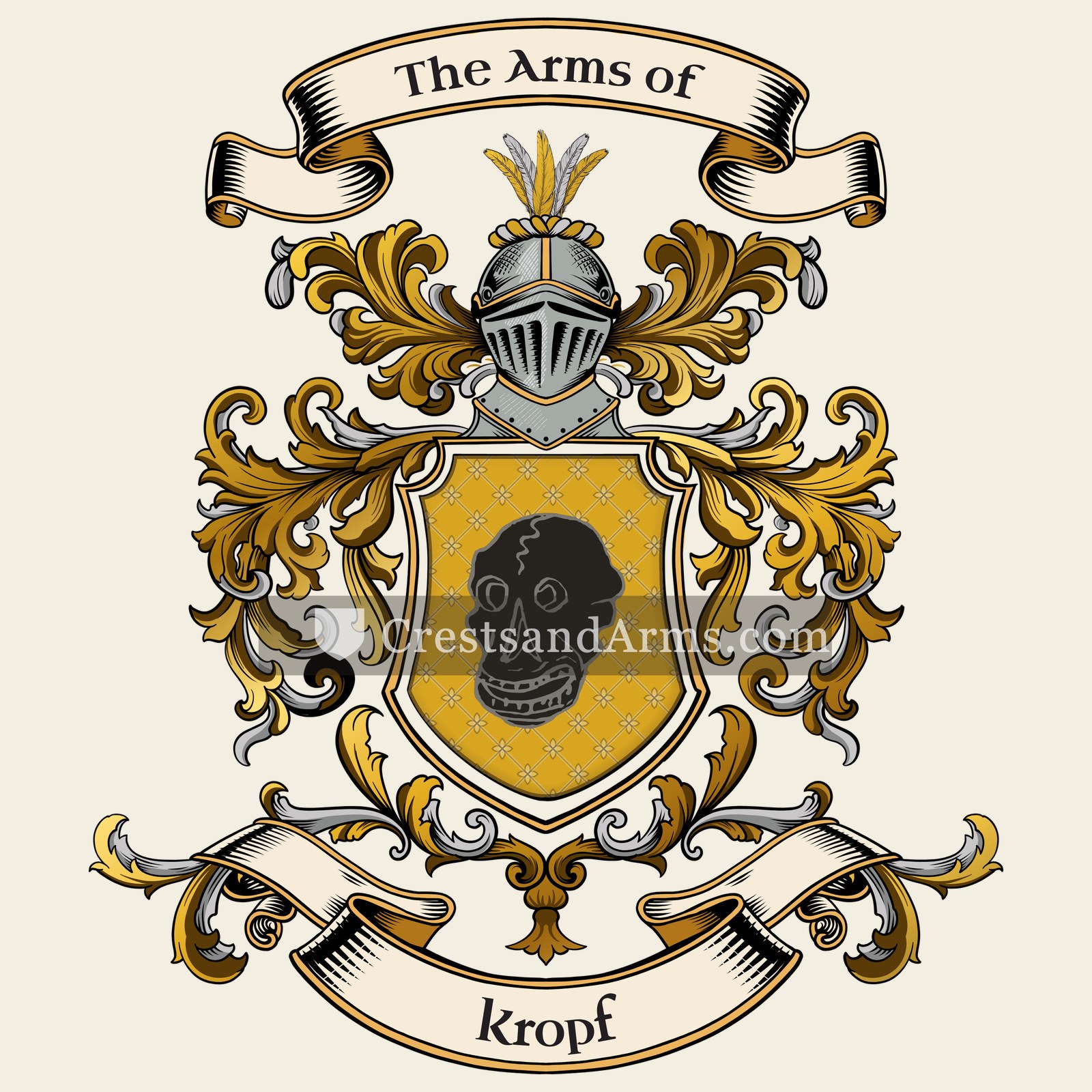
skullMortality remembered, and courage in the face of death
Colours
Gold (Or)Means: Generosity
Black (Sable)Means: Constancy
Historical info
Source
J. B. Rietstap, Armorial Général, Gouda: G. B. van Goor Zonen, 1884–87
Blazon (the actual original written record)
“D'or à un crâne de boeuf de sa. C.: une aigle iss. de sa.”
AlsaceAlsace, c. 1663
Digital archive packCoat of arms PNG, gold border print PDF, vector SVG and the certificate of authenticity. Sent to your email in minutes.
Map of France showing where the Kropf arms are recorded
The Kropf arms were recorded in Alsace, c. 1663.
Alsace lay between France and the German lands and belonged to both at different times. Its families held small estates and served whichever side ruled, and men who served in arms carried arms of their own.
This is where the arms were entered in the register. Families often moved to other parts of the country, so the same name can turn up in more than one region.
The body that granted and recorded arms in France in this period.
Louis XIV of France
Sovereign of the period
Louis XIV of France
1643–1715
Reigning in Germany when the Kropf arms are first recorded.
How Arms Worked in France
In France, a coat of arms was a mark of honor that passed down through the male line to all legitimate descendants. Families often used the same shield without changes to show their shared heritage. If a branch wanted to stand out, they could add a small mark to their shield to show their specific place in the family tree.
Granting authority
The Juge d'armes de France acted as the official authority that regulated and verified coats of arms across the country.
How they got arms
Families typically inherited their arms from ancestors, though they could also receive them through royal grants or by proving their noble status.
Where arms were recorded
Coats of arms were officially recorded in the Armorial Général de France, which began its main collection in the year 1696.
The family's standing
Recorded among the armigerous families of Alsace.
Origin & History of the Kropf Family in France
The family name Kropf has deep roots in the Alsace region, a territory that has historically shifted between French and German cultural influences. By the year 1663, records confirm that members of the Kropf family were already established residents in this area. The name itself is thought to originate from Middle High German, where the term "kropf" referred to a physical characteristic or a specific type of swelling, often used as a descriptive nickname for an ancestor. In the context of seventeenth-century Alsace, families like the Kropfs were typically part of the agrarian or artisan classes who navigated the complex social changes following the Thirty Years' War. As the region became more integrated into the French kingdom under Louis XIV, the family would have experienced the transition from local Germanic customs to the administrative structures of the French state. Throughout this period, the Kropfs remained closely tied to the land and the local parish records that documented their births, marriages, and deaths within the vibrant borderland of eastern France.
Related Branches & Arms
Root word
Krop
Middle High German term referring to a crop, craw, or goiter.
This name
KropfA nickname for a person with a prominent throat, a goiter, or a stout, pot-bellied appearance.
also spelled
Kropfe
Kropfh
Kropff
Documented Sources
J. B. Rietstap, Armorial Général, Gouda: G. B. van Goor Zonen, 1884–87
Bahlow, Hans, Deutsches Namenlexikon: Familien- und Vornamen nach Ursprung und Sinn erklärt, 1967
Heintze, Albert, Die deutschen Familien-Namen: geschichtlich, geographisch, sprachlich, 1903
Bayerisches Hauptstaatsarchiv, Bayerische Landesgeschichte: Steuerlisten und Personenstandsregister, 1560
Digital archive packCoat of arms PNG, gold border print PDF, vector SVG and the certificate of authenticity. Sent to your email in minutes.


 chevronProtection, and faithful service completed
 paleMilitary strength, and a fortified defence
 ringFidelity, and a promise kept
 chevronProtection, and faithful service completed
 paleMilitary strength, and a fortified defence
 ringFidelity, and a promise kept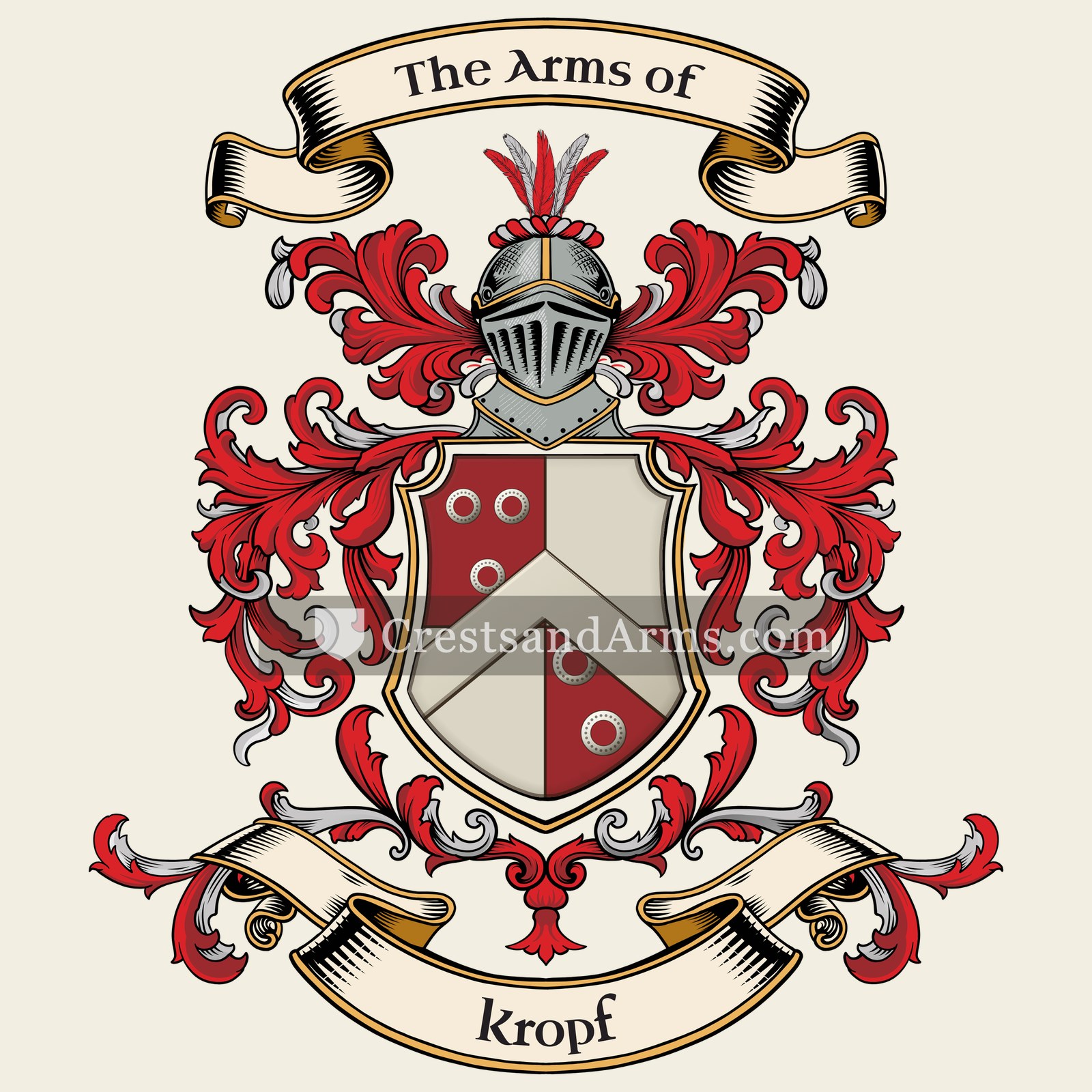


 skullMortality remembered, and courage in the face of death