A record of documented arms, meaning and origin, researched for the Kropp family lines. Documented in 2 countries.
Reg. 9107 · German, J–L
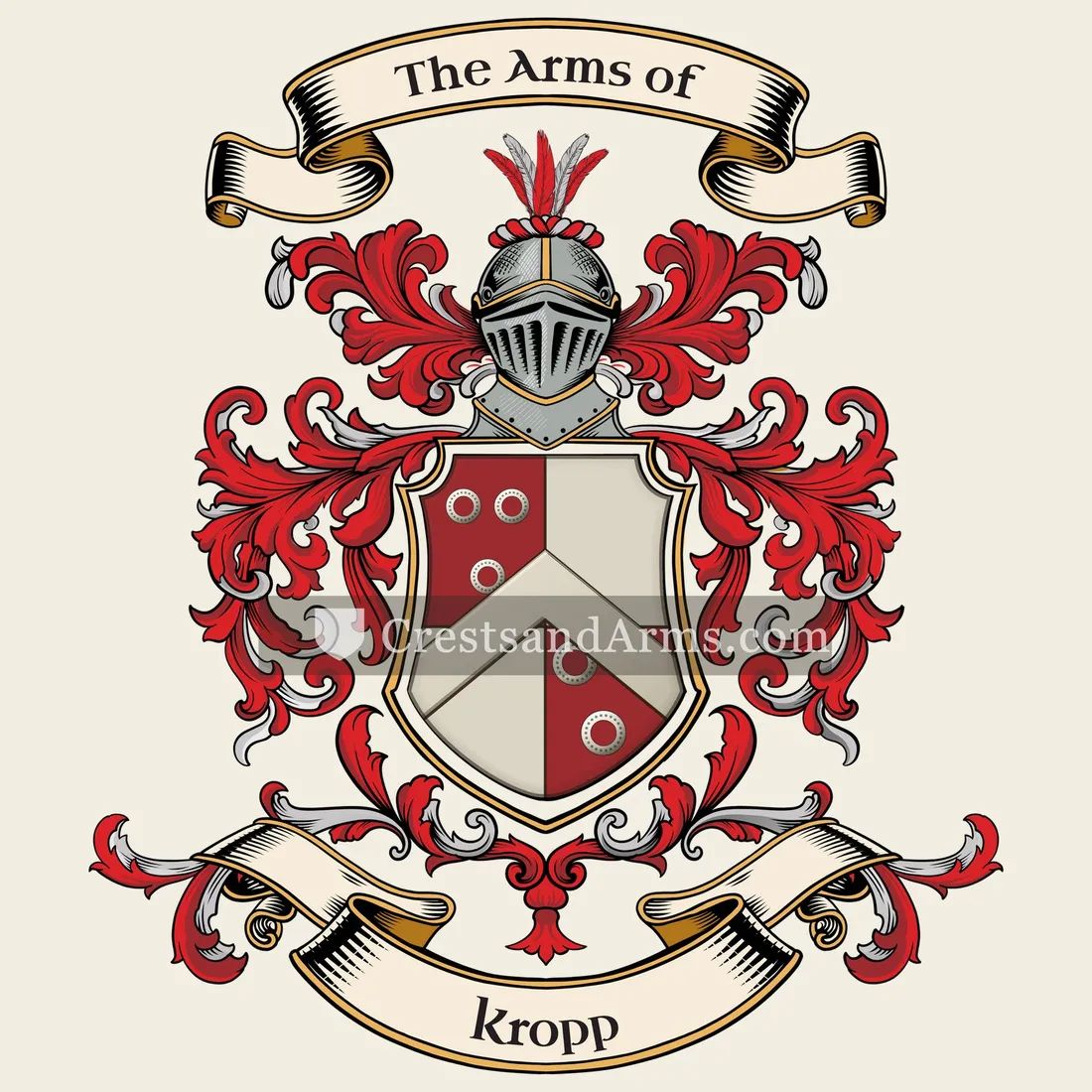
Meaning of the Kropp family crest colors & symbols
Symbols on this shield
chevronProtection, and faithful service completed
ringFidelity, and a promise kept
Colours
Red (Gules)Means: Military strength
Silver (Argent)Means: Peace and sincerity
Historical info
Source
J. B. Rietstap, Armorial Général, Gouda: G. B. van Goor Zonen, 1884–87
Blazon (the actual original written record)
“Ec.: aux 1 et 4 de gu., au chev. d'arg., acc. de trois annelets du même (Kropf); aux 2 et 3 d'arg. au pal de gu. Cq. cour. C.: trois clous de tente de gu., ayant chacun un annelet en haut à dextre; ou, trois épées, les pointes en bas.”
BavariaHan · Bavaria, c. 1560
Digital archive packCoat of arms PNG, gold border print PDF, vector SVG and the certificate of authenticity. Sent to your email in minutes.
Map of Germany showing where the Kropp arms are recorded
The Kropp arms were recorded in Bavaria, c. 1560.
Bavaria was a country of old landed families and walled market towns. Estates passed down the same line for centuries, and both the landowners and the leading townsmen kept arms, which is why so many Bavarian names sit in the registers.
This is where the arms were entered in the register. Families often moved to other parts of the country, so the same name can turn up in more than one region.
The body that granted and recorded arms in Germany in this period.
Ferdinand I, Holy Roman Emperor
Sovereign of the period
Ferdinand I, Holy Roman Emperor
1556–1564
Reigning in Germany when the Kropp arms are first recorded.
How Arms Worked in Germany
In the Holy Roman Empire, coats of arms were often granted to individuals by the Emperor or his representatives. These arms were then passed down through the generations to all legitimate descendants of the original holder. Younger branches of a family usually kept the same shield design without needing to change it, as the arms belonged to the entire lineage.
Granting authority
The Holy Roman Emperor held the sole power to grant new coats of arms throughout his vast imperial territories.
How they got arms
Families typically obtained their coats of arms through a formal imperial grant or by proving their noble status to the authorities.
Where arms were recorded
These grants were officially recorded in the Imperial Chancery registers, which began keeping formal records of such honors during the Middle Ages.
The family's standing
Recorded among the armigerous families of Bavaria.
Origin & History of the Kropp Family in Germany
The surname Kropp emerged in the German-speaking regions as a descriptive name rooted in Middle High German. It likely originated as a nickname for a person with a hunched posture or a physical deformity, as the word "kropf" historically referred to a goiter or a swelling of the neck. By the mid-16th century, the family had established a notable presence in the Bavarian region. During this era, life in Bavaria was defined by the strict social hierarchies of the Holy Roman Empire and the religious shifts of the Reformation. Families like the Kropps were often tied to the land or specific local trades, living in small village communities where their name served as a permanent identifier in parish registers and tax records. As the family grew, they became part of the local fabric of southern Germany, contributing to the agricultural and craft-based economy that sustained the Bavarian countryside for generations.
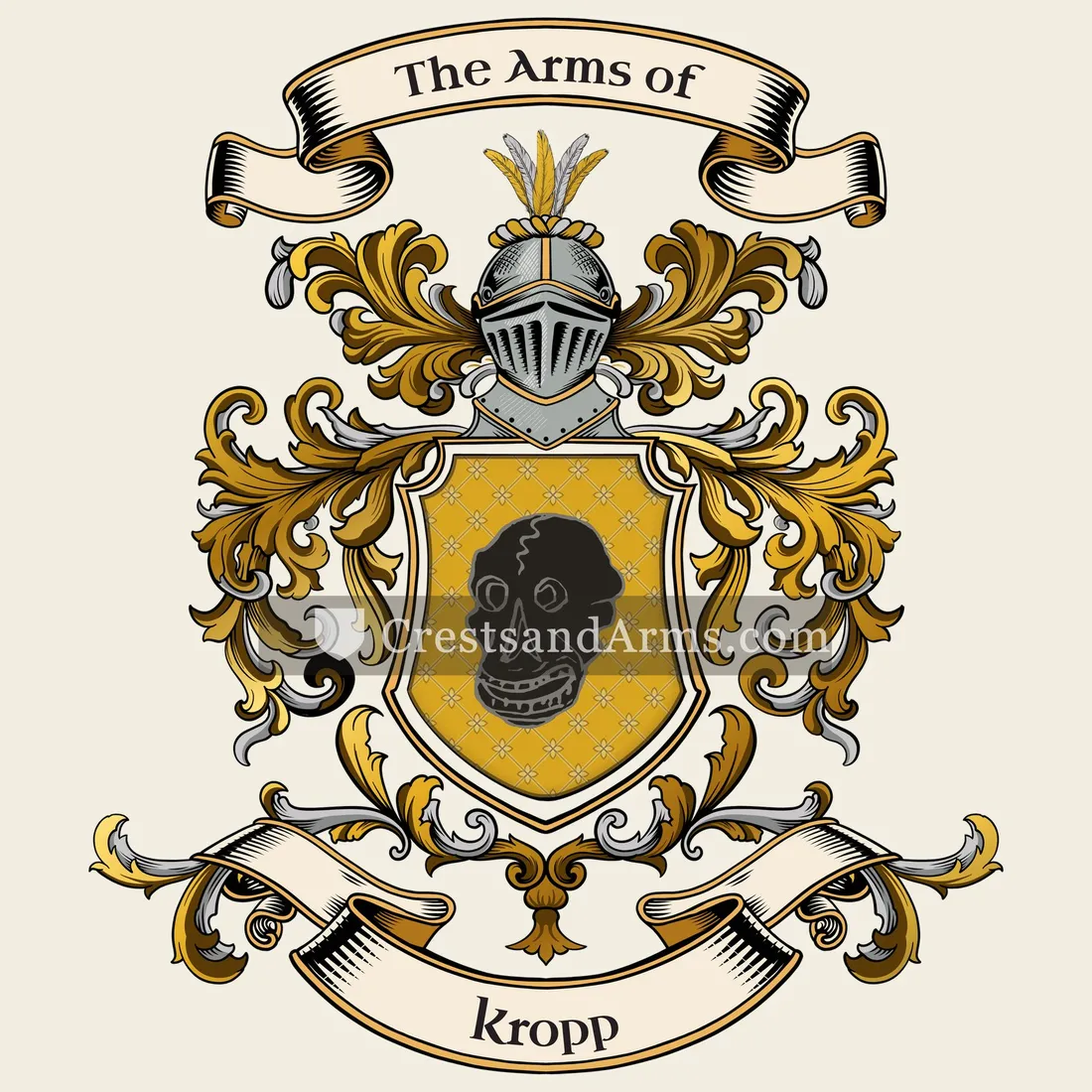
Meaning of the Kropp family crest colors & symbols
Symbols on this shield
skullMortality remembered, and courage in the face of death
Colours
Gold (Or)Means: Generosity
Black (Sable)Means: Constancy
Historical info
Source
J. B. Rietstap, Armorial Général, Gouda: G. B. van Goor Zonen, 1884–87
Blazon (the actual original written record)
“D'or à un crâne de boeuf de sa. C.: une aigle iss. de sa.”
AlsaceAlsace, c. 1663
Digital archive packCoat of arms PNG, gold border print PDF, vector SVG and the certificate of authenticity. Sent to your email in minutes.
Map of France showing where the Kropp arms are recorded
The Kropp arms were recorded in Alsace, c. 1663.
Alsace lay between France and the German lands and belonged to both at different times. Its families held small estates and served whichever side ruled, and men who served in arms carried arms of their own.
This is where the arms were entered in the register. Families often moved to other parts of the country, so the same name can turn up in more than one region.
The body that granted and recorded arms in France in this period.
Louis XIV of France
Sovereign of the period
Louis XIV of France
1643–1715
Reigning in Germany when the Kropp arms are first recorded.
How Arms Worked in France
In France, a coat of arms was a mark of honor that passed down through the male line to all legitimate descendants. Families often used the same shield without changes to show their shared heritage. If a branch wanted to stand out, they could add a small mark to their shield to show their specific place in the family tree.
Granting authority
The Juge d'armes de France acted as the official authority that regulated and verified coats of arms across the country.
How they got arms
Families typically inherited their arms from ancestors, though they could also receive them through royal grants or by proving their noble status.
Where arms were recorded
Coats of arms were officially recorded in the Armorial Général de France, which began its main collection in the year 1696.
The family's standing
Recorded among the armigerous families of Alsace.
Origin & History of the Kropp Family in France
The family name Kropp has deep roots in the Alsace region, a territory that has long served as a cultural bridge between France and its neighbors. By 1663, records confirm that members of the Kropp family were established in this area, living through a period of significant transition as Alsace became increasingly integrated into the French kingdom under Louis XIV. The name itself likely originated as a descriptive term in the Germanic dialects common to the region, often referring to a person with a distinct physical build or someone who lived near a specific geographical feature. Life for the Kropp family in the seventeenth century would have been defined by the rhythms of rural village existence, where they likely worked as farmers or skilled tradespeople. As the region shifted between different political influences, families like the Kropps maintained their presence by adapting to the changing administrative requirements of the French crown while preserving their local community ties. This early history reflects the broader story of Alsatian families who navigated the complexities of life in a borderland where language and culture blended over many generations.
Kropp Meaning & Related Branches
Root word
Krop
Middle High German term for a crop, craw, or swelling.
This name
KroppA nickname for a person with a goiter or a protruding physical feature.
also spelled
Kropfe
Kropfh
Kropff
Documented Sources
J. B. Rietstap, Armorial Général, Gouda: G. B. van Goor Zonen, 1884–87
Bahlow, Hans, Deutsches Namenlexikon: Familien- und Vornamen nach Ursprung und Sinn erklärt, 1967
Heintze, Albert, Die deutschen Familien-Namen: geschichtlich, geographisch, sprachlich, 1903


 chevronProtection, and faithful service completed
 ringFidelity, and a promise kept
 chevronProtection, and faithful service completed
 ringFidelity, and a promise kept


 skullMortality remembered, and courage in the face of death