A record of documented arms, meaning and origin, researched for the Kruit family lines. Documented in 2 countries.
Reg. 9661 · German, J–L
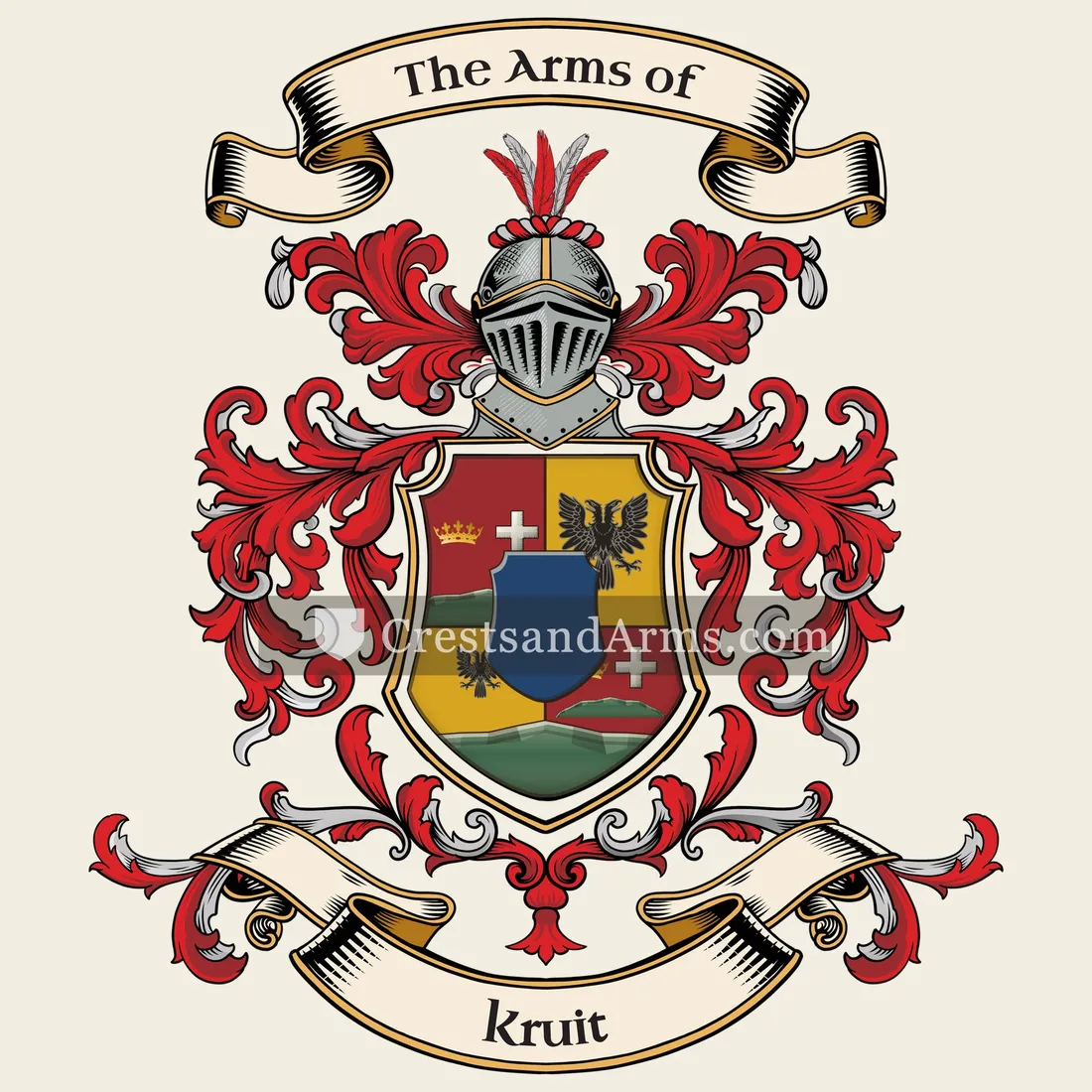
Meaning of the Kruit family crest colors & symbols
Symbols on this shield
mountThe ground held, and steadfastness upon it
cross symbolChristian faith and service
crownSovereignty, authority and just reward
eagleNobility, strength and a keen mind
Colours
Red (Gules)Means: Military strength
Gold (Or)Means: Generosity
Blue (Azure)Means: Loyalty and truth
Green (Vert)Means: Hope
Silver (Argent)Means: Peace and sincerity
Black (Sable)Means: Constancy
Historical info
Source
J. B. Rietstap, Armorial Général, Gouda: G. B. van Goor Zonen, 1884–87
Blazon (the actual original written record)
“Ec.: aux 1 et 4 de gu. à un tertre de sin., supp. une couronne d'or, de laquelle s'élève une croix de Lorraine d'arg.; aux 2 et 3 d'or à l'aigle de sa., bq., m. et cour. du champ, celle du 3 cont. Sur le tout coupé: a. d'azur à une fleur-de-lis d'arg.; b. d'arg. à trois pommes de gu., les queues en bas. Cq. cour. C.: les meubles du 1. L.: à dextre d'arg. et d'azur, à sen. d'or et de gu.”
Germanyc. 1703
Digital archive packCoat of arms PNG, gold border print PDF, vector SVG and the certificate of authenticity. Sent to your email in minutes.
Map of Germany showing where the Kruit arms are recorded
The Kruit arms were recorded in Germany, c. 1703.
Arms such as these were typically recorded in Bavaria.
Bavaria was a country of old landed families and walled market towns. Estates passed down the same line for centuries, and both the landowners and the leading townsmen kept arms, which is why so many Bavarian names sit in the registers.
This is where the arms were entered in the register. Families often moved to other parts of the country, so the same name can turn up in more than one region.
The body that granted and recorded arms in Germany in this period.
Leopold I, Holy Roman Emperor
Sovereign of the period
Leopold I, Holy Roman Emperor
1658–1705
Reigning in Germany when the Kruit arms are first recorded.
How Arms Worked in Germany
In the Holy Roman Empire, coats of arms were often granted to individuals by the Emperor or his representatives. These arms were then passed down through the generations to all legitimate descendants of the original holder. Younger branches of a family usually kept the same shield design without needing to change it, as the arms belonged to the entire lineage.
Granting authority
The Holy Roman Emperor held the sole power to grant new coats of arms throughout his vast imperial territories.
How they got arms
Families typically obtained their coats of arms through a formal imperial grant or by proving their noble status to the authorities.
Where arms were recorded
These grants were officially recorded in the Imperial Chancery registers, which began keeping formal records of such honors during the Middle Ages.
The family's standing
Recorded among the armigerous families of Germany.
Origin & History of the Kruit Family in Germany
The surname Kruit is rooted in the linguistic traditions of the German-speaking regions, where it likely functioned as a descriptive name related to the Middle High German word *krūt*, meaning herb, spice, or cabbage. By the early 18th century, records confirm that members of the Kruit family were established in the Bavarian region. During this period, Bavaria was a landscape defined by small agricultural communities and strict social hierarchies under the rule of the Wittelsbach dynasty. Families like the Kruits were often tied to the land, and their surname may have originally identified a person who worked as a gardener or a merchant who sold medicinal herbs and spices in local markets. As the family lived through the turbulent years of the War of the Spanish Succession, which heavily impacted Bavaria in 1703, they likely navigated the challenges of military occupation and shifting political loyalties while maintaining their presence in the region. This early history reflects a life deeply connected to the local economy and the rural traditions of southern Germany.
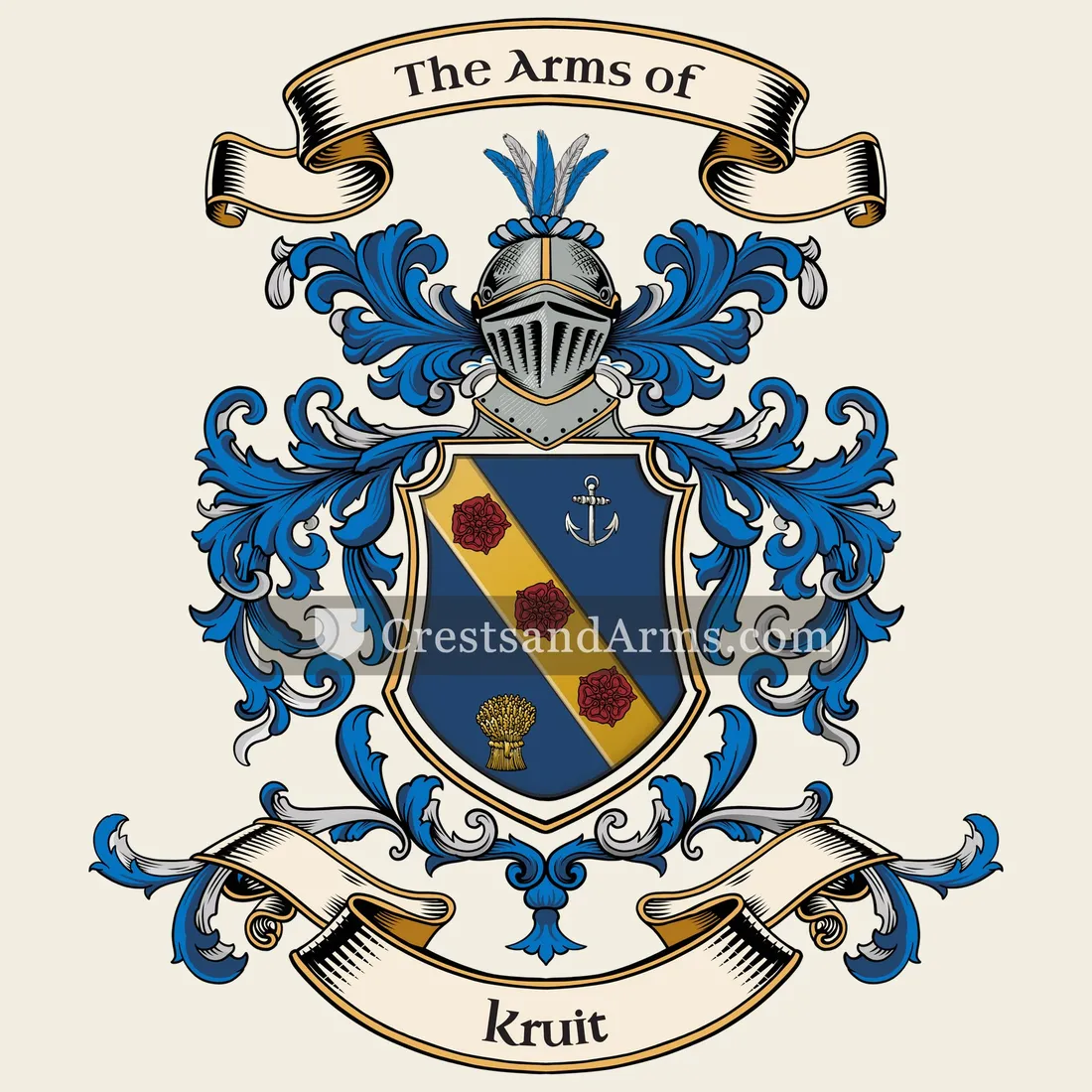
Meaning of the Kruit family crest colors & symbols
Symbols on this shield
bendDefence, and the scarf of a commander
roseThe seventh son, and beauty with grace
anchorHope, and steadfastness in trouble
wheatsheafPlenty, and the harvest of one's own labour
Colours
Blue (Azure)Means: Loyalty and truth
Gold (Or)Means: Generosity
Red (Gules)Means: Military strength
Silver (Argent)Means: Peace and sincerity
Historical info
Source
J. B. Rietstap, Armorial Général, Gouda: G. B. van Goor Zonen, 1884–87
Blazon (the actual original written record)
“D'azur à la bande d'or, ch. de trois roses de gu., acc. en chef d'une ancre d'arg. en bande et en p. d'une gerbe d'or en bande. Deux cq. cour. C.: 1° trois roses de gu., bout. d'or, tigées et feuillées de sin.; entre deux prob. coupés alt. d'azur et d'or; l. d'or et d'azur; 2° un vol à l'antique d'azur, ch. d'une bande d'or; l. d'arg. et de gu.”
Austriac. 1792
Digital archive packCoat of arms PNG, gold border print PDF, vector SVG and the certificate of authenticity. Sent to your email in minutes.
Map of Austria showing where the Kruit arms are recorded
The Kruit arms were recorded in Austria, c. 1792.
Arms such as these were typically recorded in Tyrol.
Tyrol was mountain country in western Austria, where the valleys were held by families who had been there a very long time. Old tenure counted for more than money, and old families carried arms.
This is where the arms were entered in the register. Families often moved to other parts of the country, so the same name can turn up in more than one region.
Region
Tyrol
First recorded
1792
Granting Authority for the Kruit Arms
Imperial and Royal chancery
Sodacan · CC BY-SA 3.0
The body that granted and recorded arms in Austria in this period.
Leopold II, Holy Roman Emperor
Sovereign of the period
Leopold II, Holy Roman Emperor
1790–1792
Reigning in Germany when the Kruit arms are first recorded.
How Arms Worked in Austria
Austrian coats of arms were often linked directly to noble titles granted by the Emperor. These symbols belonged to the entire family line rather than just one individual. When a family grew, new branches kept the original design without needing to change it. This system allowed all members of a noble house to share the same identity across many generations.
Granting authority
The Imperial and Royal chancery managed all heraldic matters and controlled the official granting of arms throughout the Austrian lands.
How they got arms
Families typically received their arms through a formal imperial decree that often accompanied the elevation of a person to noble status.
Where arms were recorded
Official records of these grants were kept in the Imperial Register of Nobility which began its formal documentation process in 1453.
The family's standing
Recorded among the armigerous families of Austria.
Origin & History of the Kruit Family in Austria
The family name Kruit finds its roots in the rugged landscape of the Austrian Tyrol, where records confirm the presence of family members as early as 1792. During this period, the region was defined by its mountainous terrain and a culture deeply tied to alpine agriculture and local trade. Families with this name likely lived as independent farmers or skilled laborers who navigated the complex social structures of the Habsburg monarchy. Because Tyrol served as a vital crossroads for travel between northern and southern Europe, the Kruit family members were positioned to witness significant shifts in regional politics and daily life. Their survival and growth in such a demanding environment suggest a history of resilience and adaptation to the changing economic conditions of the late eighteenth century. By maintaining their presence in these alpine valleys, the early Kruit ancestors helped shape the local community identity that persisted long after the Napoleonic era began to reshape the borders of the region.
Kruit Meaning & Related Branches
Root word
Kraut
A Middle High German term referring to herbs, vegetables, or cabbage.
This name
KruitAn occupational surname for a gardener, vegetable grower, or herb merchant.
also spelled
Krauter
Krauten
Documented Sources
J. B. Rietstap, Armorial Général, Gouda: G. B. van Goor Zonen, 1884–87
Bavarian State Archives (Bayerisches Hauptstaatsarchiv), Kurbayern Hofkammer Buchhaltung
Heintze, Albert, Die deutschen Familiennamen: geschichtlich, geographisch, sprachlich, 1903
Kohlheim, Rosa and Volker Kohlheim, Duden Familiennamen: Herkunft und Bedeutung von 20.000 Nachnamen, 2005
Digital archive packCoat of arms PNG, gold border print PDF, vector SVG and the certificate of authenticity. Sent to your email in minutes.


 mountThe ground held, and steadfastness upon it
 cross symbolChristian faith and service
 crownSovereignty, authority and just reward
 eagleNobility, strength and a keen mind
 mountThe ground held, and steadfastness upon it
 cross symbolChristian faith and service
 crownSovereignty, authority and just reward
 eagleNobility, strength and a keen mind


 bendDefence, and the scarf of a commander
 roseThe seventh son, and beauty with grace
 anchorHope, and steadfastness in trouble
 wheatsheafPlenty, and the harvest of one's own labour