Map of Netherlands showing where the Krull arms are recorded
The Krull arms were recorded in Netherlands, c. 1815.
Arms such as these were typically recorded in Friesland.
Friesland was low, wet country on the northern coast of the Netherlands, farmed by families who had held the same land for centuries. Free landholders were unusually common there, and a free landholder could carry arms.
This is where the arms were entered in the register. Families often moved to other parts of the country, so the same name can turn up in more than one region.
Region
Friesland
First recorded
1815
Granting Authority for the Krull Arms
Hoge Raad van Adel
Photograph made by me · CC BY-SA 3.0
The body that granted and recorded arms in Netherlands in this period.
William I of the Netherlands
Sovereign of the period
William I of the Netherlands
1815–1840
Reigning in Netherlands when the Krull arms are first recorded.
How Arms Worked in Netherlands
In the Netherlands, coats of arms were often used by noble families and those who held specific public offices. These arms were passed down through the generations to legitimate descendants. Younger branches of a family usually kept the original design without needing to add special marks. This system ensured that the family identity remained clear and consistent over many years.
Granting authority
The Hoge Raad van Adel is the official body that regulates and manages noble titles and coats of arms in the Netherlands.
How they got arms
Families typically obtained their coats of arms through official royal grants or by proving their long-standing historical use of the symbols.
Where arms were recorded
Coats of arms are officially recorded in the registers held by the Hoge Raad van Adel, which began its work in 1814.
The family's standing
Recorded among the armigerous families of Netherlands.
Origin & History of the Krull Family in Netherlands
The surname Krull has deep roots in the northern regions of the Netherlands, particularly within the province of Friesland. In the Dutch language, the word *krul* refers to a curl, which likely served as a descriptive nickname for an ancestor with curly hair. By the early 19th century, the family was well-established in the Frisian landscape, a region known for its distinct language and independent cultural history. During this period, the Napoleonic administration required citizens to register permanent surnames for official civil records. This transition helped solidify the Krull name as a formal family identity across local parish and municipal registers. These early family members were often part of the rural community, living in a society that valued trade, agriculture, and strong maritime connections. The persistence of the name in Frisian records from 1815 onward reflects the family's integration into the social and administrative fabric of the Netherlands during a time of significant national change.
Meaning of the Krull family crest colors & symbols
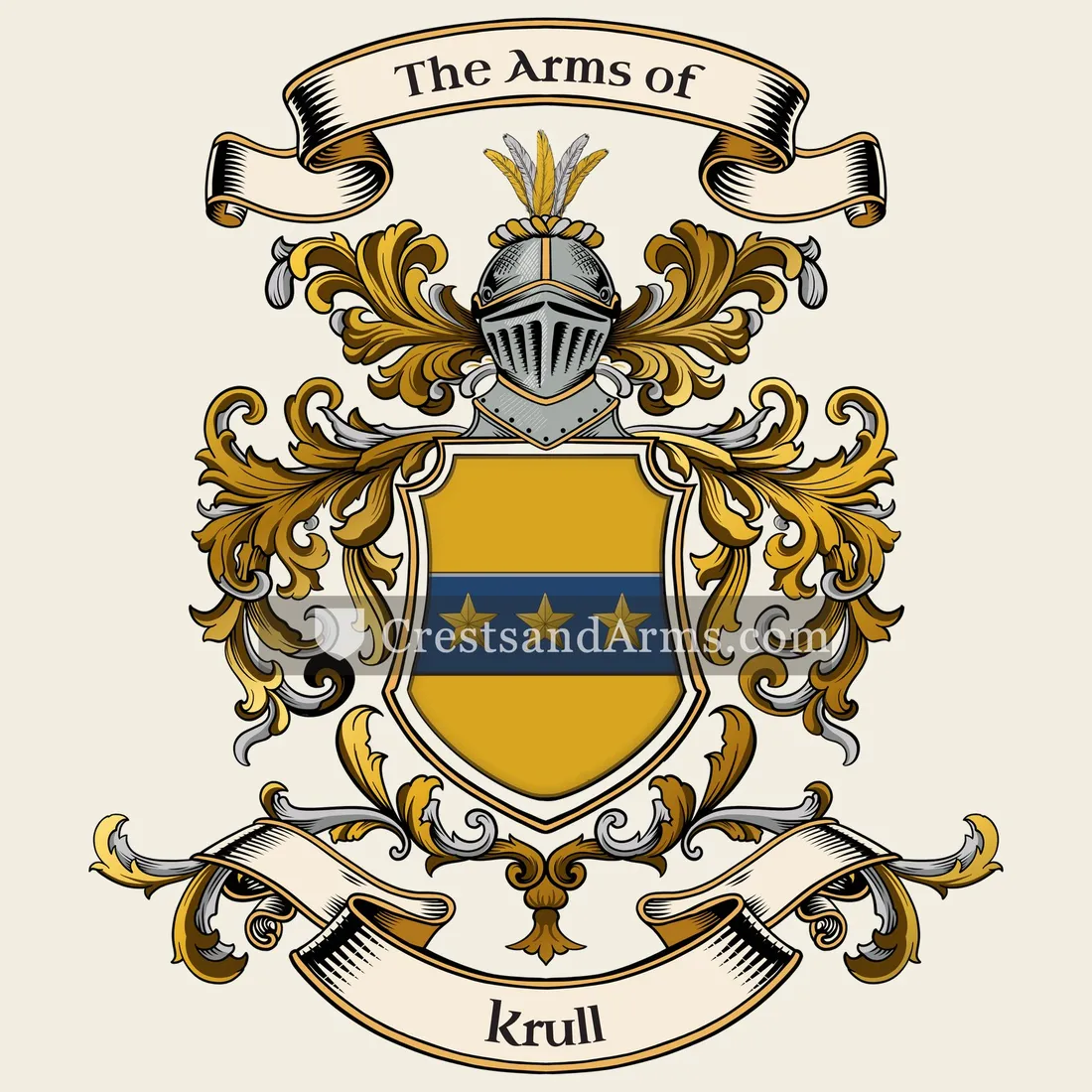
Symbols on this shield
fessThe military belt, and readiness to serve
mulletThe third son, and a divine quality from above
Colours
Gold (Or)Means: Generosity
Blue (Azure)Means: Loyalty and truth
Historical info
Source
J. B. Rietstap, Armorial Général, Gouda: G. B. van Goor Zonen, 1884–87
Blazon (the actual original written record)
“D'or à la fasce d'azur, ch. de trois étoiles du champ. C.: un homme iss., chevelé d'or, hab. d'un parti d'azur et d'or, au rabat de l'un en l'autre, ceint et rebr. de l'un en l'autre, tenant de sa main dextre une étoile d'or, la sen. posée sur son estomac.”
GermanyMecklembourg-Schwerin, c. 1765
Digital archive packCoat of arms PNG, gold border print PDF, vector SVG and the certificate of authenticity. Sent to your email in minutes.
Map of Germany showing where the Krull arms are recorded
The Krull arms were recorded in Mecklembourg-Schwerin, c. 1765.
This is where the arms were entered in the register. Families often moved to other parts of the country, so the same name can turn up in more than one region.
The body that granted and recorded arms in Germany in this period.
Francis I, Holy Roman Emperor
Sovereign of the period
Francis I, Holy Roman Emperor
1745–1765
Reigning in Netherlands when the Krull arms are first recorded.
How Arms Worked in Germany
In the Holy Roman Empire, coats of arms were often granted to individuals by the Emperor or his representatives. These arms were then passed down through the generations to all legitimate descendants of the original holder. Younger branches of a family usually kept the same shield design without needing to change it, as the arms belonged to the entire lineage.
Granting authority
The Holy Roman Emperor held the sole power to grant new coats of arms throughout his vast imperial territories.
How they got arms
Families typically obtained their coats of arms through a formal imperial grant or by proving their noble status to the authorities.
Where arms were recorded
These grants were officially recorded in the Imperial Chancery registers, which began keeping formal records of such honors during the Middle Ages.
The family's standing
Recorded among the armigerous families of Germany.
Origin & History of the Krull Family in Germany
The surname Krull has deep roots in the northern regions of Germany, particularly within the historic territory of Mecklenburg-Schwerin. Linguists believe the name originated as a descriptive nickname, likely derived from the Middle Low German word "krul," which refers to curly or frizzy hair. During the eighteenth century, families bearing this name were well-established in the rural landscapes of this Baltic region. By 1765, records confirm that individuals named Krull were active members of these local communities, likely working as farmers or tradesmen. Because Mecklenburg-Schwerin was a region defined by its feudal structure and agricultural economy, the family name became tied to the specific social and economic developments of the area. Over generations, the name persisted as a mark of identity for families living in the villages and towns of northern Germany, reflecting the common practice of using physical traits to distinguish one family from another in a growing population.
Krull Meaning & Related Branches
Root word
Krulle
Middle Dutch term for someone with curly or frizzy hair.
This name
KrullA descriptive nickname for an individual characterized by having curly hair.
also spelled
Krul
Related arms
Pabst d'Ohainsimilar arms
Crullvariant spelling
Krulvariant spelling
Nussbaumrecorded with Krull, same area
Documented Sources
J. B. Rietstap, Armorial Général, Gouda: G. B. van Goor Zonen, 1884–87
Meertens, P.J., De betekenis van de Nederlandse familienamen, 1950
Van der Schaar, J., Woordenboek van voornamen, 1964
AlleFriezen, Burgerlijke Stand Friesland (Civil Registry of Friesland), 1811–1950
Nationaal Archief, Registers van de Burgerlijke Stand (Civil Registry Records), 1811–1815
Digital archive packCoat of arms PNG, gold border print PDF, vector SVG and the certificate of authenticity. Sent to your email in minutes.




 fessThe military belt, and readiness to serve
 mulletThe third son, and a divine quality from above