Map of Germany showing where the Krys arms are recorded
The Krys arms were recorded in Swabia, c. 1765.
Swabia was broken into a great many small territories in southern Germany, and each had its own landowners and its own leading townsmen. That fragmentation produced an unusual number of families with arms.
This is where the arms were entered in the register. Families often moved to other parts of the country, so the same name can turn up in more than one region.
The body that granted and recorded arms in Germany in this period.
Francis I, Holy Roman Emperor
Sovereign of the period
Francis I, Holy Roman Emperor
1745–1765
Reigning in Germany when the Krys arms are first recorded.
How Arms Worked in Germany
In the Holy Roman Empire, coats of arms were often granted to individuals by the Emperor or his representatives. These arms were then passed down through the generations to all legitimate descendants of the original holder. Younger branches of a family usually kept the same shield design without needing to change it, as the arms belonged to the entire lineage.
Granting authority
The Holy Roman Emperor held the sole power to grant new coats of arms throughout his vast imperial territories.
How they got arms
Families typically obtained their coats of arms through a formal imperial grant or by proving their noble status to the authorities.
Where arms were recorded
These grants were officially recorded in the Imperial Chancery registers, which began keeping formal records of such honors during the Middle Ages.
The family's standing
Recorded among the armigerous families of Swabia.
Origin & History of the Krys Family in Germany
The family name Krys finds its historical roots in the region of Swabia, a historic area in southwestern Germany known for its distinct cultural identity and complex social structure. By the year 1765, records confirm that members of the Krys family were well-established within this landscape, living through a period defined by agricultural transition and the influence of the Holy Roman Empire. The name itself likely evolved from regional dialects, possibly functioning as a shortened form of longer given names or as a descriptive nickname used to identify individuals within small, tight-knit village communities. During the eighteenth century, families in Swabia were often tied to the land through tenant farming or skilled craftsmanship, meaning the Krys ancestors were likely active participants in the local guilds and parish life that formed the backbone of German society at the time. This era was marked by significant social stability, allowing families to maintain deep roots in specific towns for generations as they navigated the changing political climate of the German states.
Krys Meaning & Related Branches
Root word
Christophorus
Bearer of Christ
This name
KrysA shortened German variant derived from the Greek name meaning Christ-bearer.
also spelled
Kreys
Kreysse
Kreyssh
Krys
Documented Sources
J. B. Rietstap, Armorial Général, Gouda: G. B. van Goor Zonen, 1884–87
Bader, Karl S., Der deutsche Südwesten in seiner territorialgeschichtlichen Entwicklung, 1978
Staatsarchiv Ludwigsburg, Bestand B 157 (Reichskammergerichtsprozesse)
Zimmermann, Volker, Die schwäbische Gesellschaft im 18. Jahrhundert, 1995
Digital archive packCoat of arms PNG, gold border print PDF, vector SVG and the certificate of authenticity. Sent to your email in minutes.


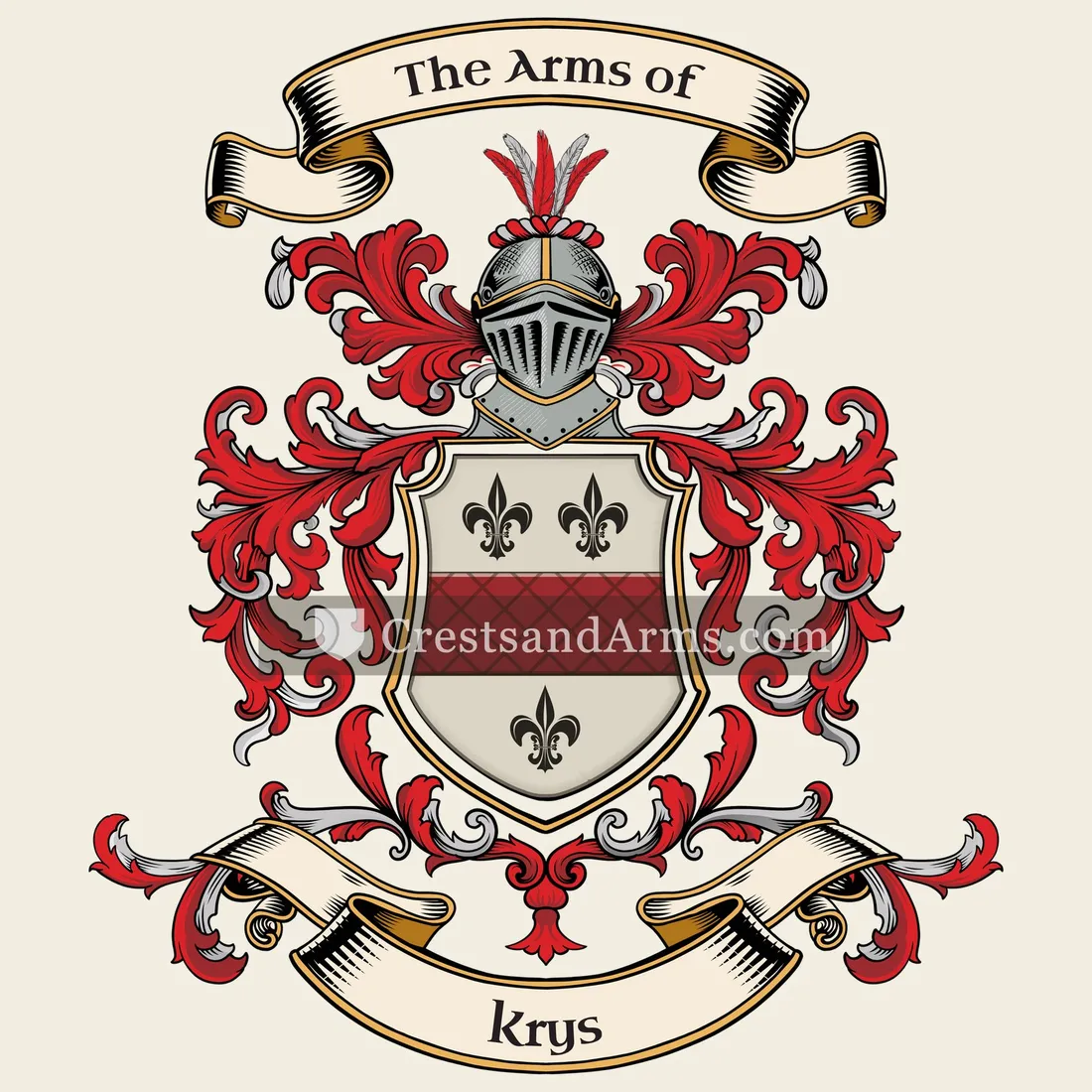
 fessThe military belt, and readiness to serve
 fleur de lisPurity, light, and the sixth son
 fessThe military belt, and readiness to serve
 fleur de lisPurity, light, and the sixth son