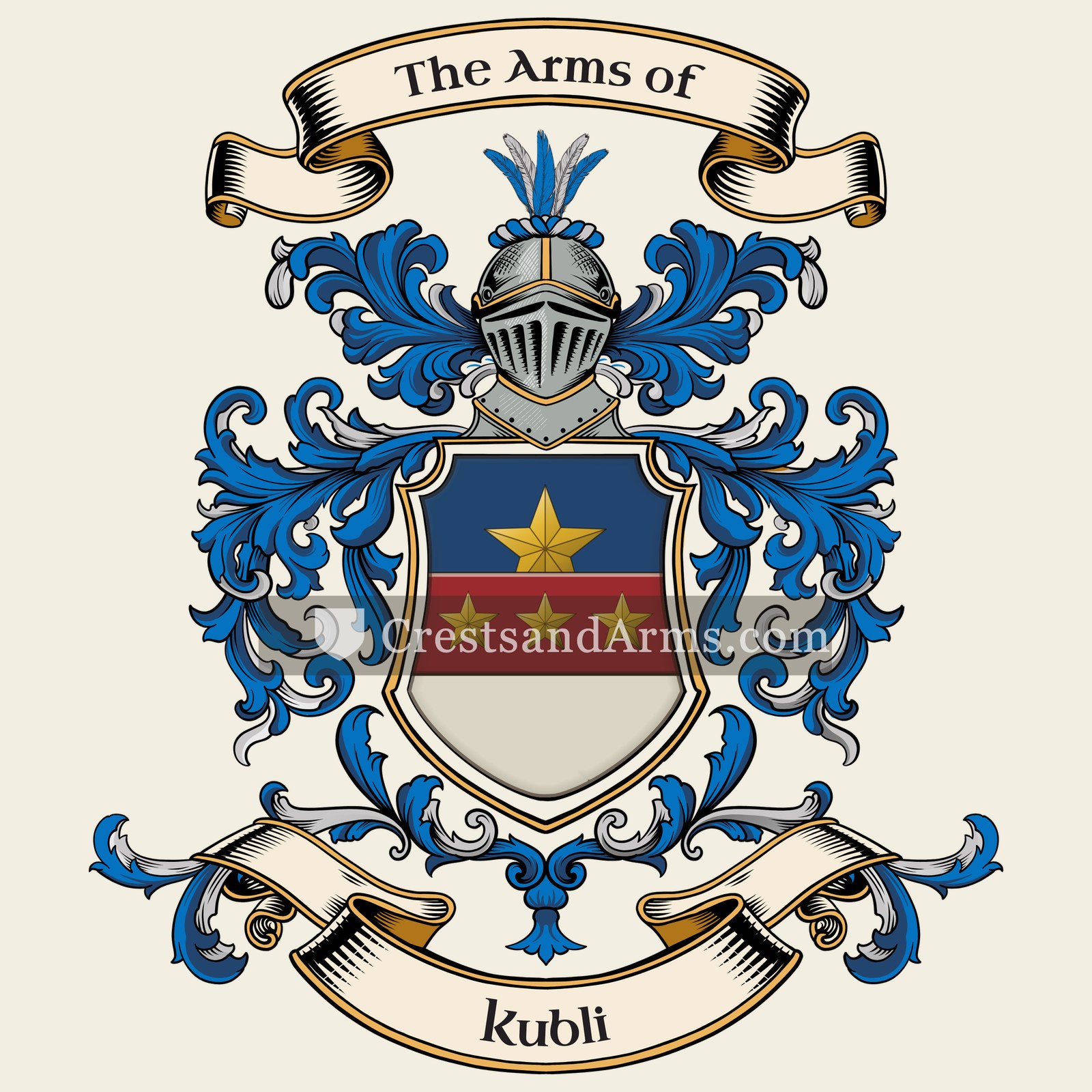
A record of documented arms, meaning and origin, researched for the Kubli family of Switzerland.
Reg. 4693 · Swiss, J–L
Coat of Arms & Family Crest Details
Symbols on this shield
fessThe military belt, and readiness to serve
mulletThe third son, and a divine quality from above
Colours
Blue (Azure)Means: Loyalty and truth
Silver (Argent)Means: Peace and sincerity
Red (Gules)Means: Military strength
Gold (Or)Means: Generosity
Historical info
Source
J. B. Rietstap, Armorial Général, Gouda: G. B. van Goor Zonen, 1884–87
Blazon (the actual original written record)
“Coupé, d'azur à une étoile d'or, sur arg. plein; à la fasce de gu., br. sur le coupé et ch. de trois étoiles d'or. C.: un homme iss., hab. de gu., au rabat d'arg., coiffé d'un bonnet albanais de gu., retr. d'arg., tenant de sa main dextre une branche feuillée d'or, la sen. appuyée sur sa hanche. L.: à dextre d'arg. et de gu., à sen. d'or et d'azur.”
SwitzerlandCoire, c. 1725
Digital archive packCoat of arms PNG, gold border print PDF, vector SVG and the certificate of authenticity. Sent to your email in minutes.
Map of Switzerland showing where the Kubli arms are recorded
The Kubli arms were recorded in Coire, c. 1725.
This is where the arms were entered in the register. Families often moved to other parts of the country, so the same name can turn up in more than one region.
The body that granted and recorded arms in Switzerland in this period.
How Arms Worked in Switzerland
In Switzerland, coats of arms were not restricted to the nobility and were often adopted by common citizens and families. These symbols were passed down through generations to show family identity. When branches of a family grew, they often changed small details of the design to distinguish their own line from the original group.
Granting authority
Cantonal and civic authorities managed the use of coats of arms within their specific regions and local jurisdictions.
How they got arms
Families typically assumed their own coats of arms based on local custom rather than receiving them from a central monarch.
Where arms were recorded
Arms were recorded in various cantonal and civic registers starting from the fourteenth century throughout the Swiss region.
The family's standing
Recorded among the armigerous families of Switzerland.
Origin & History of the Kubli Family in Switzerland
The family name Kubli traces its deep roots to the mountainous regions of eastern Switzerland, particularly within the canton of Glarus. Historical records confirm that members of the family were well-established in the city of Coire, also known as Chur, by 1725. During this era, the family was deeply integrated into the local social and economic life of the Grisons region. Many individuals bearing the name were recognized as citizens who participated in the governance and trade networks that defined life in the high Alpine valleys. Over the centuries, the Kubli name became synonymous with the resilient spirit of the Swiss mountain communities, reflecting a long history of migration and settlement across the rugged landscape of the eastern cantons.
Related Branches & Arms
Root word
Jakob
Derived from the Hebrew name Yaakov meaning supplanter or holder of heel.
This name
KubliA diminutive form originating from the Swiss-German region referring to a descendant of Jacob.
also spelled
Kubly
Documented Sources
J. B. Rietstap, Armorial Général, Gouda: G. B. van Goor Zonen, 1884–87
Gottfried Heer, Glarner Geschichte in drei Bänden, 1900
Staatsarchiv Graubünden, Bürgerrodel der Stadt Chur, 1725
Historisches Lexikon der Schweiz, Kubli, 2009
Digital archive packCoat of arms PNG, gold border print PDF, vector SVG and the certificate of authenticity. Sent to your email in minutes.


 fessThe military belt, and readiness to serve
 mulletThe third son, and a divine quality from above
 fessThe military belt, and readiness to serve
 mulletThe third son, and a divine quality from above