Map of Russia showing where the Kuc arms are recorded
The Kuc arms were recorded in Russia, c. 1784.
Arms such as these were typically recorded in Moscow.
Moscow held the Russian court, and rank there came from service rather than land. Families who served the Tsar were entered in the registers of nobility, and that entry is where their arms are recorded.
This is where the arms were entered in the register. Families often moved to other parts of the country, so the same name can turn up in more than one region.
The body that granted and recorded arms in Russia in this period.
Catherine II of Russia
Sovereign of the period
Catherine II of Russia
1762–1796
Reigning in Russia when the Kuc arms are first recorded.
How Arms Worked in Russia
Russian heraldry was strictly tied to the nobility and the state service system. Families proved their ancient status or earned new rank to receive an official grant from the Tsar. These symbols were then inherited by all legitimate children of the noble line. If a family lacked proof of their status, they were often excluded from the official records entirely.
Granting authority
The Herald Master's Office acted as the central state body that strictly regulated and verified all noble heraldic symbols.
How they got arms
Families typically received their arms through a formal state grant or by proving their noble status to the government authorities.
Where arms were recorded
All approved coats of arms were officially recorded in the General Armorial of the Noble Families of the Russian Empire starting in 1797.
The family's standing
Recorded among the armigerous families of Russia.
Origin & History of the Kuc Family in Russia
The family name Kuc carries a history deeply rooted in the social and geographic shifts of Eastern Europe. While the name is often associated with Slavic linguistic origins, its presence in Moscow by 1784 suggests that early family members were part of the mobile populations moving through the Russian Empire during the late eighteenth century. During this era, families with this surname were frequently recorded in administrative documents related to urban migration and the expansion of the merchant and artisan classes. These early ancestors likely navigated the complex bureaucracy of the Russian state as they established themselves in the capital. By settling in a major center like Moscow, the family became part of the broader demographic changes that defined the city as a hub for trade and professional life before the turn of the nineteenth century.
Related Branches & Arms
Root word
Kuts
Derived from the Slavic word for someone who is lame or limping.
This name
KucA surname historically used as a nickname for an individual with a physical limp or gait.
also spelled
Kuche
Kuchh
Documented Sources
J. B. Rietstap, Armorial Général, Gouda: G. B. van Goor Zonen, 1884–87
Unbegaun, Boris Ottokar, Russkie familii (Russian Surnames), 1972
Petrov, Yuri Alexandrovich, Gorodskie sosloviya Moskvy v XVIII veke (The Urban Estates of Moscow in the 18th Century), 1991
Russian State Archive of Ancient Acts (Rossiyskiy gosudarstvennyy arkhiv drevnikh aktov), Fond 16, Materialy po perepisi naseleniya Moskvy (Materials on the Moscow Census)
Digital archive packCoat of arms PNG, gold border print PDF, vector SVG and the certificate of authenticity. Sent to your email in minutes.


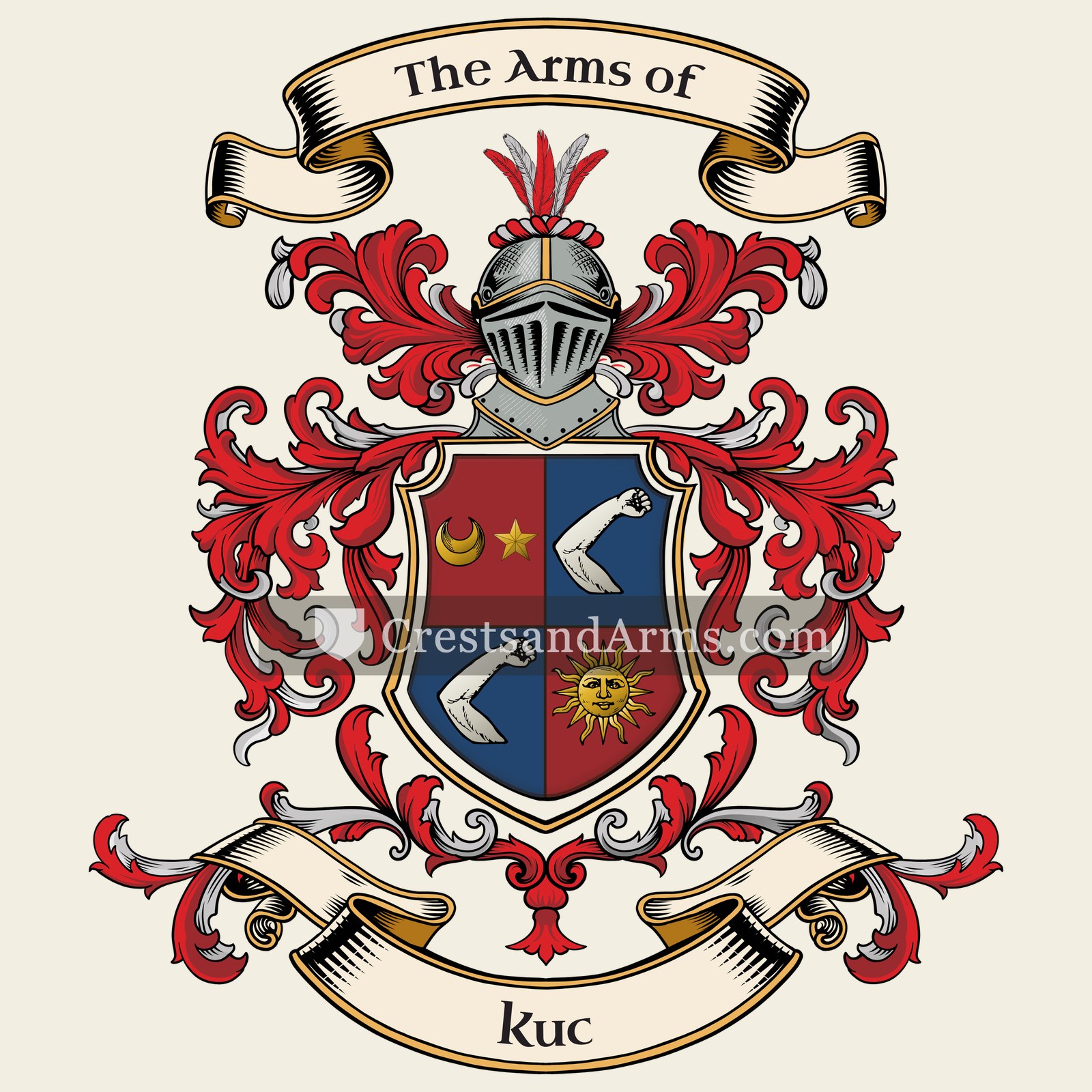
 crescentHonour by the sovereign, and the second son
 mulletThe third son, and a divine quality from above
 armA person of action, industrious and laborious
 sunGlory, splendour and the source of life
 crescentHonour by the sovereign, and the second son
 mulletThe third son, and a divine quality from above
 armA person of action, industrious and laborious
 sunGlory, splendour and the source of life