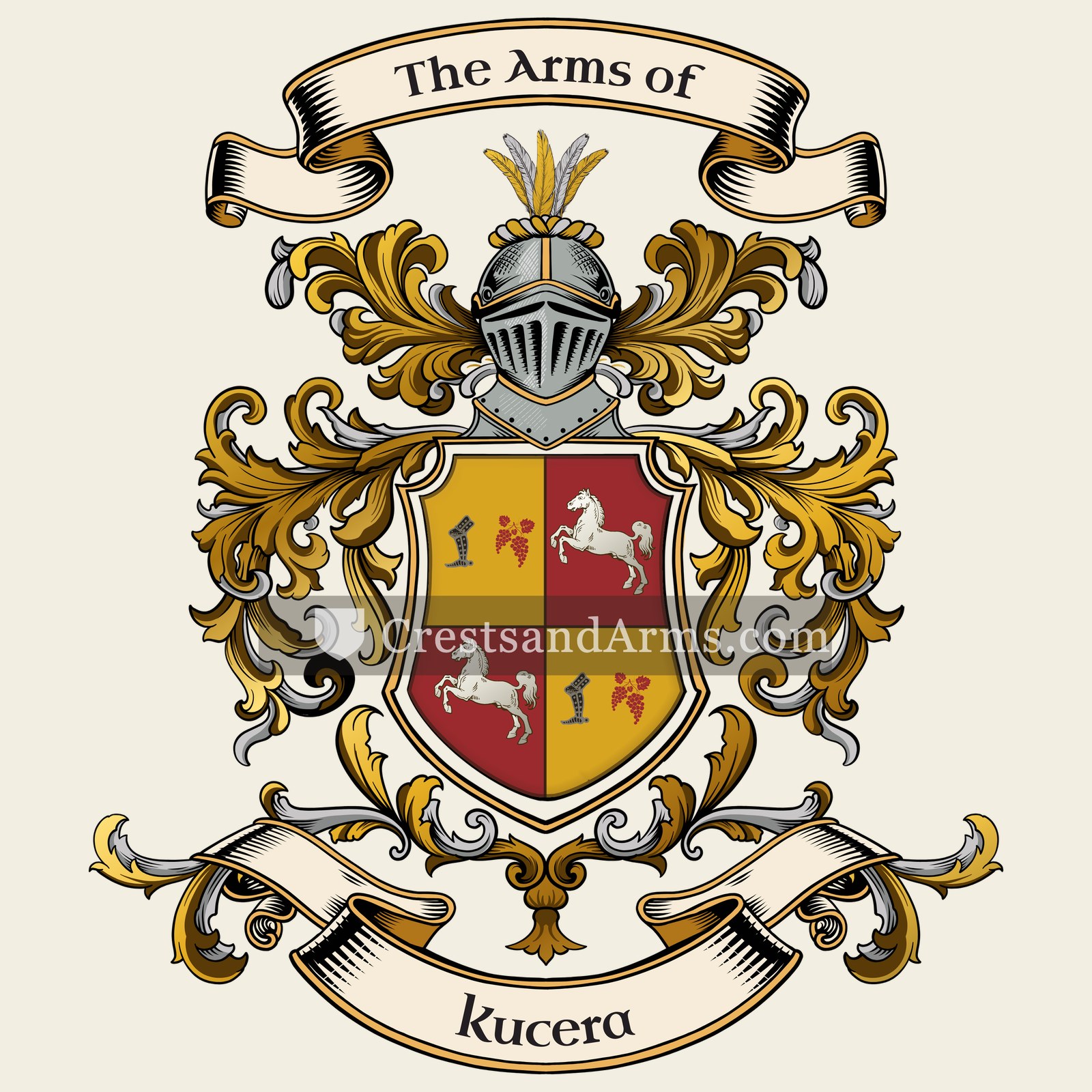
A record of documented arms, meaning and origin, researched for the Kucera family of Austria.
Reg. 7613 · Austrian, J–L
Coat of Arms & Family Crest Details
Symbols on this shield
chevronProtection, and faithful service completed
legStrength and swiftness
grapesPlenty, and the labour of the vine
horseReadiness to serve king and country
Colours
Gold (Or)Means: Generosity
Red (Gules)Means: Military strength
Black (Sable)Means: Constancy
Silver (Argent)Means: Peace and sincerity
Historical info
Source
J. B. Rietstap, Armorial Général, Gouda: G. B. van Goor Zonen, 1884–87
Blazon (the actual original written record)
“Ec.: aux 1 et 4 d'or à un membre d'aigle de sa., courbé en chev. renv., la serre tenant une grappe de raisins de gu., pamprée de sin.; aux 2 et 3 de gu. à un cheval naiss. d'arg., criné d'or. Deux cq. cour. C.: 1° les meubles du 1, cont.; 1. d'or et de sa.; 2° le cheval iss.; 1. d'arg. et de gu.”
GaliciaGalicia, c. 1772
Digital archive packCoat of arms PNG, gold border print PDF, vector SVG and the certificate of authenticity. Sent to your email in minutes.
Map of Austria showing where the Kucera arms are recorded
The Kucera arms were recorded in Galicia, c. 1772.
Galicia was eastern country of large estates and small farming villages, held by families who had been there for a very long time. Land was what entitled a family to arms, and land there rarely changed hands.
This is where the arms were entered in the register. Families often moved to other parts of the country, so the same name can turn up in more than one region.
Region
Galicia
First recorded
1772
Granting Authority for the Kucera Arms
Imperial and Royal chancery
Sodacan · CC BY-SA 3.0
The body that granted and recorded arms in Austria in this period.
Joseph II, Holy Roman Emperor
Sovereign of the period
Joseph II, Holy Roman Emperor
1765–1790
Reigning in Austria when the Kucera arms are first recorded.
How Arms Worked in Austria
Austrian coats of arms were often linked directly to noble titles granted by the Emperor. These symbols belonged to the entire family line rather than just one individual. When a family grew, new branches kept the original design without needing to change it. This system allowed all members of a noble house to share the same identity across many generations.
Granting authority
The Imperial and Royal chancery managed all heraldic matters and controlled the official granting of arms throughout the Austrian lands.
How they got arms
Families typically received their arms through a formal imperial decree that often accompanied the elevation of a person to noble status.
Where arms were recorded
Official records of these grants were kept in the Imperial Register of Nobility which began its formal documentation process in 1453.
The family's standing
Recorded among the armigerous families of Galicia.
Origin & History of the Kucera Family in Austria
The surname Kucera is a classic Slavic name that originates from the Czech word "kučera," which translates to a lock of hair or a curl. Historically, this name functioned as a descriptive nickname for an ancestor who had curly or wavy hair. By the time the family was documented in the Galicia region in 1772, the name had become a stable hereditary surname passed down through generations. During the late 18th century, Galicia was part of the Habsburg Monarchy, and the family likely lived as part of a rural or agrarian community under the administration of the Austrian Empire. Because Galicia was a diverse crossroads of cultures, families with this name often integrated into the local social structures while maintaining their linguistic roots. Over time, the name spread throughout Central Europe as families moved to find work or better farmland, eventually becoming a common identifier for people with shared ancestral ties to the region.
Related Branches & Arms
Root word
kuc
A Slavic term referring to someone with curly or wavy hair.
This name
KuceraA descriptive surname for a person characterized by having curly hair.
also spelled
Kuczere
Kutzera
Kucera
Documented Sources
J. B. Rietstap, Armorial Général, Gouda: G. B. van Goor Zonen, 1884–87
Moldovan, Ioan, Din istoria populației din Galiția, 1998
Svoboda, Jan, Staročeská osobní jména a naše příjmení, 1964
Central State Historical Archives of Ukraine, Galician Gubernium Records (Halytske namisnytstvo), 1772
Digital archive packCoat of arms PNG, gold border print PDF, vector SVG and the certificate of authenticity. Sent to your email in minutes.


 chevronProtection, and faithful service completed
 legStrength and swiftness
 grapesPlenty, and the labour of the vine
 horseReadiness to serve king and country
 chevronProtection, and faithful service completed
 legStrength and swiftness
 grapesPlenty, and the labour of the vine
 horseReadiness to serve king and country