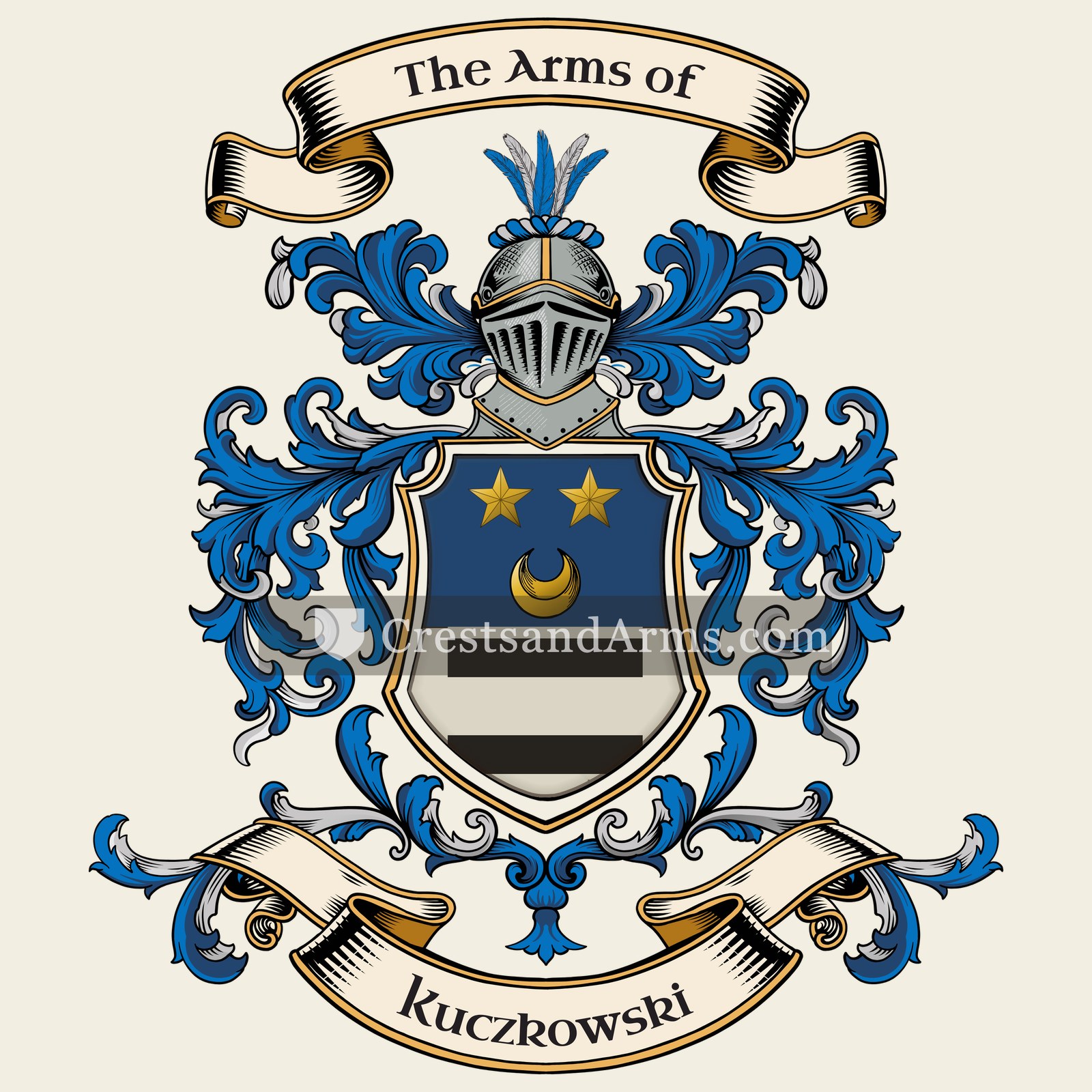
A record of documented arms, meaning and origin, researched for the Kuczkowski family of Germany.
Reg. 7812 · German, J–L
Coat of Arms & Family Crest Details
Symbols on this shield
fessThe military belt, and readiness to serve
crescentHonour by the sovereign, and the second son
mulletThe third son, and a divine quality from above
Colours
Blue (Azure)Means: Loyalty and truth
Silver (Argent)Means: Peace and sincerity
Gold (Or)Means: Generosity
Historical info
Source
J. B. Rietstap, Armorial Général, Gouda: G. B. van Goor Zonen, 1884–87
Blazon (the actual original written record)
“Coupé-ondé: au 1 d'azur à un croiss. figuré versé d'or, surmontant deux étoiles accostées du même; au 2 d'arg. à deux fasces ondées d'azur. Cq. cour. C.: trois pl. d'aut., une d'arg. entre deux d'azur.”
PomeraniaPomerania, c. 1765
Digital archive packCoat of arms PNG, gold border print PDF, vector SVG and the certificate of authenticity. Sent to your email in minutes.
Map of Germany showing where the Kuczkowski arms are recorded
The Kuczkowski arms were recorded in Pomerania, c. 1765.
Pomerania was flat farming country on the Baltic coast, held in large estates by a small number of families. They kept their land for generations, and generations of landholding is what fills the registers.
This is where the arms were entered in the register. Families often moved to other parts of the country, so the same name can turn up in more than one region.
The body that granted and recorded arms in Germany in this period.
Francis I, Holy Roman Emperor
Sovereign of the period
Francis I, Holy Roman Emperor
1745–1765
Reigning in Germany when the Kuczkowski arms are first recorded.
How Arms Worked in Germany
In the Holy Roman Empire, coats of arms were often granted to individuals by the Emperor or his representatives. These arms were then passed down through the generations to all legitimate descendants of the original holder. Younger branches of a family usually kept the same shield design without needing to change it, as the arms belonged to the entire lineage.
Granting authority
The Holy Roman Emperor held the sole power to grant new coats of arms throughout his vast imperial territories.
How they got arms
Families typically obtained their coats of arms through a formal imperial grant or by proving their noble status to the authorities.
Where arms were recorded
These grants were officially recorded in the Imperial Chancery registers, which began keeping formal records of such honors during the Middle Ages.
The family's standing
Recorded among the armigerous families of Pomerania.
Origin & History of the Kuczkowski Family in Germany
The Kuczkowski family name is rooted in the historical region of Pomerania, where records confirm members of the family were established by the year 1765. The name itself follows a common Polish naming pattern, likely derived from the word "kuczka," which refers to a small hut or a specific type of seasonal shelter. This suggests that the earliest ancestors may have been associated with a particular location or a specific trade involving rural construction. During the eighteenth century, families in this part of the Baltic coast were often tied to the land, and the name served as a way to identify individuals based on their family lineage or their place of residence. As the family grew, they became part of the broader social fabric of the Pomeranian landscape, living through a period of significant political and cultural transition in the region.
Related Branches & Arms
Root word
Kuczka
A Slavic term referring to a small hut or a booth.
This name
KuczkowskiA topographic or occupational surname denoting someone who lived in or worked at a small hut.
also spelled
Kuczkowsky
Kutskowski
Kuckowski
Documented Sources
J. B. Rietstap, Armorial Général, Gouda: G. B. van Goor Zonen, 1884–87
Archiwum Państwowe w Szczecinie (State Archive in Szczecin), Akta stanu cywilnego parafii rzymskokatolickiej w Pomerania (Civil registration records of the Roman Catholic parish in Pomerania)
Brückner, Aleksander, Słownik etymologiczny języka polskiego (Etymological Dictionary of the Polish Language), 1927
Taszycki, Witold, Słownik staropolskich nazw osobowych (Dictionary of Old Polish Personal Names), 1965
Digital archive packCoat of arms PNG, gold border print PDF, vector SVG and the certificate of authenticity. Sent to your email in minutes.


 fessThe military belt, and readiness to serve
 crescentHonour by the sovereign, and the second son
 mulletThe third son, and a divine quality from above
 fessThe military belt, and readiness to serve
 crescentHonour by the sovereign, and the second son
 mulletThe third son, and a divine quality from above