A record of documented arms, meaning and origin, researched for the Kuersteiner family lines. Documented in 3 countries.
Reg. 2021 · Belgian, J–L
Coat of Arms & Family Crest Details
Symbols on this shield
chevronProtection, and faithful service completed
chiefAuthority, wisdom and dominion
roundelA coin, and one who has been to the crusades
martletA younger son, who must win his own land
eagleNobility, strength and a keen mind
Colours
Gold (Or)Means: Generosity
Blue (Azure)Means: Loyalty and truth
Silver (Argent)Means: Peace and sincerity
Black (Sable)Means: Constancy
Red (Gules)Means: Military strength
Historical info
Source
J. B. Rietstap, Armorial Général, Gouda: G. B. van Goor Zonen, 1884–87
Blazon (the actual original written record)
“D'or au chev. d'azur, ch. de trois bes. d'arg., surch. chacune d'une merlette de sa.; le chev. acc. de trois navets de sin.; au chef du premier, ch. de trois têtes et cols d'aigle de gu.”
BrabantBrabant, c. 1737
Digital archive packCoat of arms PNG, gold border print PDF, vector SVG and the certificate of authenticity. Sent to your email in minutes.
Map of Belgium showing where the Kuersteiner arms are recorded
The Kuersteiner arms were recorded in Brabant, c. 1737.
Brabant lay at the heart of the Low Countries, where the trade routes met. Its towns were wealthy and its landowners many, and both kinds of family kept arms, which is why the region is so heavily represented.
This is where the arms were entered in the register. Families often moved to other parts of the country, so the same name can turn up in more than one region.
The body that granted and recorded arms in Belgium in this period.
Charles VI, Holy Roman Emperor
Sovereign of the period
Charles VI, Holy Roman Emperor
1711–1740
Reigning in Belgium when the Kuersteiner arms are first recorded.
How Arms Worked in Belgium
In Belgium, a coat of arms is considered personal property that is passed down through the male line to legitimate descendants. Families often use the same shield design across generations to show their shared heritage. If a branch of the family wants to change the design, they must apply for an official update to their specific version of the arms.
Granting authority
The Conseil héraldique is the official body that regulates and approves all coats of arms in Belgium.
How they got arms
Families obtain their coats of arms through formal royal grants or by confirming their historical right to use existing designs.
Where arms were recorded
All approved coats of arms are officially recorded in the public registers of the Conseil héraldique since 1844.
The family's standing
Recorded among the armigerous families of Brabant.
Origin & History of the Kuersteiner Family in Belgium
The Kuersteiner family name traces its roots in Belgium back to the early eighteenth century, specifically appearing in the historical records of the Brabant region by 1737. During this period, Brabant served as a vital crossroads for trade and administration within the Austrian Netherlands. Families like the Kuersteiners often moved through these territories as skilled professionals or merchants, taking advantage of the region's stable economy and central location. The name itself reflects a linguistic connection to Germanic naming traditions, which were common among families living in the borderlands between modern-day Belgium and the German-speaking territories. By establishing themselves in Brabant, the early members of this family became part of a diverse social fabric that defined the local community during the mid-1700s. Their presence in the official documents of the time suggests they were active participants in the civic and economic life of the province as it navigated the complexities of eighteenth-century European politics.
Coat of Arms & Family Crest Details
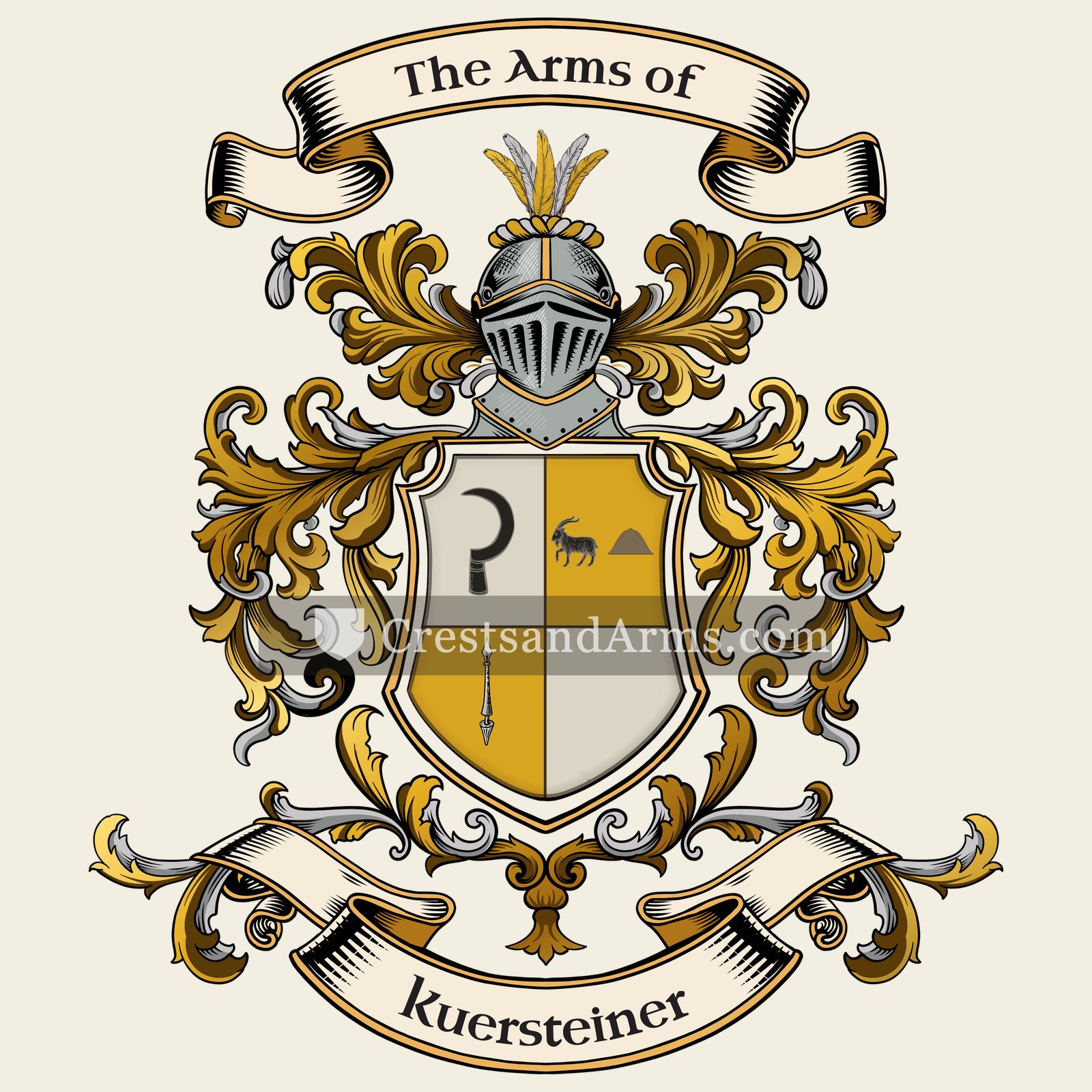
Symbols on this shield
mountThe ground held, and steadfastness upon it
chequyConstancy, and the counting-board
sickleThe harvest, and the reaping of what was sown
goatOne who wins by diplomacy rather than force
lanceKnightly service and the tilt
Colours
Silver (Argent)Means: Peace and sincerity
Gold (Or)Means: Generosity
Black (Sable)Means: Constancy
Historical info
Source
J. B. Rietstap, Armorial Général, Gouda: G. B. van Goor Zonen, 1884–87
Blazon (the actual original written record)
“Ec.: au 1 d'arg. à une houe de vigneron de sa., posée en bande; au 2 d'or à un bouquetin arrêté de sa. sur un rocher au nat.; au 3 d'azur à une lance d'arg., posée en pal, mouv. de la p., surm. d'une balance du même; au 4 échiq. de gu. et d'arg. Cq. cour. C.: un bouquetin iss. de sa. L. d'arg. et d'azur.”
GermanyAnhalt-Bernburg, c. 1765
Digital archive packCoat of arms PNG, gold border print PDF, vector SVG and the certificate of authenticity. Sent to your email in minutes.
Map of Germany showing where the Kuersteiner arms are recorded
The Kuersteiner arms were recorded in Anhalt-Bernburg, c. 1765.
This is where the arms were entered in the register. Families often moved to other parts of the country, so the same name can turn up in more than one region.
The body that granted and recorded arms in Germany in this period.
Francis I, Holy Roman Emperor
Sovereign of the period
Francis I, Holy Roman Emperor
1745–1765
Reigning in Belgium when the Kuersteiner arms are first recorded.
How Arms Worked in Germany
In the Holy Roman Empire, coats of arms were often granted to individuals by the Emperor or his representatives. These arms were then passed down through the generations to all legitimate descendants of the original holder. Younger branches of a family usually kept the same shield design without needing to change it, as the arms belonged to the entire lineage.
Granting authority
The Holy Roman Emperor held the sole power to grant new coats of arms throughout his vast imperial territories.
How they got arms
Families typically obtained their coats of arms through a formal imperial grant or by proving their noble status to the authorities.
Where arms were recorded
These grants were officially recorded in the Imperial Chancery registers, which began keeping formal records of such honors during the Middle Ages.
The family's standing
Recorded among the armigerous families of Germany.
Origin & History of the Kuersteiner Family in Germany
The surname Kuersteiner originates from the German-speaking regions of Europe, where it functioned as a topographic or occupational identifier. The name likely refers to someone who lived near or worked on a specific type of small farm or a "Kuer," which was a term historically associated with land parcels or specific agricultural rights in various German dialects. By the mid-18th century, the family established a notable presence in the principality of Anhalt-Bernburg. Records from 1765 indicate that members of the family were integrated into the local social and administrative structures of this region. During this period, families in Anhalt-Bernburg were often tied to the land or specific trades supported by the local dukes. The migration and settlement of the Kuersteiners in this area reflect the broader patterns of internal movement within the Holy Roman Empire, as families sought stability and economic opportunity in the smaller German states.
Coat of Arms & Family Crest Details
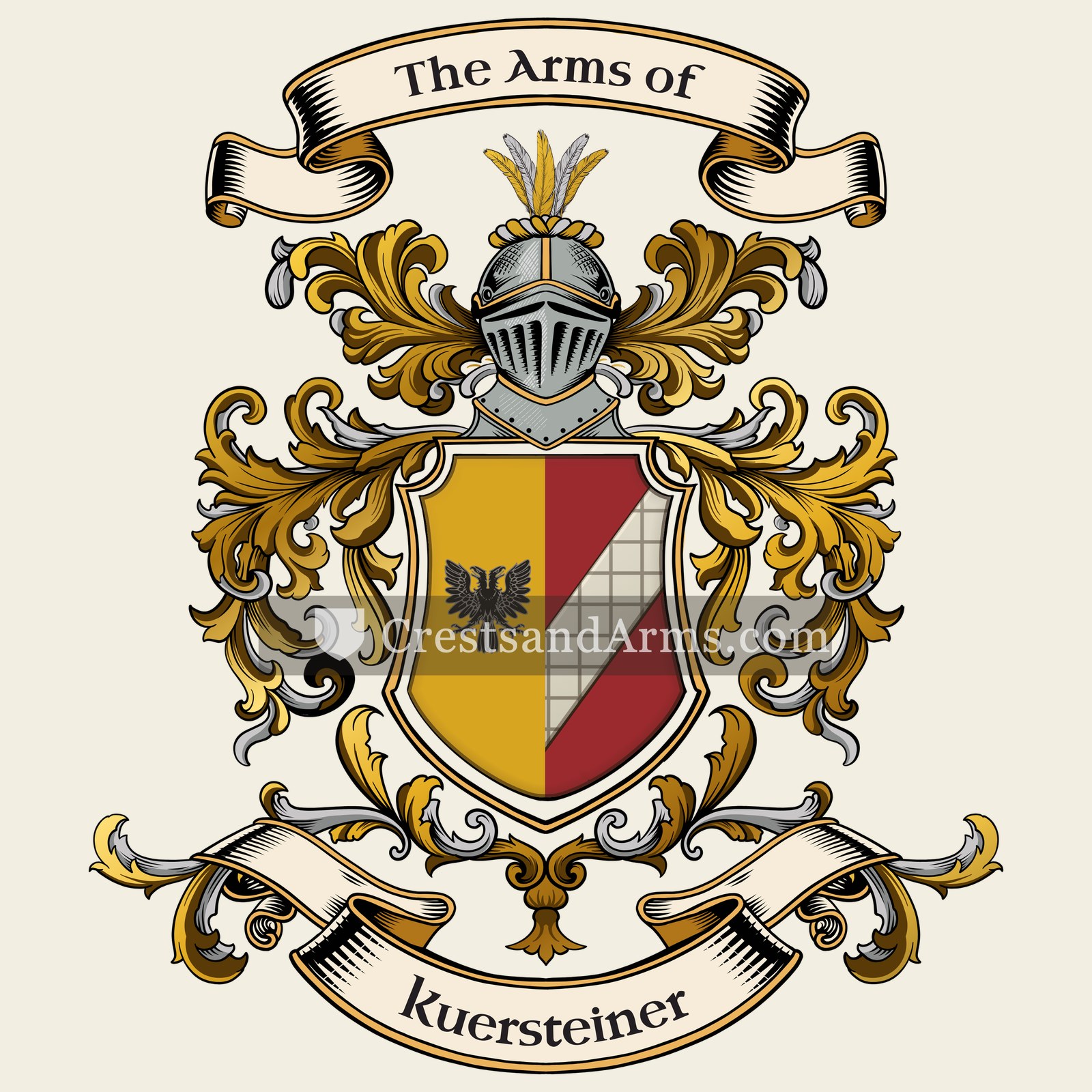
Symbols on this shield
eagleNobility, strength and a keen mind
Colours
Gold (Or)Means: Generosity
Red (Gules)Means: Military strength
Black (Sable)Means: Constancy
Historical info
Source
J. B. Rietstap, Armorial Général, Gouda: G. B. van Goor Zonen, 1884–87
Blazon (the actual original written record)
“Parti: au 1 d'or à la demi-aigle de sa., mouv. du parti; au 2 de gu. à la barre d'or.”
Netherlandsc. 1815
Digital archive packCoat of arms PNG, gold border print PDF, vector SVG and the certificate of authenticity. Sent to your email in minutes.
Map of Netherlands showing where the Kuersteiner arms are recorded
The Kuersteiner arms were recorded in Netherlands, c. 1815.
Arms such as these were typically recorded in Friesland.
Friesland was low, wet country on the northern coast of the Netherlands, farmed by families who had held the same land for centuries. Free landholders were unusually common there, and a free landholder could carry arms.
This is where the arms were entered in the register. Families often moved to other parts of the country, so the same name can turn up in more than one region.
Region
Friesland
First recorded
1815
Granting Authority for the Kuersteiner Arms
Hoge Raad van Adel
Photograph made by me · CC BY-SA 3.0
The body that granted and recorded arms in Netherlands in this period.
William I of the Netherlands
Sovereign of the period
William I of the Netherlands
1815–1840
Reigning in Belgium when the Kuersteiner arms are first recorded.
How Arms Worked in Netherlands
In the Netherlands, coats of arms were often used by noble families and those who held specific public offices. These arms were passed down through the generations to legitimate descendants. Younger branches of a family usually kept the original design without needing to add special marks. This system ensured that the family identity remained clear and consistent over many years.
Granting authority
The Hoge Raad van Adel is the official body that regulates and manages noble titles and coats of arms in the Netherlands.
How they got arms
Families typically obtained their coats of arms through official royal grants or by proving their long-standing historical use of the symbols.
Where arms were recorded
Coats of arms are officially recorded in the registers held by the Hoge Raad van Adel, which began its work in 1814.
The family's standing
Recorded among the armigerous families of Netherlands.
Origin & History of the Kuersteiner Family in Netherlands
The Kuersteiner family name carries a history rooted in the northern regions of the Netherlands, specifically within the province of Friesland during the early nineteenth century. By 1815, records confirm that family members were established in this area, a time when the Netherlands was undergoing significant administrative changes following the Napoleonic era. The name itself reflects a linguistic connection to Germanic roots, likely describing individuals who lived near a specific type of land or worked as stone cutters. During this period, families in Friesland often held deep ties to their local communities, working in agriculture or trade as the region transitioned into the newly formed Kingdom of the Netherlands. The presence of the family in Friesland suggests they were part of the local social fabric during a time of national reconstruction and census standardization.
Related Branches & Arms
Root word
Kürsteiner
Derived from the German word Kürste, referring to a cheese maker.
This name
KuersteinerAn occupational surname for an individual who produced or sold cheese.
also spelled
Kerstein
Documented Sources
J. B. Rietstap, Armorial Général, Gouda: G. B. van Goor Zonen, 1884–87
State Archives in Belgium (Rijksarchief te Brussel), Parochieregisters van de provincie Brabant
Digital archive packCoat of arms PNG, gold border print PDF, vector SVG and the certificate of authenticity. Sent to your email in minutes.


 chevronProtection, and faithful service completed
 chiefAuthority, wisdom and dominion
 roundelA coin, and one who has been to the crusades
 martletA younger son, who must win his own land
 eagleNobility, strength and a keen mind
 chevronProtection, and faithful service completed
 chiefAuthority, wisdom and dominion
 roundelA coin, and one who has been to the crusades
 martletA younger son, who must win his own land
 eagleNobility, strength and a keen mind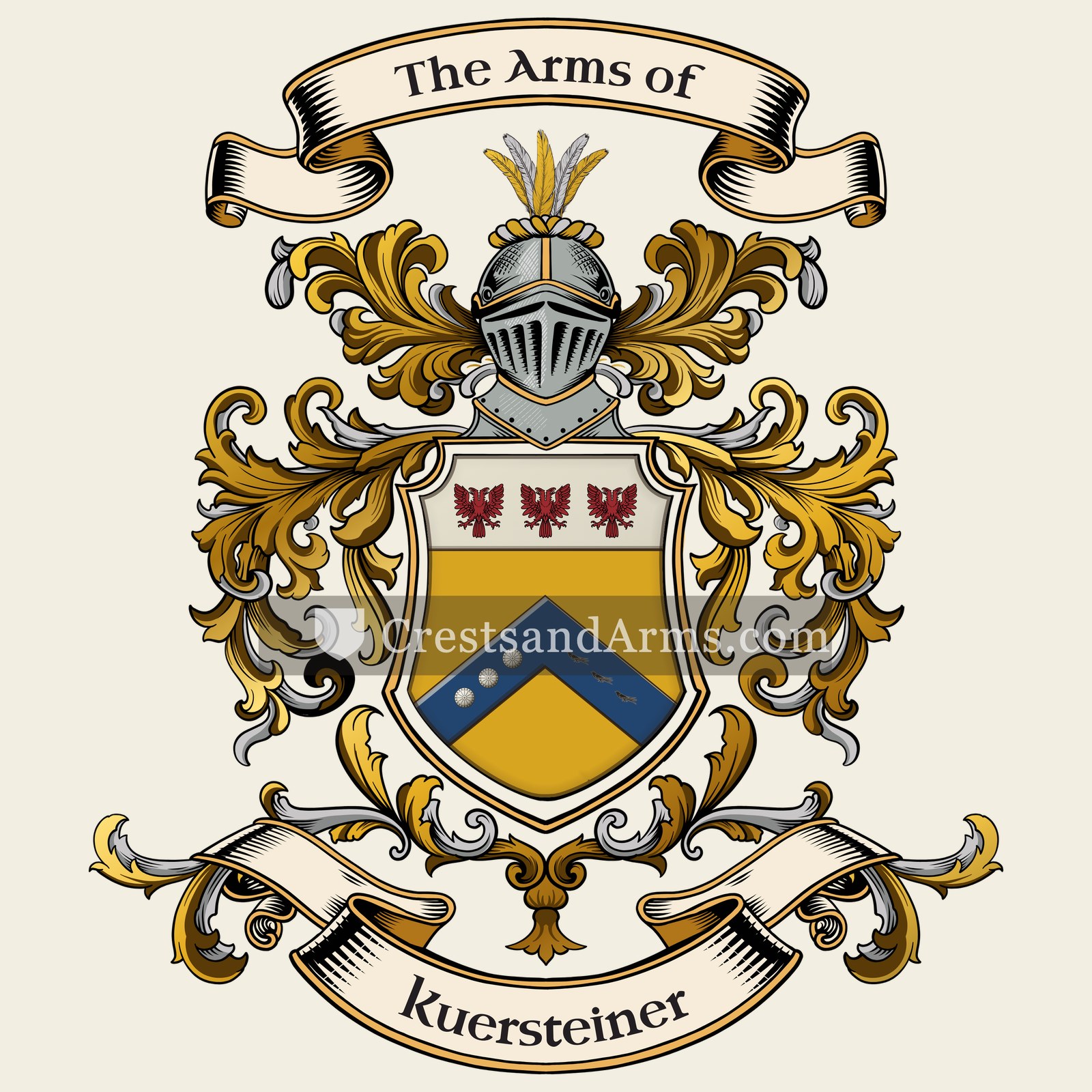


 mountThe ground held, and steadfastness upon it
 chequyConstancy, and the counting-board
 sickleThe harvest, and the reaping of what was sown
 goatOne who wins by diplomacy rather than force
 lanceKnightly service and the tilt