A record of documented arms, meaning and origin, researched for the Kugler family lines. Documented in 3 countries.
Reg. 5358 · Austrian, J–L
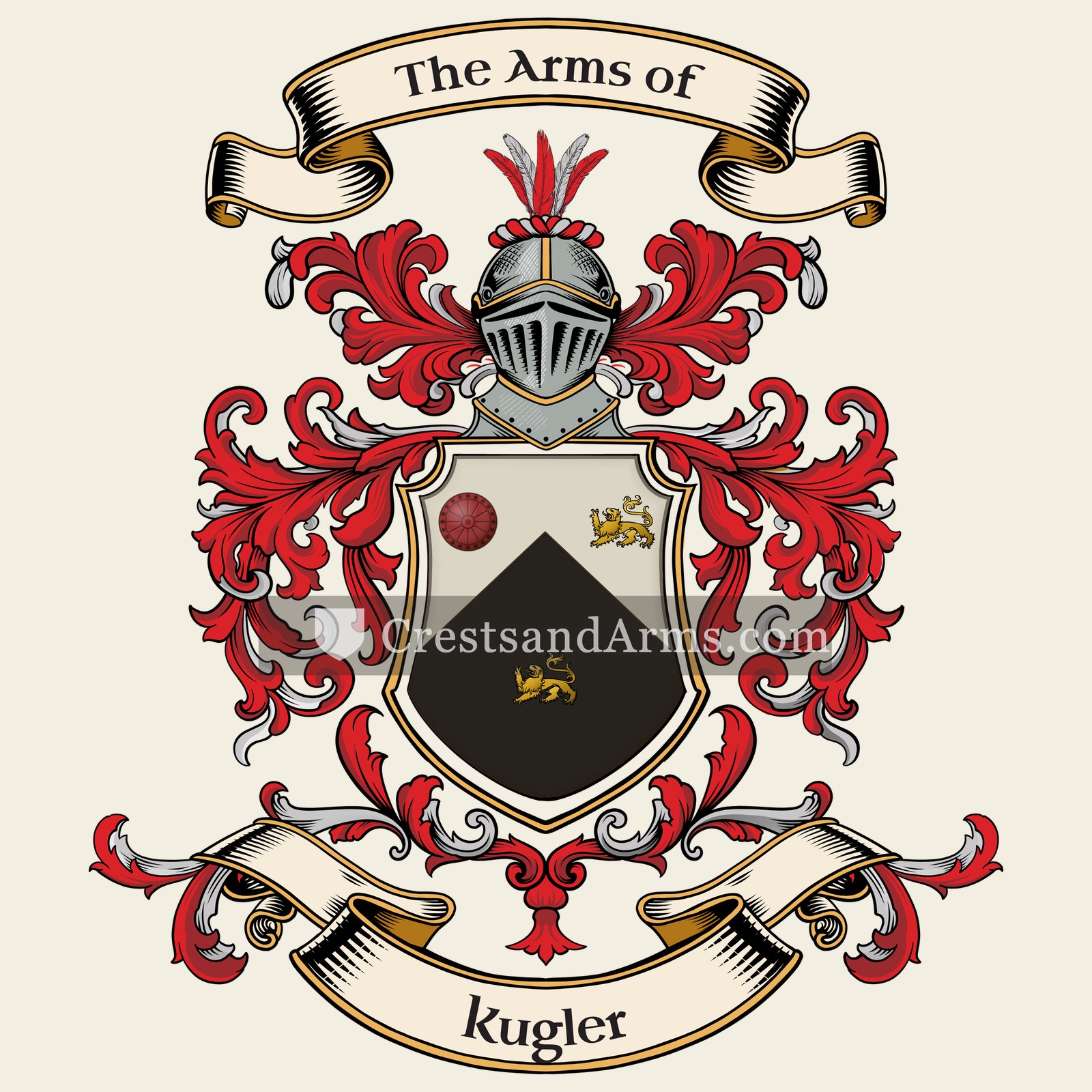
Coat of Arms & Family Crest Details
Symbols on this shield
roundelA coin, and one who has been to the crusades
lionCourage, strength and royalty
Colours
Silver (Argent)Means: Peace and sincerity
Black (Sable)Means: Constancy
Red (Gules)Means: Military strength
Gold (Or)Means: Generosity
Historical info
Source
J. B. Rietstap, Armorial Général, Gouda: G. B. van Goor Zonen, 1884–87
Blazon (the actual original written record)
“D'arg. à une boule de gu.; le champ chapé-ployé de sa., à deux lions affr. d'or, cour. du même. Cq. cour. C.: un lion iss. d'or, cour. du même, posé de front; entre un vol, chaque aile d'arg. chapé-ployé de sa., l'arg. ch. d'une boule de gu. L.: à dextre d'or et de sa., à sen. d'arg. et de gu.”
Austriac. 1596
Digital archive packCoat of arms PNG, gold border print PDF, vector SVG and the certificate of authenticity. Sent to your email in minutes.
Map of Austria showing where the Kugler arms are recorded
The Kugler arms were recorded in Austria, c. 1596.
Arms such as these were typically recorded in Tyrol.
Tyrol was mountain country in western Austria, where the valleys were held by families who had been there a very long time. Old tenure counted for more than money, and old families carried arms.
This is where the arms were entered in the register. Families often moved to other parts of the country, so the same name can turn up in more than one region.
Region
Tyrol
First recorded
1596
Granting Authority for the Kugler Arms
Imperial and Royal chancery
Sodacan · CC BY-SA 3.0
The body that granted and recorded arms in Austria in this period.
Emperor Rudolf II
Sovereign of the period
Emperor Rudolf II
1576–1612
Reigning in Austria when the Kugler arms are first recorded.
How Arms Worked in Austria
Austrian coats of arms were often linked directly to noble titles granted by the Emperor. These symbols belonged to the entire family line rather than just one individual. When a family grew, new branches kept the original design without needing to change it. This system allowed all members of a noble house to share the same identity across many generations.
Granting authority
The Imperial and Royal chancery managed all heraldic matters and controlled the official granting of arms throughout the Austrian lands.
How they got arms
Families typically received their arms through a formal imperial decree that often accompanied the elevation of a person to noble status.
Where arms were recorded
Official records of these grants were kept in the Imperial Register of Nobility which began its formal documentation process in 1453.
The family's standing
Recorded among the armigerous families of Austria.
Origin & History of the Kugler Family in Austria
The surname Kugler originates from the German language and is classified as an occupational name. It is derived from the Middle High German word *kugel*, which refers to a round object or a specific type of head covering. In the mountainous region of Tyrol, where family records confirm the presence of the Kugler name as early as 1596, the name likely identified a craftsman who made spherical items or perhaps a maker of specialized hats. During this period in Austrian history, surnames were becoming increasingly necessary for tax records and local administration. Families often settled in the valleys of the Alps, where they worked as skilled laborers or farmers. The name spread through the region as these families moved between villages to find work in the growing trade centers of the late sixteenth century. By establishing themselves in Tyrol, the early Kuglers became part of the distinct cultural and social fabric of the Austrian highlands.
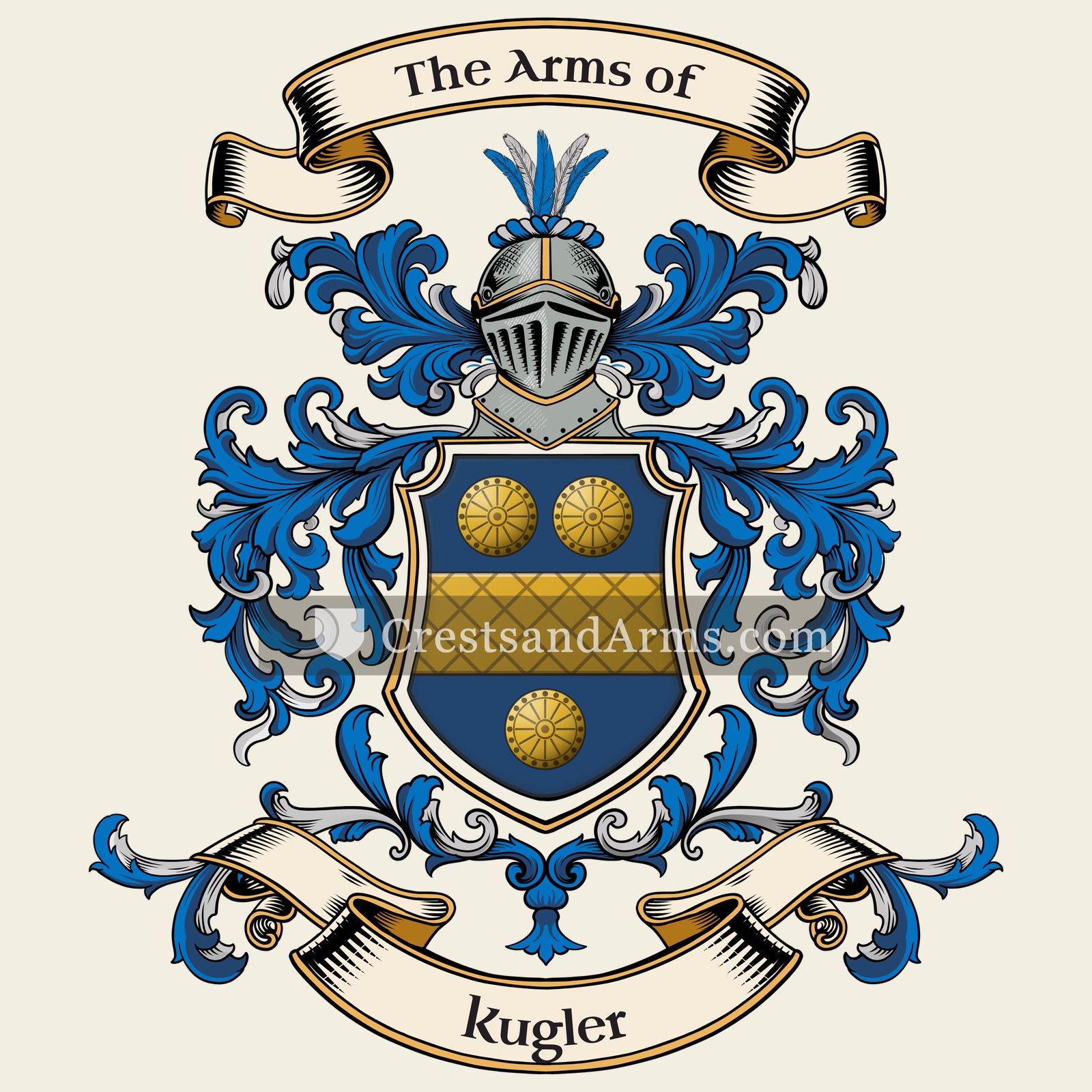
Coat of Arms & Family Crest Details
Symbols on this shield
fessThe military belt, and readiness to serve
roundelA coin, and one who has been to the crusades
Colours
Blue (Azure)Means: Loyalty and truth
Gold (Or)Means: Generosity
Historical info
Source
J. B. Rietstap, Armorial Général, Gouda: G. B. van Goor Zonen, 1884–87
Blazon (the actual original written record)
“D'azur à la fasce d'or, acc. de trois bes. du même. C.: une boule d'azur, entre une ramure de cerf d'or.”
FranceStrasbourg, c. 1663
Digital archive packCoat of arms PNG, gold border print PDF, vector SVG and the certificate of authenticity. Sent to your email in minutes.
Map of France showing where the Kugler arms are recorded
The Kugler arms were recorded in Strasbourg, c. 1663.
This is where the arms were entered in the register. Families often moved to other parts of the country, so the same name can turn up in more than one region.
The body that granted and recorded arms in France in this period.
Louis XIV of France
Sovereign of the period
Louis XIV of France
1643–1715
Reigning in Austria when the Kugler arms are first recorded.
How Arms Worked in France
In France, a coat of arms was a mark of honor that passed down through the male line to all legitimate descendants. Families often used the same shield without changes to show their shared heritage. If a branch wanted to stand out, they could add a small mark to their shield to show their specific place in the family tree.
Granting authority
The Juge d'armes de France acted as the official authority that regulated and verified coats of arms across the country.
How they got arms
Families typically inherited their arms from ancestors, though they could also receive them through royal grants or by proving their noble status.
Where arms were recorded
Coats of arms were officially recorded in the Armorial Général de France, which began its main collection in the year 1696.
The family's standing
Recorded among the armigerous families of France.
Origin & History of the Kugler Family in France
The surname Kugler originates from the German word *Kugel*, which translates to ball or sphere, and it was historically used as an occupational name for a maker of metal balls, bullets, or spherical objects. By 1663, records confirm that members of the Kugler family were well-established in Strasbourg, a city that served as a unique cultural bridge between French and German traditions. During this period, Strasbourg was a free imperial city that eventually came under the control of the French crown following the Peace of Westphalia and the subsequent expansionist policies of Louis XIV. Because the region of Alsace frequently shifted between different political powers, families like the Kuglers often navigated a complex identity that blended Germanic roots with the evolving administrative and legal systems of France. Living in this crossroads allowed the family to participate in the vibrant trade and craftsmanship that defined the city, with their name reflecting the specialized metalwork that was essential to the local economy of the seventeenth century.
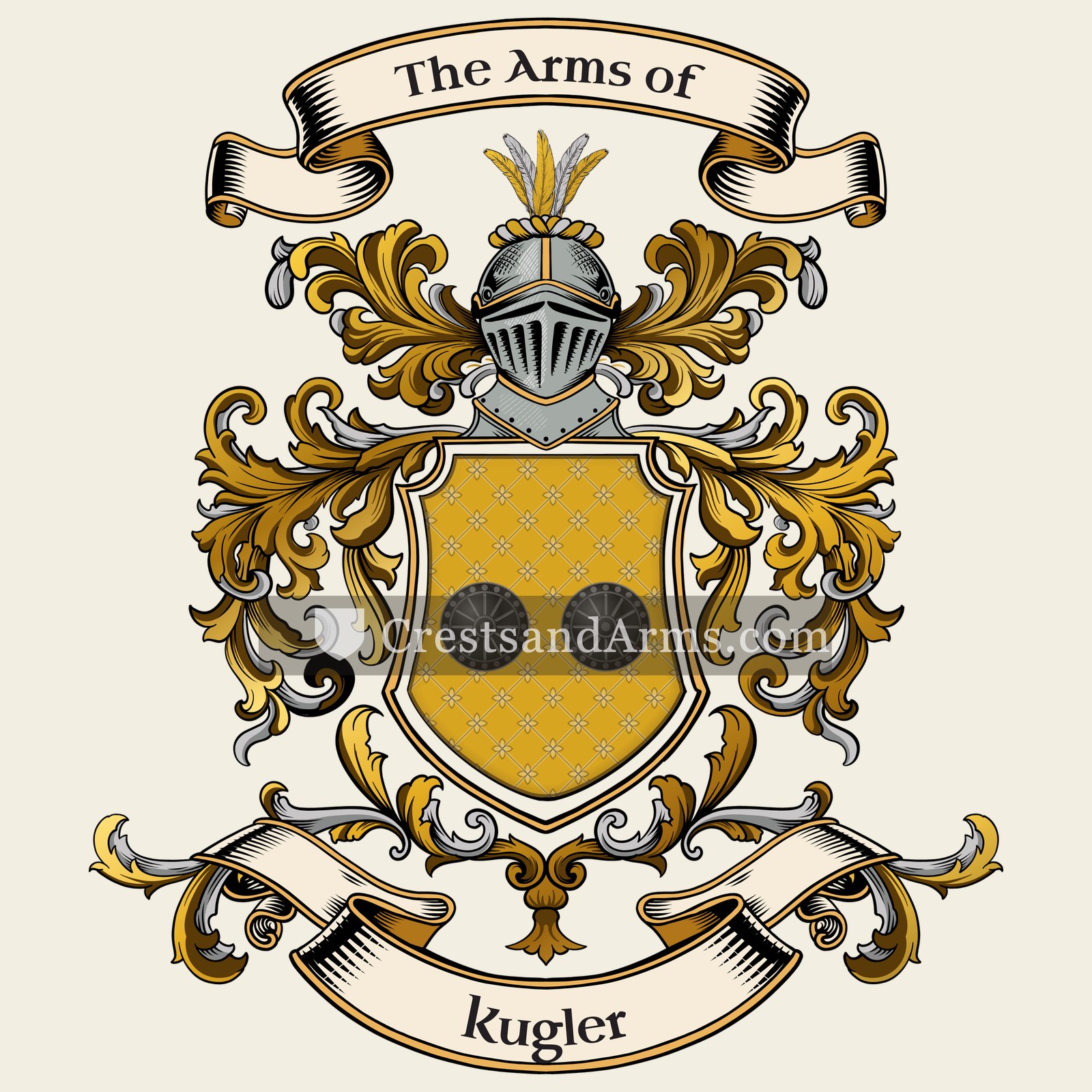
Coat of Arms & Family Crest Details
Symbols on this shield
roundelA coin, and one who has been to the crusades
Colours
Gold (Or)Means: Generosity
Black (Sable)Means: Constancy
Historical info
Source
J. B. Rietstap, Armorial Général, Gouda: G. B. van Goor Zonen, 1884–87
Blazon (the actual original written record)
“D'or à un diable, pose sur une boule et supp. de chaque main une autre boule, le tout de sa. C.: les meubles de l'écu.”
GermanyHeilbronn Wurt, c. 1765
Digital archive packCoat of arms PNG, gold border print PDF, vector SVG and the certificate of authenticity. Sent to your email in minutes.
Map of Germany showing where the Kugler arms are recorded
The Kugler arms were recorded in Heilbronn Wurt, c. 1765.
This is where the arms were entered in the register. Families often moved to other parts of the country, so the same name can turn up in more than one region.
The body that granted and recorded arms in Germany in this period.
Francis I, Holy Roman Emperor
Sovereign of the period
Francis I, Holy Roman Emperor
1745–1765
Reigning in Austria when the Kugler arms are first recorded.
How Arms Worked in Germany
In the Holy Roman Empire, coats of arms were often granted to individuals by the Emperor or his representatives. These arms were then passed down through the generations to all legitimate descendants of the original holder. Younger branches of a family usually kept the same shield design without needing to change it, as the arms belonged to the entire lineage.
Granting authority
The Holy Roman Emperor held the sole power to grant new coats of arms throughout his vast imperial territories.
How they got arms
Families typically obtained their coats of arms through a formal imperial grant or by proving their noble status to the authorities.
Where arms were recorded
These grants were officially recorded in the Imperial Chancery registers, which began keeping formal records of such honors during the Middle Ages.
The family's standing
Recorded among the armigerous families of Germany.
Origin & History of the Kugler Family in Germany
The surname Kugler is a classic example of an occupational name that emerged from the German-speaking regions of Europe. The name is derived from the Middle High German word *kugel*, which refers to a ball or a spherical object. Historically, this name was likely given to a craftsman who made items such as wooden bowls, balls, or even specialized tools for spinning and weaving. By the time your ancestors were established in Heilbronn in 1765, the name had been in use for several generations across southern Germany. During the eighteenth century, Heilbronn was a significant center for trade and craftsmanship along the Neckar River. Families like the Kuglers often played essential roles in these local economies by providing the necessary goods that supported daily life and commerce. As the family grew, they became part of the social fabric of the region, contributing to the development of the town through their steady work and community involvement.
Kugler Meaning & Related Branches
Root word
Kugel
A spherical object or ball.
This name
KuglerAn occupational name for a maker of balls or a nickname for a round-faced person.
also spelled
Kuglerr
Kuglere
Kuglerh
Documented Sources
J. B. Rietstap, Armorial Général, Gouda: G. B. van Goor Zonen, 1884–87
Kohlheim, Rosa and Volker Kohlheim. Duden Familiennamen: Herkunft und Bedeutung von 20.000 Nachnamen. 2005


 roundelA coin, and one who has been to the crusades
 lionCourage, strength and royalty
 roundelA coin, and one who has been to the crusades
 lionCourage, strength and royalty


 fessThe military belt, and readiness to serve