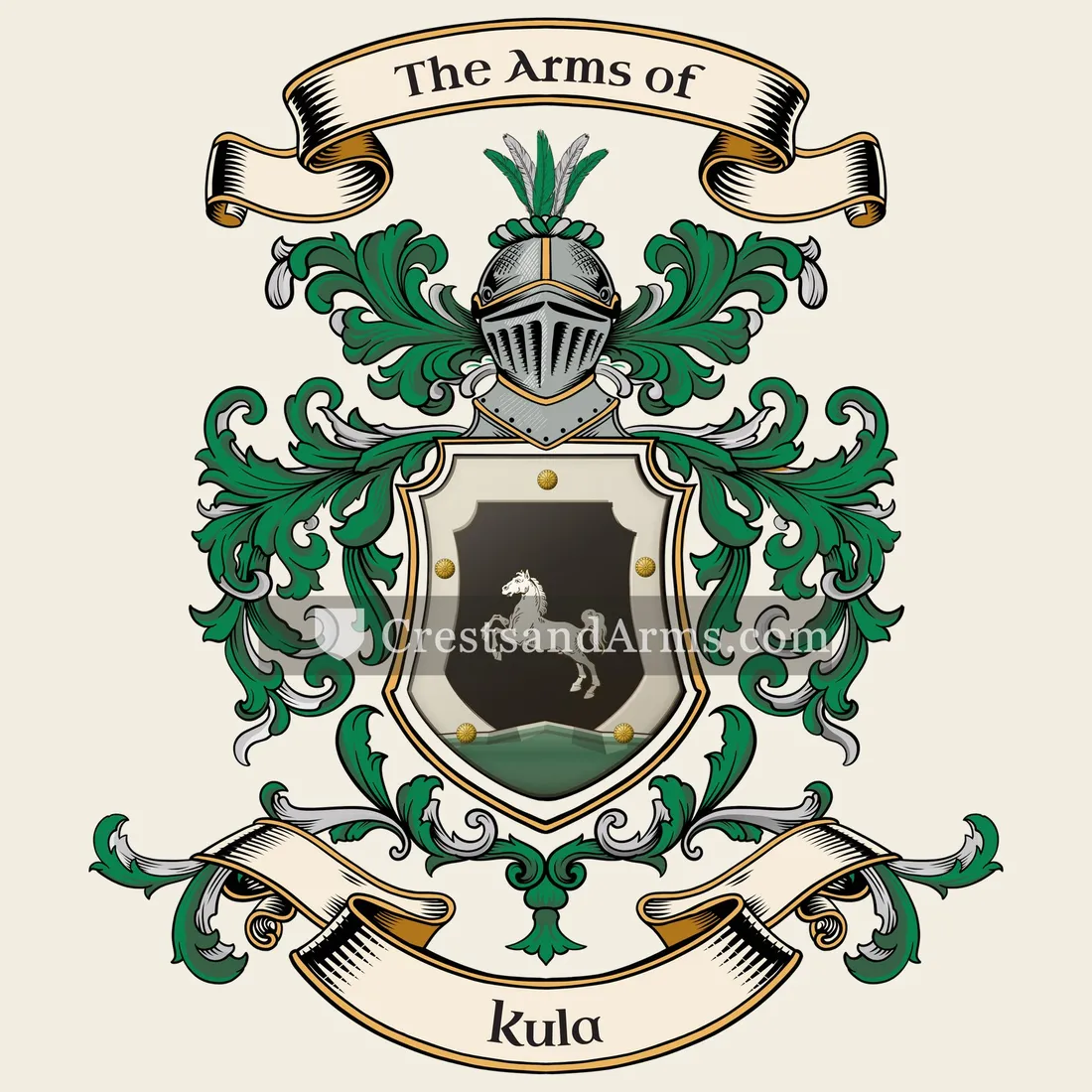
A record of documented arms, meaning and origin, researched for the Kula family of Germany.
Reg. 4076 · German, J–L
Meaning of the Kula family crest colors & symbols
Symbols on this shield
mountThe ground held, and steadfastness upon it
horseReadiness to serve king and country
roundelA coin, and one who has been to the crusades
Colours
Black (Sable)Means: Constancy
Silver (Argent)Means: Peace and sincerity
Green (Vert)Means: Hope
Gold (Or)Means: Generosity
Historical info
Source
J. B. Rietstap, Armorial Général, Gouda: G. B. van Goor Zonen, 1884–87
Blazon (the actual original written record)
“De sa. à un cheval d'arg., galopant sur une terrasse de sin.; à la bord. d'arg., ch. de cinq bes. d'or. Cq. cour. C.: un renard iss. au nat., la tête sommée d'une étoile d'arg., entre un vol coupé, à dextre de gu. sur sa., à sen. d'or sur sa. L.: à dextre d'or et de sa., à sen. de gu. et de sa.”
GermanyMunich, c. 1725
Digital archive packCoat of arms PNG, gold border print PDF, vector SVG and the certificate of authenticity. Sent to your email in minutes.
Map of Germany showing where the Kula arms are recorded
The Kula arms were recorded in Munich, c. 1725.
This is where the arms were entered in the register. Families often moved to other parts of the country, so the same name can turn up in more than one region.
The body that granted and recorded arms in Germany in this period.
Charles VI, Holy Roman Emperor
Sovereign of the period
Charles VI, Holy Roman Emperor
1711–1740
Reigning in Germany when the Kula arms are first recorded.
How Arms Worked in Germany
In the Holy Roman Empire, coats of arms were often granted to individuals by the Emperor or his representatives. These arms were then passed down through the generations to all legitimate descendants of the original holder. Younger branches of a family usually kept the same shield design without needing to change it, as the arms belonged to the entire lineage.
Granting authority
The Holy Roman Emperor held the sole power to grant new coats of arms throughout his vast imperial territories.
How they got arms
Families typically obtained their coats of arms through a formal imperial grant or by proving their noble status to the authorities.
Where arms were recorded
These grants were officially recorded in the Imperial Chancery registers, which began keeping formal records of such honors during the Middle Ages.
The family's standing
Recorded among the armigerous families of Germany.
Origin & History of the Kula Family in Germany
The family name Kula has deep roots in the cultural landscape of Central Europe, with documented evidence placing members of the family in Munich as early as 1725. During the eighteenth century, Munich was a growing center for trade and craftsmanship within the Electorate of Bavaria. Families like the Kulas often moved through these urban centers to pursue specialized work in guilds or administrative roles. The name itself is thought to be of Slavic origin, likely derived from words meaning a tower or a rounded structure, which suggests that early ancestors may have lived near a prominent landmark or a fortified building. As the family settled into the social fabric of Munich, they became part of the steady migration of people who helped shape the city into the bustling hub it is today. By maintaining their presence in the region, the Kula family contributed to the long history of local community development and the preservation of their unique heritage through generations.
Kula Meaning & Related Branches
Root word
Kugel
A spherical object or ball.
This name
KulaA topographic name for someone living near a round hill or a nickname for a stout person.
also spelled
Kaula
Kaull
Documented Sources
J. B. Rietstap, Armorial Général, Gouda: G. B. van Goor Zonen, 1884–87


 mountThe ground held, and steadfastness upon it
 horseReadiness to serve king and country
 roundelA coin, and one who has been to the crusades
 mountThe ground held, and steadfastness upon it
 horseReadiness to serve king and country
 roundelA coin, and one who has been to the crusades