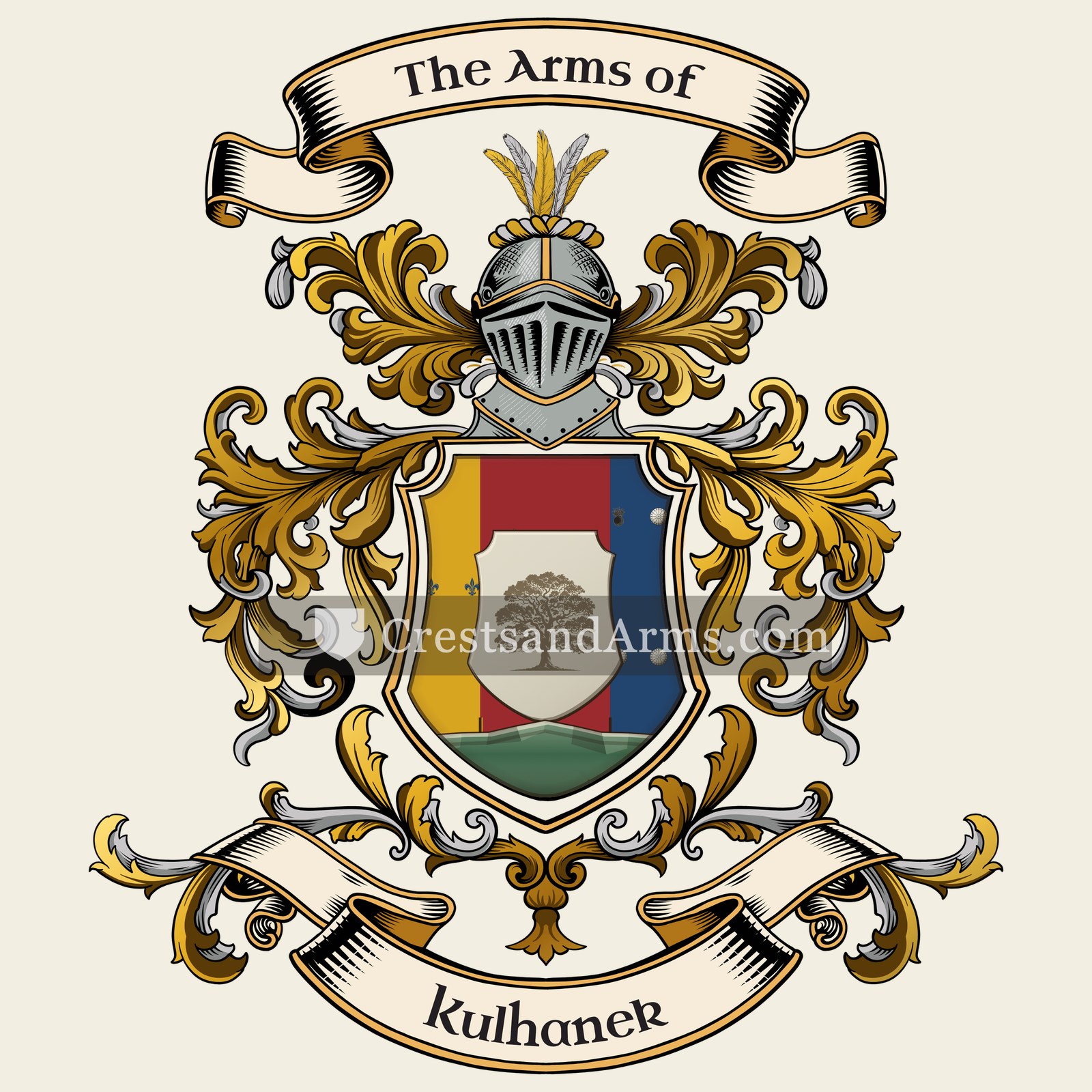
A record of documented arms, meaning and origin, researched for the Kulhanek family of France.
Reg. 7671 · French, J–L
Coat of Arms & Family Crest Details
Symbols on this shield
mountThe ground held, and steadfastness upon it
treeLife, endurance and deep roots
fleur de lisPurity, light, and the sixth son
unicornPurity, and extreme courage in defence of honour
bombOne who has faced a great siege
roundelA coin, and one who has been to the crusades
Colours
Gold (Or)Means: Generosity
Red (Gules)Means: Military strength
Blue (Azure)Means: Loyalty and truth
Silver (Argent)Means: Peace and sincerity
Green (Vert)Means: Hope
Black (Sable)Means: Constancy
Historical info
Source
J. B. Rietstap, Armorial Général, Gouda: G. B. van Goor Zonen, 1884–87
Blazon (the actual original written record)
“d'or à deux fleurs-de-lis opposées et jointes par la base d'azur; au 2 de gu. à une licorne saillante d'arg.; au 3 d'azur à une bombe de sa., allumée de gu., posée sur trois disques mal-ordonnés d'arg. Sur le tout d'arg. à un tronc de tilleul au nat., posé sur une terrasse de sin., et poussant trois branches feuillées du même. Trois cq. cour. C.: 1° les meubles du 3, entre un vol de sa.; 2° un cerisier, feuillé et fruité au nat.; 3° la licorne, iss. L.: à dextre d'arg. et de gu., à sen. d'or et d'azur.”
Francec. 1725
Digital archive packCoat of arms PNG, gold border print PDF, vector SVG and the certificate of authenticity. Sent to your email in minutes.
Map of France showing where the Kulhanek arms are recorded
The Kulhanek arms were recorded in France, c. 1725.
Arms such as these were typically recorded in Bretagne.
More families held coats of arms in Bretagne than anywhere else in France. The land was divided into many small estates rather than a few large ones, so far more households counted as gentry, and each needed a shield of its own to be told apart.
This is where the arms were entered in the register. Families often moved to other parts of the country, so the same name can turn up in more than one region.
The body that granted and recorded arms in France in this period.
Louis XV of France
Sovereign of the period
Louis XV of France
1715–1774
Reigning in France when the Kulhanek arms are first recorded.
How Arms Worked in France
In France, a coat of arms was a mark of honor that passed down through the male line to all legitimate descendants. Families often used the same shield without changes to show their shared heritage. If a branch wanted to stand out, they could add a small mark to their shield to show their specific place in the family tree.
Granting authority
The Juge d'armes de France acted as the official authority that regulated and verified coats of arms across the country.
How they got arms
Families typically inherited their arms from ancestors, though they could also receive them through royal grants or by proving their noble status.
Where arms were recorded
Coats of arms were officially recorded in the Armorial Général de France, which began its main collection in the year 1696.
The family's standing
Recorded among the armigerous families of France.
Origin & History of the Kulhanek Family in France
The name Kulhanek is rooted in the Slavic linguistic tradition, specifically originating from the Czech word "kulhavý," which translates to someone who limps or walks with a noticeable gait. Historically, such names were often descriptive nicknames given to ancestors to distinguish them within a community before the widespread use of formal surnames. By the year 1725, records confirm that members of the family had established a presence in the region of Bretagne in France. This suggests a significant migration pattern, as individuals moved from Central Europe toward the western coast of France during the early eighteenth century. While the name remains tied to its Central European linguistic origins, the family’s presence in Bretagne highlights a history of mobility and adaptation as they integrated into new cultural and social landscapes far from their ancestral home.
Related Branches & Arms
Root word
kulhavý
A Czech adjective describing someone who is lame or limping.
This name
KulhanekA topographic or descriptive surname referring to a person who walked with a limp.
also spelled
Kulhanek
Documented Sources
J. B. Rietstap, Armorial Général, Gouda: G. B. van Goor Zonen, 1884–87
Moldanová, Dobrava. Naše příjmení. 2010
Matriční knihy (Parish Registers), Státní oblastní archiv v Třeboni (State Regional Archive in Třeboň)
Digital archive packCoat of arms PNG, gold border print PDF, vector SVG and the certificate of authenticity. Sent to your email in minutes.


 mountThe ground held, and steadfastness upon it
 treeLife, endurance and deep roots
 fleur de lisPurity, light, and the sixth son
 unicornPurity, and extreme courage in defence of honour
 bombOne who has faced a great siege
 roundelA coin, and one who has been to the crusades
 mountThe ground held, and steadfastness upon it
 treeLife, endurance and deep roots
 fleur de lisPurity, light, and the sixth son
 unicornPurity, and extreme courage in defence of honour
 bombOne who has faced a great siege
 roundelA coin, and one who has been to the crusades