Map of Netherlands showing where the Kupper arms are recorded
The Kupper arms were recorded in Amsterdam, c. 1815.
This is where the arms were entered in the register. Families often moved to other parts of the country, so the same name can turn up in more than one region.
Region
Amsterdam
Town
Amsterdam
First recorded
1815
Granting Authority for the Kupper Arms
Hoge Raad van Adel
Photograph made by me · CC BY-SA 3.0
The body that granted and recorded arms in Netherlands in this period.
William I of the Netherlands
Sovereign of the period
William I of the Netherlands
1815–1840
Reigning in Netherlands when the Kupper arms are first recorded.
How Arms Worked in Netherlands
In the Netherlands, coats of arms were often used by noble families and those who held specific public offices. These arms were passed down through the generations to legitimate descendants. Younger branches of a family usually kept the original design without needing to add special marks. This system ensured that the family identity remained clear and consistent over many years.
Granting authority
The Hoge Raad van Adel is the official body that regulates and manages noble titles and coats of arms in the Netherlands.
How they got arms
Families typically obtained their coats of arms through official royal grants or by proving their long-standing historical use of the symbols.
Where arms were recorded
Coats of arms are officially recorded in the registers held by the Hoge Raad van Adel, which began its work in 1814.
The family's standing
Recorded among the armigerous families of Netherlands.
Origin & History of the Kupper Family in Netherlands
The surname Kupper is an occupational name that originated in the Germanic regions of Europe. It comes from the Middle High German word "kupper," which referred to a person who worked as a cooper or a maker of wooden barrels and casks. Because these containers were essential for storing and transporting goods like beer, wine, and salted fish, the profession was highly valued in growing trade hubs. By the early 19th century, members of the Kupper family were well-established in Amsterdam, a city that served as a major center for international commerce. In 1815, as the Netherlands transitioned into a new kingdom following the Napoleonic era, families like the Kuppers were deeply integrated into the urban economy. Their presence in Amsterdam suggests they were part of the skilled artisan class that kept the city’s busy ports and warehouses functioning during a time of significant political and social change.
Kupper Meaning & Related Branches
Root word
Cuparius
Latin term for a maker of wooden casks or barrels.
This name
KupperAn occupational surname for a cooper or barrel maker.
also spelled
Kuiper
Kiper
Documented Sources
J. B. Rietstap, Armorial Général, Gouda: G. B. van Goor Zonen, 1884–87
Bahlow, Hans, Deutsches Namenlexikon: Familien- und Vornamen nach Ursprung und Sinn erklärt, 1967
Gottschald, Max, Deutsche Namenkunde: Unsere Familiennamen, 1982


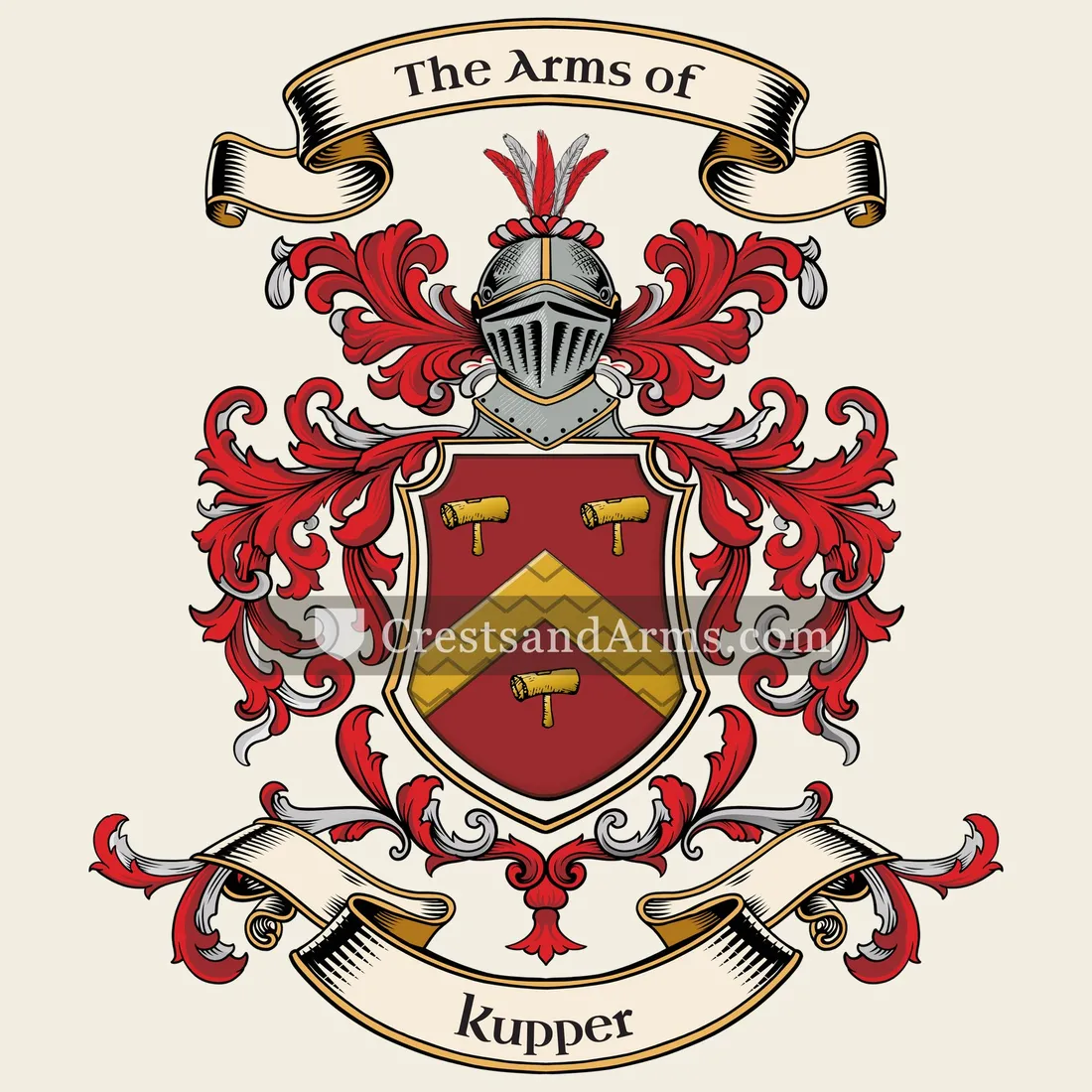
 chevronProtection, and faithful service completed
 hammerHonest labour, and the smith's craft
 chevronProtection, and faithful service completed
 hammerHonest labour, and the smith's craft