A record of documented arms, meaning and origin, researched for the Kurti family lines. Documented in 2 countries.
Reg. 2270 · Italian, J–L
Coat of Arms & Family Crest Details
Symbols on this shield
lionCourage, strength and royalty
towerGrandeur and solidity, and a stronghold defended
Colours
Silver (Argent)Means: Peace and sincerity
Red (Gules)Means: Military strength
Historical info
Source
J. B. Rietstap, Armorial Général, Gouda: G. B. van Goor Zonen, 1884–87
Blazon (the actual original written record)
“Coupé: au 1 parti: a. d'arg. à un lion de sin. à deux têtes adossées, lamp. de gu.; b. de gu. à un château flanqué de deux tours de gu., ouv. et aj. du champ, sommé d'une aigle héraldique de sa. entre les tours;”
VeniceVenice, c. 1665
Digital archive packCoat of arms PNG, gold border print PDF, vector SVG and the certificate of authenticity. Sent to your email in minutes.
Map of Italy showing where the Kurti arms are recorded
The Kurti arms were recorded in Venice, c. 1665.
Venice ran on trade, and its great families were merchants before they were anything else. The city kept a formal list of its noble houses, and a name on that list carried arms as a matter of record.
This is where the arms were entered in the register. Families often moved to other parts of the country, so the same name can turn up in more than one region.
The body that granted and recorded arms in Italy in this period.
Charles Emmanuel II of Savoy
Sovereign of the period
Charles Emmanuel II of Savoy
1638–1675
Reigning in Italy when the Kurti arms are first recorded.
How Arms Worked in Italy
In the Italian states, coats of arms were often used by noble families to show their status and history. These symbols were passed down through the generations to all legitimate male descendants. Younger branches of a family usually kept the original design but sometimes added small changes to distinguish their specific line from the main branch.
Granting authority
Various local rulers and city governments controlled the use of coats of arms across the different Italian states.
How they got arms
Families often assumed their own arms or received them as official grants from local lords, popes, or city councils.
Where arms were recorded
Arms were recorded in local city archives or private family books rather than in one single national register.
The family's standing
Recorded among the armigerous families of Venice.
Origin & History of the Kurti Family in Italy
The history of the Kurti family in Italy is deeply connected to the vibrant maritime culture of Venice during the seventeenth century. By 1665, records confirm that members of the family were already established within the city, which served as a major hub for trade and cultural exchange between Europe and the East. During this period, Venice was a crossroads for merchants and skilled professionals who moved across the Adriatic Sea. The presence of the Kurti name in Venetian archives suggests that the family likely participated in the city's complex social and economic life as it navigated the transition between the Renaissance and the modern era. Their integration into the Venetian landscape highlights the family's role as part of the diverse population that sustained the city's influence as a center of commerce and diplomacy.
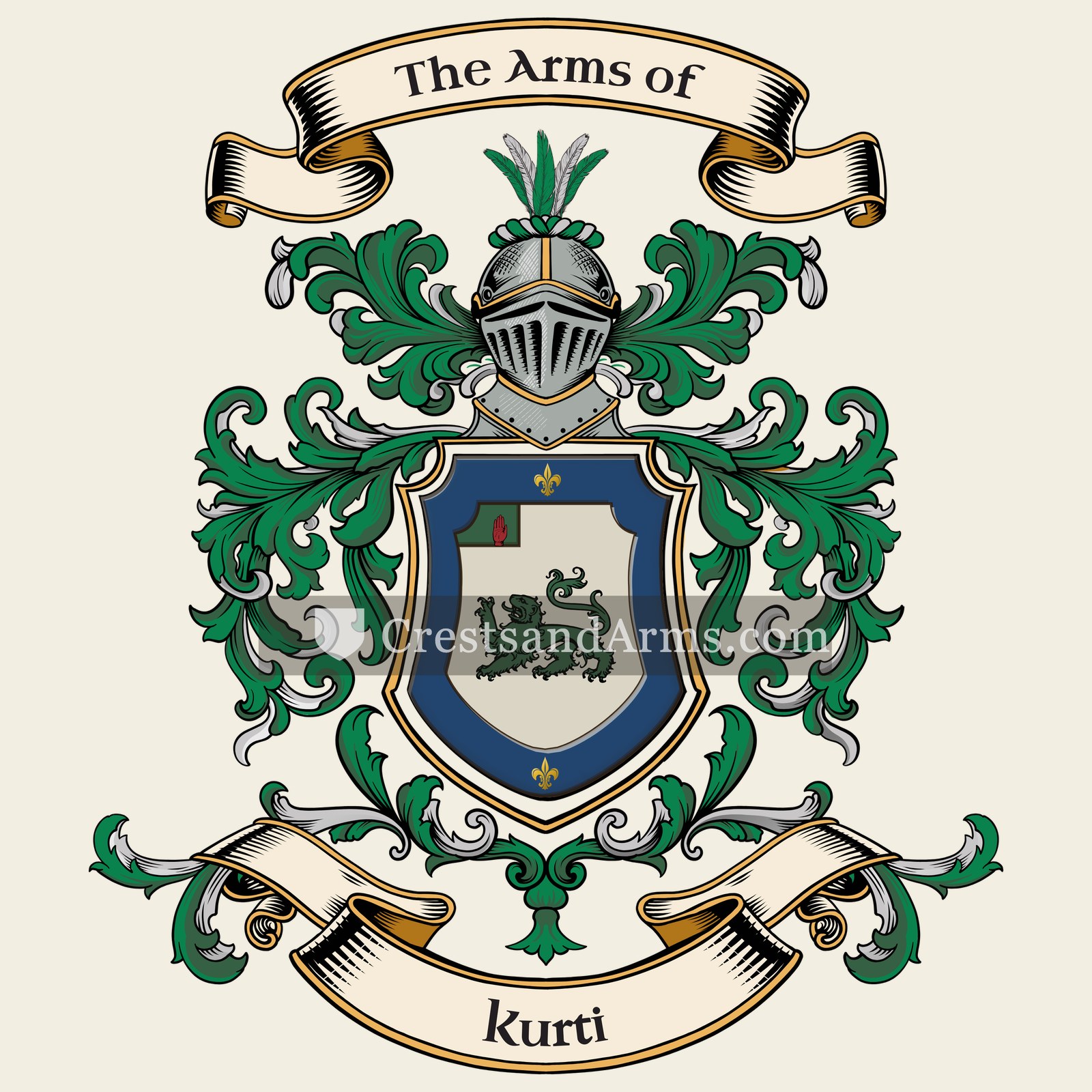
Coat of Arms & Family Crest Details
Symbols on this shield
cantonA mark of honour granted by the sovereign
lionCourage, strength and royalty
handFaith, sincerity and justice
fleur de lisPurity, light, and the sixth son
Colours
Silver (Argent)Means: Peace and sincerity
Blue (Azure)Means: Loyalty and truth
Red (Gules)Means: Military strength
Gold (Or)Means: Generosity
Historical info
Source
J. B. Rietstap, Armorial Général, Gouda: G. B. van Goor Zonen, 1884–87
Blazon (the actual original written record)
“D'arg. à un lion de sin. à deux têtes adossées, lamp. de gu.; à la bord. d'azur, et un canton d'arg., br. sur la bord.; le canton ch. d'une main sen. appaumée de gu. et la bord. de deux fleurs-de-lis d'or, mouv. du champ, l'une au canton sen. du chef et l'autre en p. renv. Brl. de sin. et d'arg. C.: une aigle de profil de sa., cour. d'or, le vol ouv. et abaissé. L. d'arg. et de sin.”
HesseHesse, c. 1823
Digital archive packCoat of arms PNG, gold border print PDF, vector SVG and the certificate of authenticity. Sent to your email in minutes.
Map of Germany showing where the Kurti arms are recorded
The Kurti arms were recorded in Hesse, c. 1823.
Hesse was central German country, divided among a large number of small landowners and prosperous towns. So many separate households held ground there that the region produced an unusual number of coats of arms.
This is where the arms were entered in the register. Families often moved to other parts of the country, so the same name can turn up in more than one region.
The body that granted and recorded arms in Germany in this period.
Frederick William III of Prussia
Sovereign of the period
Frederick William III of Prussia
1797–1840
Reigning in Italy when the Kurti arms are first recorded.
How Arms Worked in Germany
Prussian heraldry was strictly tied to social rank and noble status rather than being a free choice for every citizen. These symbols were treated as permanent family property that moved through the generations to all legitimate heirs. If a family branch wanted to change their design to stand out, they had to apply for official permission to alter their specific version of the shield.
Granting authority
The Prussian Heroldsamt acted as the central state office that managed and strictly controlled all noble titles and coats of arms.
How they got arms
Families usually obtained their arms through formal royal grants or by proving their long-standing noble status to the state authorities.
Where arms were recorded
All official coats of arms were kept in the rolls of the Prussian Heroldsamt, which functioned from 1706 until 1918.
The family's standing
Recorded among the armigerous families of Hesse.
Origin & History of the Kurti Family in Germany
The family name Kurti has deep roots in the German state of Hesse, where records confirm members of the family were living as early as 1823. During this period, the region was undergoing significant social and economic shifts as it transitioned from the Napoleonic era into a time of industrial growth. Families like the Kurtis often lived in small, agrarian communities where surnames were frequently tied to specific occupations or local geographic landmarks. Because the name appears in Hessian civil and parish records during the early nineteenth century, it suggests that the family was well-established within the local social fabric of the region. These early ancestors likely navigated the challenges of a changing landscape, contributing to the agricultural and communal life that defined Hesse before the unification of Germany. By documenting their presence in these official registers, the family secured a place in the historical narrative of the area, reflecting the broader movement of people across the German states during the nineteenth century.
Related Branches & Arms
Root word
Curtus
Latin term meaning short, stunted, or curtailed.
This name
KurtiA descriptive surname historically used to identify a person of short stature.
also spelled
Kurti
Documented Sources
J. B. Rietstap, Armorial Général, Gouda: G. B. van Goor Zonen, 1884–87
Archivio di Stato di Venezia, Avogaria di Comun, Libro d'Oro
Benzoni, Gino, Venezia nell'età moderna, 1998
Lane, Frederic C., Venice, A Maritime Republic, 1973
Digital archive packCoat of arms PNG, gold border print PDF, vector SVG and the certificate of authenticity. Sent to your email in minutes.


 lionCourage, strength and royalty
 towerGrandeur and solidity, and a stronghold defended
 lionCourage, strength and royalty
 towerGrandeur and solidity, and a stronghold defended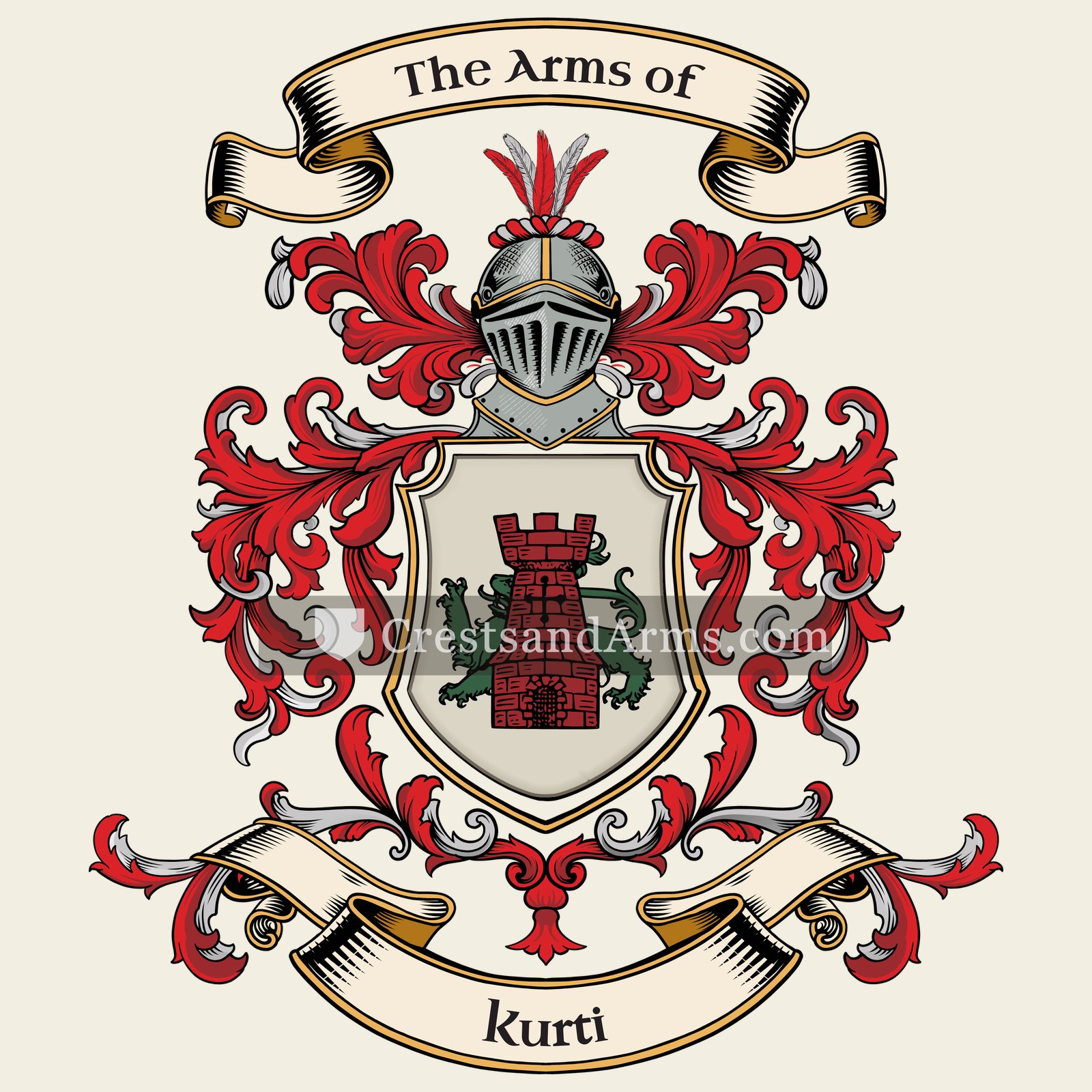


 cantonA mark of honour granted by the sovereign
 handFaith, sincerity and justice
 fleur de lisPurity, light, and the sixth son