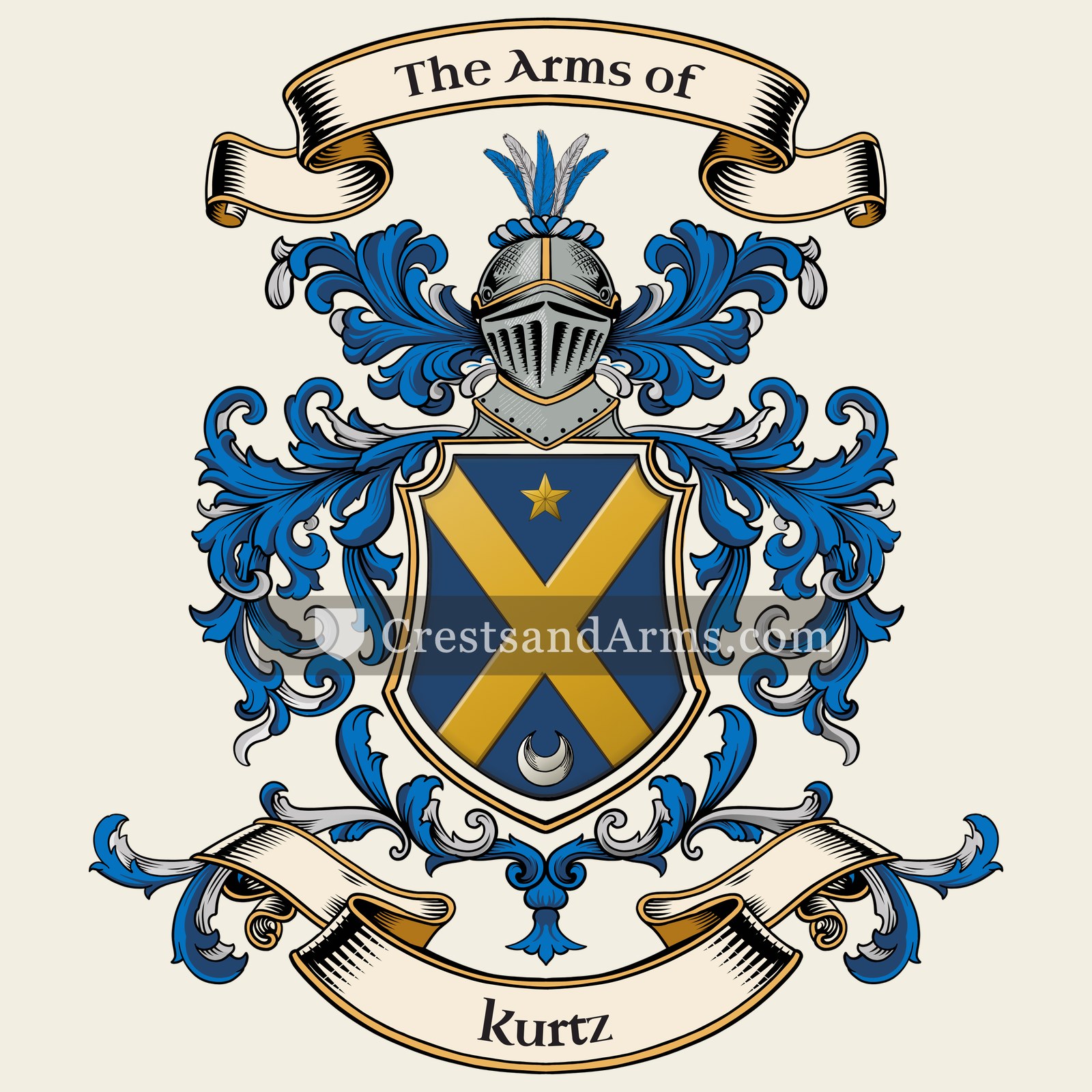
A record of documented arms, meaning and origin, researched for the Kurtz family of Poland.
Reg. 8703 · Polish, J–L
Coat of Arms & Family Crest Details
Symbols on this shield
paleMilitary strength, and a fortified defence
mulletThe third son, and a divine quality from above
crescentHonour by the sovereign, and the second son
Colours
Blue (Azure)Means: Loyalty and truth
Gold (Or)Means: Generosity
Silver (Argent)Means: Peace and sincerity
Historical info
Source
J. B. Rietstap, Armorial Général, Gouda: G. B. van Goor Zonen, 1884–87
Blazon (the actual original written record)
“D'azur à un pairle alésé, le pied soutenu d'une traverse cramponnée vers le haut à sen., le pal du pairle croisé près de l'enfourchement d'une traverse, le bout à dextre remontant et celui à sen. s'abaissant; le pal du pairle adextré d'une étoile et senestré d'un croiss. tourné; le tout d'or, excepté le croiss. qui est d'arg. Cq. cour. C.: trois pl. d'aut. d'arg.”
Polandc. 1772
Digital archive packCoat of arms PNG, gold border print PDF, vector SVG and the certificate of authenticity. Sent to your email in minutes.
Map of Poland showing where the Kurtz arms are recorded
The Kurtz arms were recorded in Poland, c. 1772.
Arms such as these were typically recorded in Mazovia.
Mazovia held Warsaw, the Polish court and the assemblies where the szlachta met. Poland's nobles were unusually numerous and every one of them bore arms, and Warsaw is where those arms were argued over and recorded.
This is where the arms were entered in the register. Families often moved to other parts of the country, so the same name can turn up in more than one region.
Region
Mazovia
First recorded
1772
Granting Authority for the Kurtz Arms
Ennoblement by the Sejm
Author: Olek Remesz · CC BY-SA 3.0
The body that granted and recorded arms in Poland in this period.
Stanisław August Poniatowski
Sovereign of the period
Stanisław August Poniatowski
1764–1795
Reigning in Poland when the Kurtz arms are first recorded.
How Arms Worked in Poland
Polish noble families shared a single coat of arms across many different surnames, creating large clans rather than individual designs. These symbols were held collectively by all members of the clan regardless of their specific family name. When a new family joined the nobility, they were adopted into an existing clan and began using that group's established shield.
Granting authority
The Sejm, which was the Polish parliament, held the power to grant noble status and the right to bear arms.
How they got arms
Families typically received their coat of arms through a formal act of ennoblement granted by the Sejm for distinguished service.
Where arms were recorded
These grants were officially recorded in the Crown Metrica, which served as the central archive for state documents starting in the sixteenth century.
The family's standing
Recorded among the armigerous families of Poland.
Origin & History of the Kurtz Family in Poland
The surname Kurtz is rooted in the Middle High German word "kurtz," which translates to "short." During the Middle Ages, this name was typically used as a descriptive nickname to identify a person of shorter stature. By the time members of the family were documented in the Mazovia region in 1772, the name had long transitioned from a simple nickname into a permanent hereditary surname. The presence of the family in Mazovia during this period is significant because the region was undergoing major political shifts due to the First Partition of Poland. Families with this name often lived as skilled tradespeople or farmers, moving across Central Europe as they sought new opportunities in the fertile lands of the Vistula river basin. Over generations, the name became firmly established within the local social fabric, reflecting a history of migration and adaptation in a changing European landscape.
Related Branches & Arms
Root word
curtus
Latin term meaning short, curtailed, or cut off.
This name
KurtzA descriptive nickname for a person of short physical stature.
also spelled
Kurts
Kurz
Kurtz
Documented Sources
J. B. Rietstap, Armorial Général, Gouda: G. B. van Goor Zonen, 1884–87
Bahlow, Hans, Deutsches Namenlexikon: Familien- und Vornamen nach Ursprung und Sinn erklärt, 1967
Gottschald, Max, Deutsche Namenkunde: Unsere Familiennamen nach ihrer Entstehung und Bedeutung, 1971
Archiwum Główne Akt Dawnych (Central Archives of Historical Records), Księgi metrykalne parafii rzymskokatolickich z terenu Mazowsza (Parish registers of Roman Catholic parishes in the Mazovia region)
Digital archive packCoat of arms PNG, gold border print PDF, vector SVG and the certificate of authenticity. Sent to your email in minutes.


 paleMilitary strength, and a fortified defence
 mulletThe third son, and a divine quality from above
 crescentHonour by the sovereign, and the second son
 paleMilitary strength, and a fortified defence
 mulletThe third son, and a divine quality from above
 crescentHonour by the sovereign, and the second son