Map of Russia showing where the Kusch arms are recorded
The Kusch arms were recorded in Russia, c. 1784.
Arms such as these were typically recorded in Moscow.
Moscow held the Russian court, and rank there came from service rather than land. Families who served the Tsar were entered in the registers of nobility, and that entry is where their arms are recorded.
This is where the arms were entered in the register. Families often moved to other parts of the country, so the same name can turn up in more than one region.
The body that granted and recorded arms in Russia in this period.
Catherine II of Russia
Sovereign of the period
Catherine II of Russia
1762–1796
Reigning in Russia when the Kusch arms are first recorded.
How Arms Worked in Russia
Russian heraldry was strictly tied to the nobility and the state service system. Families proved their ancient status or earned new rank to receive an official grant from the Tsar. These symbols were then inherited by all legitimate children of the noble line. If a family lacked proof of their status, they were often excluded from the official records entirely.
Granting authority
The Herald Master's Office acted as the central state body that strictly regulated and verified all noble heraldic symbols.
How they got arms
Families typically received their arms through a formal state grant or by proving their noble status to the government authorities.
Where arms were recorded
All approved coats of arms were officially recorded in the General Armorial of the Noble Families of the Russian Empire starting in 1797.
The family's standing
Recorded among the armigerous families of Russia.
Origin & History of the Kusch Family in Russia
The family name Kusch has deep roots that trace back to the Slavic regions of Eastern Europe. By the late 18th century, the family was well-established in Moscow, as evidenced by records confirming their presence in the city by 1784. During this period, Moscow served as a bustling center of trade and culture, drawing families from various backgrounds who sought new opportunities in the heart of the Russian Empire. The name itself is often linked to linguistic roots in Old Slavic and Germanic dialects, suggesting that early ancestors may have been involved in agriculture or skilled craftsmanship. As the family settled into the urban environment of Moscow, they became part of the growing middle class that helped shape the city’s social and economic landscape during the Enlightenment era. This transition from rural origins to city life reflects the broader movement of families across the continent during the 1700s.
Related Branches & Arms
Root word
Kush
A Slavic term referring to a tuft of hair or a crest.
This name
KuschA descriptive nickname for someone with a prominent tuft of hair or a distinctive hairstyle.
also spelled
Kuche
Kuchh
Documented Sources
J. B. Rietstap, Armorial Général, Gouda: G. B. van Goor Zonen, 1884–87
Central State Archive of Moscow (Tsentral'nyy gosudarstvennyy arkhiv goroda Moskvy), Fond 203, Opis 747
Kuznetsov, A. A., Istoriya familiy Rossiyskoy imperii (History of Surnames of the Russian Empire), 1998
Unbegaun, B. O., Russkiye familii (Russian Surnames), 1972
Digital archive packCoat of arms PNG, gold border print PDF, vector SVG and the certificate of authenticity. Sent to your email in minutes.


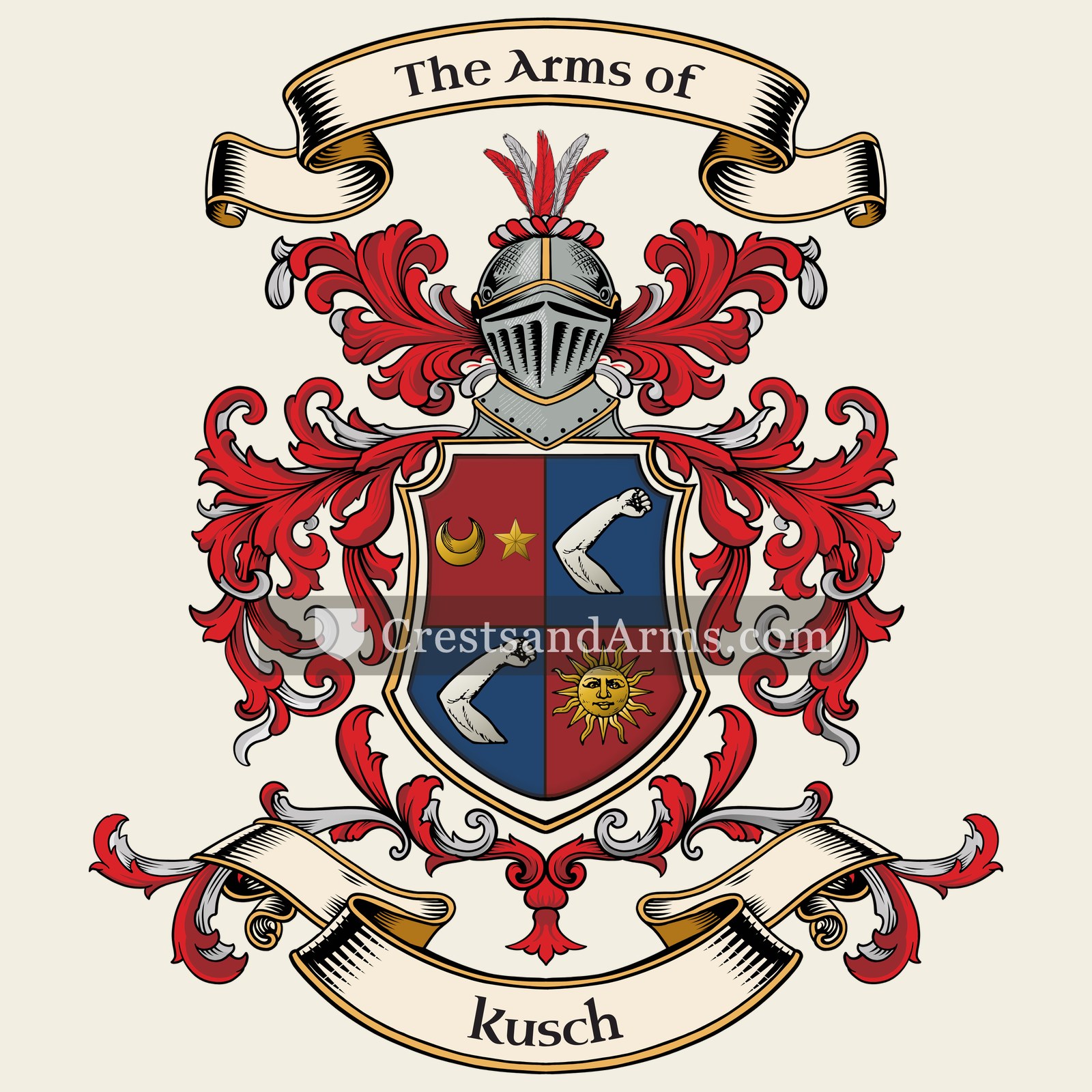
 crescentHonour by the sovereign, and the second son
 mulletThe third son, and a divine quality from above
 armA person of action, industrious and laborious
 sunGlory, splendour and the source of life
 crescentHonour by the sovereign, and the second son
 mulletThe third son, and a divine quality from above
 armA person of action, industrious and laborious
 sunGlory, splendour and the source of life